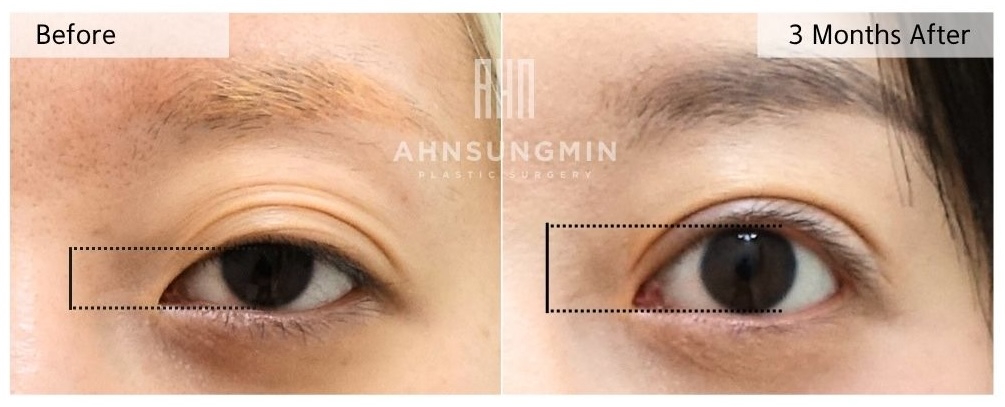
Before and Three Months After Incisional Revision Ptosis Surgery
This patient underwent revision ptosis surgery after developing multiple eyelid folds, unstable eyelid opening, and redundant upper eyelid skin following previous eyelid surgery.
Before revision surgery, the problem was not simply the appearance of asymmetry or extra folds.
The eyelids showed unstable opening mechanics and excessive tissue overlap caused by previous structural changes.
In many revision patients, repeated folding and chronic compensation can gradually create multiple crease lines and an unnatural upper eyelid contour over time.
Because of this, revision surgery sometimes requires not only ptosis correction, but also careful release of previous adhesions and conservative excision of redundant skin.
Functional Stability Was Prioritized Over Aggressive Correction
This case required an incisional revision approach because structural imbalance and redundant tissue could not be adequately corrected through limited adjustment alone.
Revision surgery focused on restoring smoother eyelid opening and reducing unstable fold formation while preserving long-term eyelid stability.
Excessive tissue removal in revision surgery can increase the risk of tightness, asymmetry, and long-term instability.
For this reason, surgical planning emphasized conservative correction and balanced tissue preservation rather than aggressive crease creation.
Three Months After Revision Ptosis Surgery
Three months after surgery, the eyelid contour appears smoother and more stable compared to before revision surgery.
Rather than creating an exaggerated fold, the goal was to improve functional balance and reduce the unstable appearance caused by multiple folds and tissue redundancy.
In revision surgery especially, meaningful improvement often depends on restoring stability rather than pursuing dramatic change.
Related Insights
Patients considering revision ptosis surgery may also find these articles helpful:
- Why High Fold Eyelids Often Feel Unnatural
- Why Some Patients Develop Multiple Eyelid Folds After Surgery
- Ptosis and Hollow Eyelids: Why Volume Loss Is Not Always the Cause
Frequently Asked Questions
Why do multiple eyelid folds develop after previous eyelid surgery?
Multiple folds can develop when scar tissue, unstable adhesions, ptosis, or chronic muscular compensation alter the natural eyelid mechanics over time.
Why is skin excision sometimes necessary in revision surgery?
In some revision patients, redundant skin and repeated folding contribute to unstable eyelid contour and functional imbalance. Conservative skin excision may help restore smoother eyelid opening.
Why is conservative correction important in revision surgery?
Excessive correction can increase the risk of tightness, asymmetry, unnatural folds, and long-term instability. Revision surgery often requires a more restrained approach.
How long does recovery take after revision ptosis surgery?
Revision surgery often requires a longer stabilization period than primary surgery. Functional balance and tissue settling continue to improve over several months.
If previous eyelid surgery left your eyelids feeling unstable or unnatural, understanding the structural cause is often more important than pursuing aggressive correction.
→ Request a Revision Eyelid Evaluation
Seeing the Eye as a Whole, Not in Parts
A Clinic Dedicated to Eyelid Revision Surgery in Korea
Ahnsungmin Plastic Surgery
