Hollowing After Lower Eyelid Surgery Is Often Progressive
Lower eyelid hollowing is not always immediately visible after surgery.
In many patients, the under-eye area initially appears smooth because postoperative swelling temporarily masks structural volume loss. However, as swelling resolves and natural aging continues, hollowing may gradually become more noticeable over time.
This is one reason why lower eyelid surgery should never be evaluated only a few weeks after surgery.
A result that appears “flat” early on may later become skeletonized or sunken as tissue volume decreases with age.
Excessive Fat Removal Is One of the Most Common Causes
Lower eyelid hollowing often occurs because too much fat was removed during surgery.
The goal of surgery is not simply to eliminate every bulge beneath the eyes. The lower eyelid is a structural transition zone between the eyelid and the cheek, and maintaining appropriate volume is important for long-term balance.
When fat is aggressively removed, the eye may eventually appear:
- hollow
- fatigued
- aged
- structurally unsupported
This is one reason why aggressive fat removal can age the eyes over time.
This change may become more severe several years after surgery as natural facial volume loss continues. For this reason, many surgeons now prioritize lower eyelid fat preservation for more natural long-term results rather than aggressive excision.
Fat Preservation Often Ages More Naturally
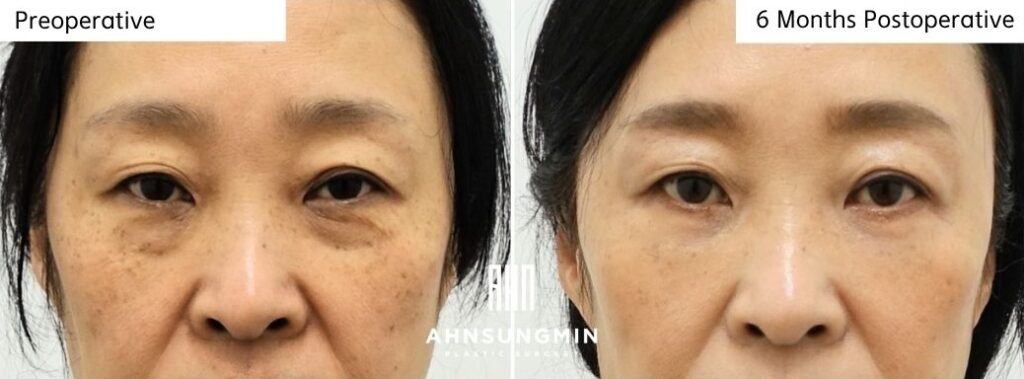
Fat preservation and repositioning often produce more stable long-term outcomes than aggressive excision.
A younger-looking eye is not necessarily the flattest eye.
In many patients, maintaining smooth structural continuity beneath the lower eyelid creates a more natural appearance over time than attempting to completely eliminate all fullness.
This becomes especially important in:
- older patients
- revision surgery patients
- patients with naturally limited tissue volume
- patients with thin skin
In many cases, conservative lower blepharoplasty produces more stable long-term outcomes than aggressive correction.
Revision Surgery After Hollowing Can Be Complex
Revision lower blepharoplasty after excessive fat removal is often unpredictable.
Many patients already have:
- scar tissue
- volume deficiency
- adhesions
- limited remaining tissue
- lower eyelid tightness
In many revision patients, tissue deficiency becomes one of the biggest limitations during secondary surgery.
Even when improvement is possible, complete restoration is not always realistic.
This is why long-term judgment during the first surgery is extremely important.
Removing slightly less tissue may sometimes create a safer and more stable result years later.
Long-Term Stability Matters More Than Immediate Flatness
The goal of lower eyelid surgery is not immediate flatness.
The true goal is long-term structural balance that continues to appear natural as the face ages.
Many revision problems begin not because surgery was performed — but because surgery was performed too aggressively.
In lower eyelid surgery, restraint is often more important than overcorrection, because long-term stability matters more than aggressive correction.
Key Takeaways
- Postoperative swelling can temporarily hide structural volume loss after surgery.
- Aggressive fat removal is one of the most common causes of long-term hollowing beneath the eyes.
- Fat preservation and structural support often produce more natural long-term aging outcomes.
- Revision surgery after excessive fat removal may become complex because of tissue deficiency and scar formation.
- In lower eyelid surgery, long-term stability is often more important than immediate flatness.
Frequently Asked Questions
1. Why do eyes look hollow after lower eyelid surgery?
Eyes may look hollow after lower eyelid surgery when too much fat or supporting tissue has been removed. Swelling can hide this problem early, but as swelling decreases and aging continues, the under-eye area may appear more sunken.
2. Can hollowing after lower eyelid surgery improve over time?
Mild hollowing may appear less noticeable as tissues settle, but hollowing caused by excessive fat removal or structural volume loss usually does not fully improve on its own. A detailed evaluation is needed to determine whether revision treatment is possible.
3. Does lower eyelid fat removal make the eyes look older?
Excessive lower eyelid fat removal can make the eyes look older because it may reduce the natural volume that supports the transition between the eyelid and cheek. A flatter result is not always a younger-looking result.
4. Why does lower eyelid hollowing become worse over time?
Lower eyelid hollowing may worsen over time because postoperative swelling resolves, natural facial volume decreases with age, and previously removed fat cannot provide long-term structural support.
5. Is revision surgery possible after hollowing from lower eyelid surgery?
Revision surgery may be possible, but it can be complex when scar tissue, adhesions, skin shortage, or volume deficiency are present. The goal is usually improvement and structural support, not complete restoration.
Request a Lower Eyelid Hollowing Evaluation
Lower eyelid hollowing after surgery is often related to structural volume loss, aggressive fat removal, and long-term tissue instability.
If you are concerned about hollow under-eyes, lower eyelid volume loss, or revision lower blepharoplasty after previous surgery, you may request a personalized evaluation based on your current tissue condition, structural support, and long-term stability.
Request a Lower Eyelid Evaluation
Seeing the Eye as a Whole, Not in Parts
A Clinic Dedicated to Eyelid Revision Surgery in Korea
Ahnsungmin Plastic Surgery
