[ Before / Postoperative Day 30]
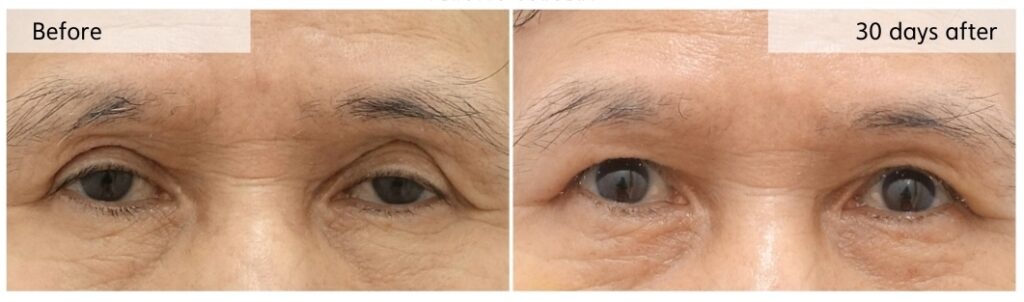
Eyelid hollowing is often approached as a problem of volume deficiency.
As a result, fat grafting is frequently suggested as the solution.
In this case, however, adding volume was not the correct answer.
The patient had already undergone fat grafting—three times at another clinic.
Despite repeated attempts, the hollowed appearance continued to recur.
This alone suggested that simple volume replacement was not addressing the underlying problem.
The Hollowing Was Not True Volume Loss
At first glance, the upper eyelid appeared sunken.
But careful evaluation showed that orbital fat volume itself was not significantly depleted.
Instead, the eyelid had been chronically overstretched.
Compensatory eyebrow elevation and persistent eyelid tension had altered how the tissue rested,
creating the appearance of hollowing without actual volume loss.
What appeared to be a volume problem was, in fact, a structural imbalance.
Why Fat Grafting Was Not Appropriate
Fat grafting involves transferring tissue that is completely disconnected from its original blood supply.
In the eyelid—where movement is constant—fat survival is inherently unpredictable.
Even when repeated, grafted fat does not always survive as expected.
Irregular resorption, contour inconsistencies, and recurrence are common.
In this patient, those limitations had already been demonstrated.
For that reason, fat grafting was not selected again.
We chose orbital fat repositioning instead.
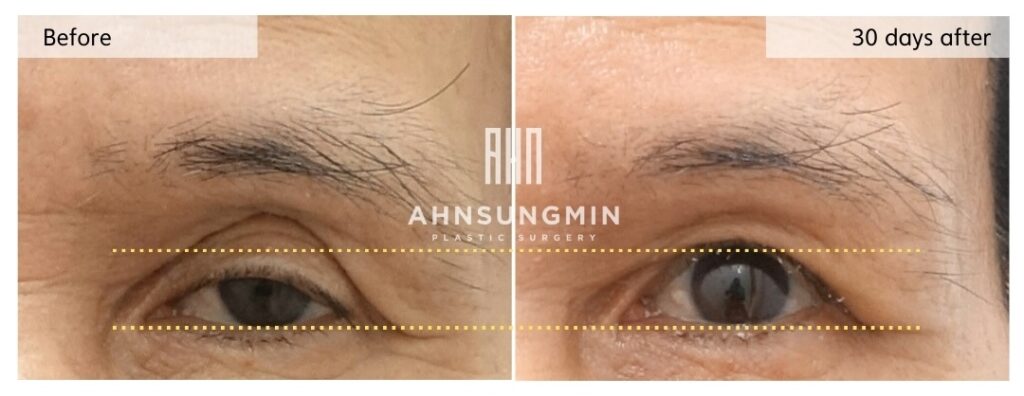
Although the amount of remaining orbital fat was limited,
we carefully mobilized and repositioned as much of the patient’s own tissue as possible.
By preserving its native blood supply,
orbital fat repositioning allows volume support to be restored in a more stable and physiologic way.
Rather than adding new volume, we worked within the patient’s existing anatomy.
Restoring Balance, Not Adding Volume
In addition to fat repositioning,
revision ptosis correction and crease lowering were performed.
By improving eyelid function and reducing compensatory effort,
excessive tension on the upper eyelid was relieved.
As eyelid movement normalized,
the hollowed appearance improved gradually—without adding volume.
The Outcome Confirmed the Decision
Over time, the upper eyelid contour became smoother and more stable.
The hollowed appearance improved
without introducing transplanted or artificial tissue.
This Case Reflects a Fundamental Principle
Eyelid hollowing should not be treated based on appearance alone.
The decision is not about what can be added—
but about what truly needs to be corrected.
Seeing the Eye as a Whole, Not in Parts
A Clinic Dedicated to Eyelid Revision Surgery in Korea
Ahnsungmin Plastic Surgery
When Evaluation Becomes Necessary
If your upper eyelids look hollow after double eyelid surgery,
if the hollow appearance persists despite previous treatments,
or if adding volume has not improved the contour,
a structured evaluation is necessary.
→ Request a Hollow Eyelid and Structural Evaluation
Internal References
→ Why Eyelid Hollowing Can Return After Fat Grafting.
→ Why We Corrected Hollowing Without Adding Volume.
Frequently Asked Questions About Eyelid Hollowing
Why did fat grafting fail in this case of eyelid hollowing?
Fat grafting failed because the underlying issue was structural imbalance, not true volume loss. Adding volume did not address the cause of the hollow appearance.
Is eyelid hollowing always caused by volume loss?
No. In many cases, hollowing is caused by tissue displacement, tension, or structural imbalance rather than a lack of volume.
Why is fat grafting less reliable in the eyelid?
Because the eyelid is a highly dynamic area, grafted fat does not always survive predictably, leading to resorption, irregularity, or recurrence.
What is the advantage of orbital fat repositioning?
It preserves the native blood supply and restores volume in a more stable and physiologic way compared to adding transplanted fat.
When should fat grafting be avoided in eyelid hollowing?
Fat grafting should be avoided when hollowing is caused by structural imbalance, repeated graft failure, or when tissue position—not volume—is the primary issue.
Insights
Why Eyelid Hollowing Can Return After Fat Grafting.
→ Volume-based correction alone may not address structural imbalance, leading to recurrence over time.
Why We Corrected Hollowing Without Adding Volume.
→ In many cases, restoring structure—not adding volume—is the key to improving hollow eyelids.
Eyelid Hollowing Improved Through Ptosis Correction and Orbital Fat Repositioning.
→ Structural repositioning can improve hollowing by restoring balance without additional volume.
When Eyelid Hollowing Is Worsened by Ptosis Asymmetry.
→ Functional imbalance can change how tissue rests, creating or worsening hollow appearance.
