What Causes Eyelid Hollowing.
Eyelid hollowing refers to a sunken appearance of the upper eyelid.
It is commonly associated with aging, but the mechanism behind it is not always the same.
In some patients, hollowing develops as orbital fat volume gradually decreases with age.
In others, the eyelid appears hollow not because fat is missing, but because the eyelid is being overstretched.
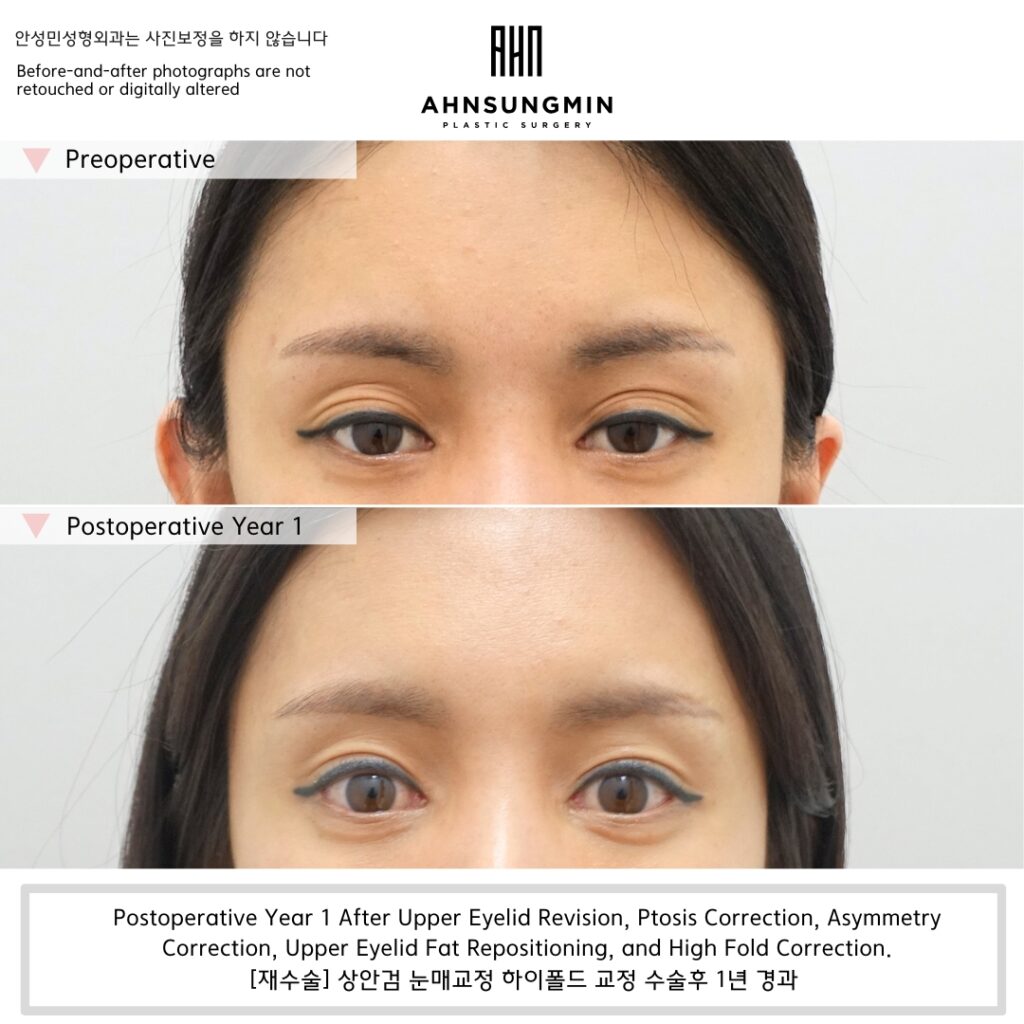
Postoperative Year 1 After Upper Eyelid Revision, Ptosis Correction, High Fold Correction, and Fat Repositioning

How Ptosis Can Create the Appearance of Hollowing.
When ptosis is present, patients often lift the eyebrows to open their eyes.
As the forehead compensates, the upper eyelid skin unfolds like an accordion.
Over time, this repeated stretching can make the eyelid look hollow, even when volume has not truly been lost.
When Hollowing Is Caused by Prior Surgery.
Another common cause is prior surgery.
If orbital fat was removed during previous eyelid procedures, true volume deficiency may be present.
These causes may look similar on the surface, but they are fundamentally different problems.
Treating all eyelid hollowing as a simple volume loss leads to incorrect decisions.
This is also why eyelid hollowing can sometimes appear worse after treatment.
Why Adding Volume Is Not Always the Solution.
For this reason, injecting filler or performing free fat grafting is not always an appropriate choice.
Fat grafting involves harvesting fat from areas such as the abdomen or thigh and transferring it to the eyelid.
In this process, the transplanted fat is completely disconnected from its original blood supply.
As a result, survival is unpredictable.
Irregular contour, lumpiness, partial resorption, and inflammatory reactions can occur.
In some cases, the grafted fat must later be surgically removed.
Because of these limitations, adding volume alone does not reliably solve the problem—and can introduce new ones.
A Structural Approach to Eyelid Hollowing.
This is why upper eyelid hollowing should not be approached as a simple volume problem.
When volume restoration is necessary, our priority is to use the patient’s own orbital fat whenever possible.
Orbital fat repositioning allows volume to be restored while maintaining its native blood supply in upper eyelid fat repositioning.
Instead of adding foreign or transplanted tissue, existing orbital fat is carefully mobilized and secured into the hollowed area.
This approach respects eyelid anatomy and reduces the risks associated with non-vascularized grafts.
Eyelid hollowing cannot be treated correctly without understanding why it occurred.
The decision is not about filling what looks empty, but about identifying what has actually changed.
Our Philosophy
This reflects our philosophy of treating the cause rather than simply correcting the appearance.
At our clinic, we make decisions with the next twenty to thirty years in mind, focusing on long-term structural stability and helping patients understand the true cause before choosing surgery.
Seeing the Eye as a Whole, Not in Parts
A Clinic Dedicated to Eyelid Revision Surgery in Korea
Ahnsungmin Plastic Surgery
Internal References
→ why eyelid hollowing is not always caused by volume loss
→ why eyelid hollowing can appear worse after treatment
→ why fat repositioning is not about adding volume
If your eyelids appear hollow over time or after surgery, a structural evaluation is necessary to determine the correct approach.
→ Request a Consultation for Eyelid Hollowing Evaluation
Frequently Asked Questions
Is eyelid hollowing always caused by volume loss?
No. Eyelid hollowing is not always the result of fat loss. In many cases, it is caused by structural factors such as ptosis or repeated stretching of the eyelid rather than true volume deficiency.
Why can eyelid hollowing appear worse after filler or fat grafting?
Because the underlying problem may not be volume loss. When filler or fat is added without correcting structural imbalance, the result can look uneven or more pronounced over time.
Can ptosis make the eyelids look hollow?
Yes. Patients with ptosis often compensate by lifting their eyebrows, which stretches the eyelid skin over time and creates a hollow appearance even when fat is still present.
When is fat repositioning preferred over filler?
Fat repositioning is preferred when the goal is to restore volume while maintaining blood supply. Unlike filler or grafted fat, orbital fat repositioning uses existing tissue, which allows for more stable and predictable long-term results.
How can you tell what is causing eyelid hollowing?
A structural evaluation is necessary. The key is to determine whether the issue is true volume loss, skin stretching, or changes caused by previous surgery.
