Lower blepharoplasty in middle-aged patients often requires more judgment than simply deciding how much under-eye fat or loose skin to remove.
With age, the lower eyelid changes as a whole. Fat may become more prominent, the skin becomes less elastic, and the support between the lower eyelid and cheek gradually weakens. Treating only the most visible problem can sometimes create another one.
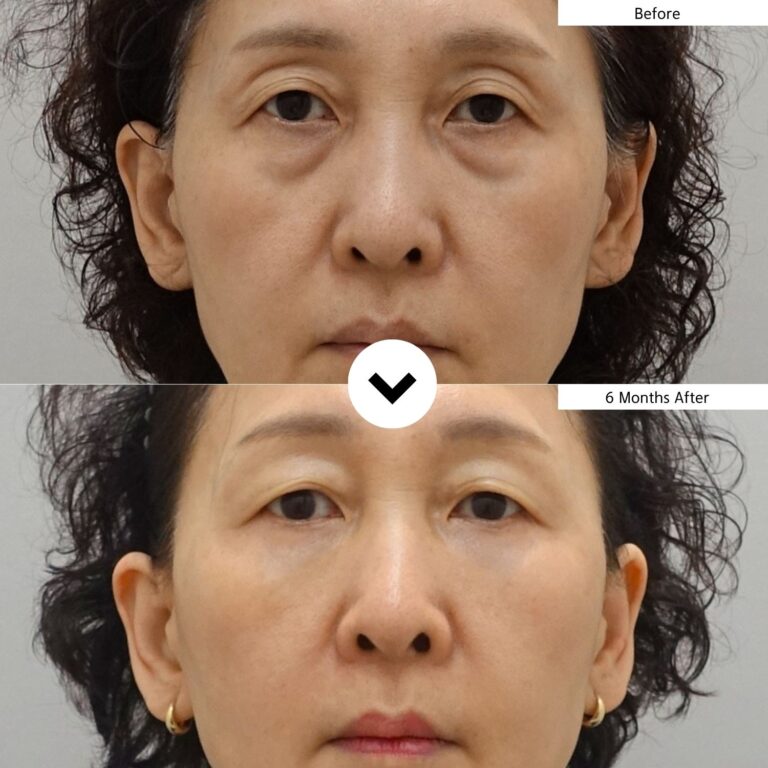
This patient underwent lower blepharoplasty with fat repositioning and SMAS fixation. Her recovery was documented from immediately after surgery through six months, allowing us to follow not only the final result, but also how the lower eyelid changed as swelling resolved and the tissues settled.
Patient Concern
Before surgery, the patient had noticeable under-eye bags and an uneven transition between the lower eyelid and upper cheek.
In a patient like this, I am cautious about simply removing the protruding fat. Removing too much can leave the lower eyelid looking hollow, particularly after the swelling has disappeared. The same caution applies to skin excision. More removal does not necessarily produce a better result.
For this patient, the priority was to reduce the visible under-eye prominence while preserving enough volume to maintain a natural lower eyelid–cheek transition.
Why I Did Not Simply Remove the Under-Eye Fat
Under-eye bags can look like an excess-volume problem, but appearance alone does not tell us what should be removed.
In middle-aged patients, the relationship between the fat, skin, lower eyelid, and cheek has already changed with aging. If the protruding fat is aggressively removed without considering that relationship, the lower eyelid may look flatter initially but increasingly hollow later.
For this reason, I prefer to decide first what should be preserved.
In this patient, there was existing volume that could be used rather than discarded. Repositioning that fat allowed us to improve the contour beneath the lower eyelid without unnecessarily reducing volume.
Skin was also managed conservatively. The amount of skin removed was determined by what the lower eyelid could safely tolerate rather than by how tightly the skin could be pulled.
Surgical Approach
Lower blepharoplasty was performed with fat repositioning and SMAS fixation.
The protruding fat was repositioned to improve the transition beneath the lower eyelid, rather than relying on extensive fat removal.
SMAS fixation was added to provide support to the lower eyelid and cheek tissues.
These decisions were made specifically for this patient’s anatomy. Another patient with a similar-looking under-eye bag may require a different combination of fat management, skin excision, and structural support.
That is why I do not consider lower blepharoplasty a standardized fat-removal procedure.
Lower Blepharoplasty Recovery from Day 1 to 6 Months
One reason I wanted to show this case is that the six-month result alone does not show what the patient actually experienced during recovery.
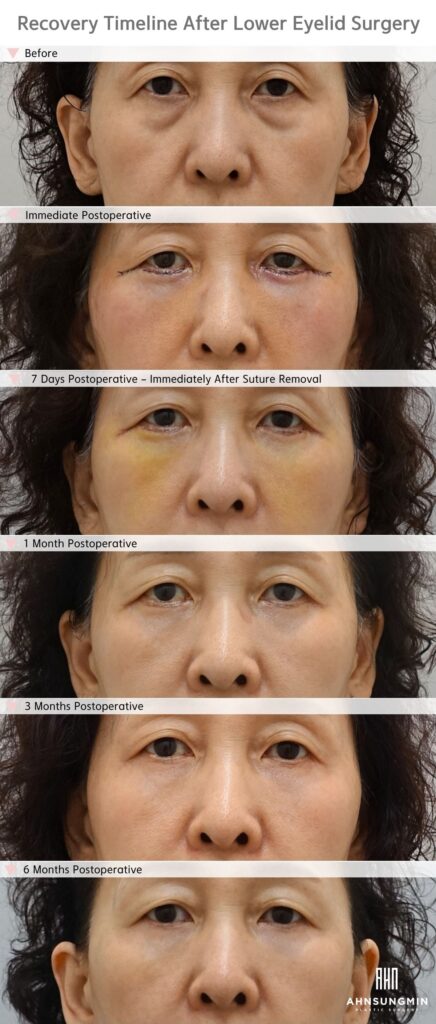
The photographs document the same lower eyelids at several stages: immediately after surgery, 7 days, 1 month, 3 months, and 6 months.
Immediately After Surgery
Swelling is already present, and the tissues have not had time to settle. The contour seen at this stage should not be interpreted as the surgical result.
Postoperative Day 7
At the time of suture removal, swelling and discoloration are still visible.
Patients often focus closely on small differences between the two sides during this period, but early asymmetry can change considerably as swelling resolves.
Postoperative Month 1
By one month, much of the obvious postoperative swelling has improved.
The patient looks considerably more recovered, but the lower eyelid is still changing. Residual swelling and firmness can remain, and the lower eyelid–cheek transition is not yet fully settled.
Postoperative Month 3
At three months, the tissues have softened further and the contour is much easier to evaluate.
The transition from the lower eyelid into the cheek appears smoother, and the result begins to resemble what we expect to see long term.
Postoperative Month 6
By six months, the lower eyelid has reached a much more stable stage.
The original under-eye prominence has been reduced, but the area has not been made completely flat. There is still enough volume to maintain a natural transition into the cheek.
For me, this is an important part of the result.
Why I Prefer to Evaluate This Result at 6 Months
Patients naturally want to know what their final result will look like as soon as possible.
But lower blepharoplasty cannot be judged accurately from the first few weeks.
Early swelling can temporarily hide hollowness, exaggerate asymmetry, or make the lower eyelid appear firmer than it eventually will. As the swelling disappears, the effect of fat repositioning, skin management, and tissue support becomes easier to see.
This is why the six-month photograph is more meaningful to me than the immediate postoperative photograph.
At this stage, I can assess whether enough volume was preserved, whether the lower eyelid–cheek transition remains smooth, and whether the correction still looks natural after the tissues have settled.
What This Case Shows About Lower Blepharoplasty in Middle-Aged Patients
With middle-aged patients, I am often more concerned about removing too much than removing too little.
Fat that is removed cannot simply be put back later. Excessive skin excision can also create problems that are much more difficult to correct than the original under-eye bag.
That does not mean fat or skin should never be removed. It means the decision should be selective.
For some patients, removal is appropriate. For others, repositioning and preservation play a larger role. Structural support may also become more important as the tissues age.
In this patient, fat repositioning and SMAS fixation allowed us to address the under-eye prominence while maintaining a natural amount of lower eyelid volume through the six-month recovery period.
Our Approach to Lower Eyelid Surgery
At Ahnsungmin Plastic Surgery, I plan lower blepharoplasty according to what I see in the individual patient rather than following the same operation for every under-eye bag.
I look at the position and amount of fat, skin laxity, lower eyelid support, the relationship between the eyelid and cheek, and how each of these factors may change after surgery.
The question is not simply:
“How much can we remove?”
A more useful question is:
“What should be corrected, what should be preserved, and what needs support?”
That distinction becomes especially important in middle-aged patients and in anyone concerned about postoperative hollowing or an unnatural lower eyelid contour.
Related Insights
Lower Eyelid Surgery Recovery Timeline
See how swelling, bruising, tissue remodeling, and final contour typically change throughout lower blepharoplasty recovery.
Why Lower Eyelid Hollowing Can Appear After Surgery
Understand why excessive fat removal can contribute to postoperative hollowing and why tissue preservation matters.
Lower Blepharoplasty in Korea
Learn how lower eyelid surgery is planned according to fat distribution, skin condition, structural support, and individual anatomy.
Request a Lower Blepharoplasty Evaluation
For patients considering lower blepharoplasty, the first question is not simply how much fat or skin should be removed.
The more important question is which anatomical changes are creating the under-eye appearance and how they can be corrected while preserving long-term lower eyelid balance.
Online consultation is available for international patients.
Seeing the Eye as a Whole, Not in Parts
A Clinic Dedicated to Eyelid Revision Surgery in Korea
Ahnsungmin Plastic Surgery
