Not everyone benefits from epicanthoplasty.
Although the procedure is often associated with making the eyes appear larger, its true purpose is to improve the balance of the inner corner by addressing a prominent epicanthal fold. For the right patient, this can create a more open, natural-looking eye without changing the individual’s overall appearance.
The decision should always be based on anatomy—not simply on the desire for larger eyes.
What Makes Someone a Good Candidate?
Patients may benefit from epicanthoplasty if they have one or more of the following characteristics:
- A prominent epicanthal fold covering the inner corner
- Eyes that appear shorter horizontally
- A desire for better inner corner definition rather than dramatic enlargement
- A naturally balanced eye shape that could benefit from subtle refinement
The goal is not to make every eye look the same, but to improve harmony while preserving natural facial characteristics.
Before and After
Preoperative
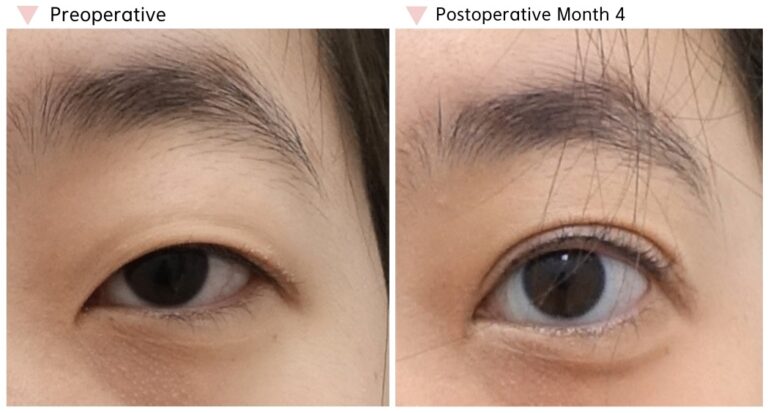
Postoperative Month 4
This patient underwent epicanthoplasty combined with ptosis correction. Four months after surgery, the inner corner appears more naturally defined, allowing the eyes to appear more open while maintaining overall facial balance. Rather than creating an exaggerated appearance, the procedure complements the patient’s natural anatomy.
When Epicanthoplasty May Not Be Necessary
Not every patient with small-looking eyes needs epicanthoplasty.
Sometimes the appearance is primarily caused by ptosis, eyebrow position, or eyelid anatomy rather than the epicanthal fold itself. In these situations, correcting the underlying cause often produces a more appropriate and natural result.
Choosing the correct procedure is often more important than performing additional procedures.
Our Surgical Philosophy
We do not recommend epicanthoplasty simply because a patient wants larger eyes.
Every recommendation begins with anatomical evaluation. If the epicanthal fold is not the primary reason for the appearance of the eyes, another procedure—or no epicanthoplasty at all—may provide the better outcome.
Natural balance should always take priority over unnecessary enlargement.
Related Insights
Does Epicanthoplasty Make the Eyes Look Bigger?
Learn why epicanthoplasty changes the appearance of eye size by improving the inner corner rather than enlarging the eye itself.
Can Epicanthoplasty Leave a Visible Scar?
Understand how surgical planning, healing, and scar maturation influence long-term scar visibility after epicanthoplasty.
Best Epicanthoplasty Surgeon in Korea
Learn what to consider when choosing an epicanthoplasty surgeon, including anatomical planning, natural results, and long-term stability.
Does Epicanthoplasty Make the Eyes Look Bigger?
Learn how epicanthoplasty changes eye proportions and why creating a more open inner corner often makes the eyes appear larger without increasing their actual size.
How Epicanthoplasty Creates a More Open Appearance
Learn how epicanthoplasty enhances eye appearance through horizontal extension, upward definition, and reduction of the epicanthal fold.
FAQ
Who is a good candidate for epicanthoplasty?
Patients with a prominent epicanthal fold that covers the inner corner of the eye are often good candidates. The procedure should be recommended based on individual anatomy rather than a desire for larger eyes.
Does everyone with small-looking eyes need epicanthoplasty?
No. Small-looking eyes may be caused by ptosis, eyebrow position, or other anatomical factors. A proper evaluation is necessary to determine whether epicanthoplasty is appropriate.
Can epicanthoplasty be combined with other eyelid procedures?
Yes. Epicanthoplasty is commonly combined with procedures such as ptosis correction or double eyelid surgery when doing so provides a more balanced and natural result.
Will epicanthoplasty make my eyes look unnatural?
When carefully planned according to your anatomy, epicanthoplasty should create a more naturally defined inner corner while preserving facial harmony rather than producing an exaggerated appearance.
How do I know if epicanthoplasty is right for me?
The best way to determine whether epicanthoplasty is appropriate is through a personalized anatomical evaluation. The decision should be based on the cause of your eye appearance, not simply on cosmetic preference.
Request an Epicanthoplasty Evaluation
If you are considering epicanthoplasty and would like to know whether you are a suitable candidate, a personalized anatomical evaluation can help determine the most appropriate treatment for your eyes.
Online consultation available for international patients.
Seeing the Eye as a Whole, Not in Parts
A Clinic Dedicated to Eyelid Revision Surgery in Korea
Ahnsungmin Plastic Surgery
