Many Patients Want Bigger Eyes, but That Is Not What Epicanthoplasty Actually Does.
One of the most common reasons patients consider epicanthoplasty is the belief that it will make their eyes significantly larger. While the procedure can create the impression of larger eyes, its true purpose is different.
Epicanthoplasty does not enlarge the eyeball or dramatically change the size of the eye. Instead, it exposes the naturally covered inner corner, improves the visible eye shape, and creates better harmony with the rest of the face. For many patients, the result is not simply a larger-looking eye but a more balanced and naturally defined appearance.
In carefully selected patients, this subtle change can make the eyes appear brighter, more open, and better proportioned without creating an overcorrected look.
The Appearance of Larger Eyes Often Comes from Better Balance.
Many patients are surprised that a relatively small adjustment around the inner corner can noticeably change the overall impression of the eyes.
When the epicanthal fold covers part of the inner corner, the visible horizontal length of the eye appears shorter. By carefully releasing this fold while preserving the natural anatomy, the eye often appears longer and more defined.
However, facial balance remains the priority. Excessive exposure of the inner corner may create an artificial appearance, visible scarring, or make future revision surgery more challenging. For this reason, our goal is never to maximize the opening but to achieve the most natural proportion for each individual patient.
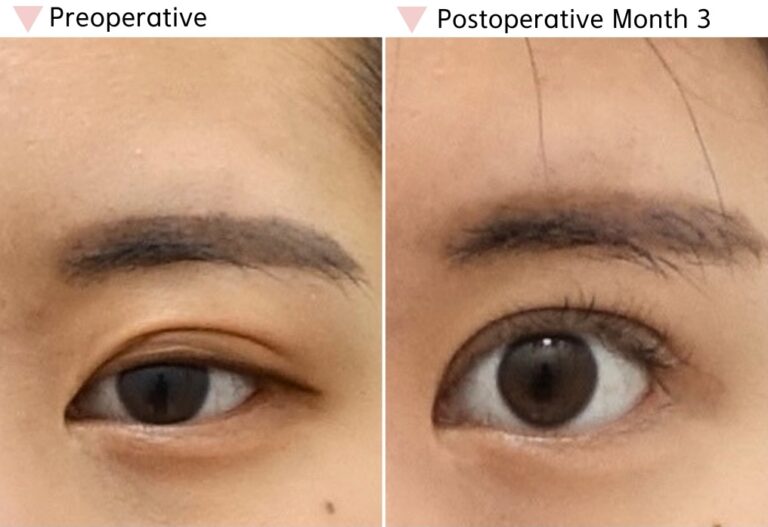
Postoperative Month 3 After Epicanthoplasty with Ptosis Correction
Sometimes the Difference Is Not Epicanthoplasty Alone.
The patient shown above underwent epicanthoplasty together with ptosis correction.
Epicanthoplasty can improve the horizontal appearance of the eyes by revealing a naturally covered inner corner. However, when limited eyelid opening is also present, changing the inner corner alone may not create a balanced result.
In this case, ptosis correction was performed to improve the vertical eye opening and restore more stable eyelid function. Combined with carefully planned epicanthoplasty, this created a brighter and more balanced appearance without excessive inner corner exposure.
Because every patient’s anatomy is different, epicanthoplasty should not be planned in isolation. A careful evaluation must determine whether the concern comes from the epicanthal fold, limited eyelid opening, or a combination of both. If you are considering epicanthoplasty, learn more about our approach to personalized evaluation and surgical planning in our Best Epicanthoplasty Surgeon in Korea guide.
FAQ
1. Does epicanthoplasty make the eyes physically bigger?
No. Epicanthoplasty does not enlarge the eyeball. It reveals the naturally covered inner corner, which can make the eyes appear longer and more balanced.
2. Can epicanthoplasty be combined with ptosis correction?
Yes. When limited eyelid opening is also present, combining epicanthoplasty with ptosis correction may produce a more balanced and natural result than either procedure alone.
3. Is epicanthoplasty suitable for everyone?
No. The procedure should only be recommended after evaluating the patient’s anatomy, facial proportions, and surgical goals.
4. Will epicanthoplasty leave visible scars?
Scars typically become less noticeable as healing progresses. Careful surgical planning and proper postoperative care help minimize visible scarring.
5. How do I know if epicanthoplasty is right for me?
A personalized anatomical evaluation is the best way to determine whether epicanthoplasty alone or a combined approach is the most appropriate treatment.
<p>
Epicanthoplasty is not simply about making the eyes look bigger.
It is about revealing the natural inner corner in a way that complements the patient’s anatomy and preserves long-term facial balance.
Choosing the right procedure begins with understanding the cause of the concern—not just the appearance of the eyes.
Request an Epicanthoplasty Evaluation
Online consultation available for international patients.
Seeing the Eye as a Whole, Not in Parts
A Clinic Dedicated to Eyelid Surgery in Korea
AHNSUNGMIN Plastic Surgery
