This patient came to consultation because her upper eyelids looked heavy and her eyes appeared smaller than she wanted.
At first glance, the appearance could easily have been interpreted as ptosis. But during the examination, I did not see enough functional evidence to justify ptosis correction.
That changed the surgical plan.
I performed upper blepharoplasty alone, without ptosis correction.
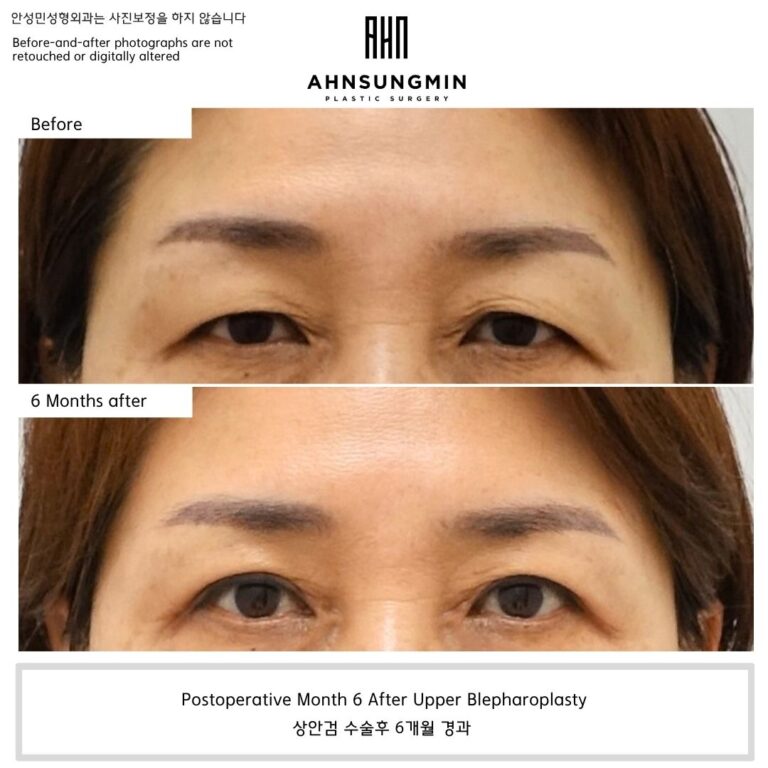
Six months later, the eyes looked less heavy and more open. What is important in this case is that this change was achieved without strengthening the eyelid-opening mechanism.
Patient Concern
Before surgery, the upper eyelids appeared heavy and the eyes looked relatively small.
This type of appearance is often interpreted as ptosis, but a heavy-looking upper eyelid can have more than one cause.
Upper eyelid skin, soft tissue distribution, brow position, crease mechanics, and eyelid movement can all influence how open or closed the eyes appear.
For this reason, I do not decide whether a patient needs ptosis correction from a static photograph alone.
I first want to understand why the eyes look heavy and whether the eyelid-opening function itself is actually weak.
Why This Could Be Mistaken for Ptosis
Heavy upper eyelids can make the eyes look as though they are not opening adequately. But that appearance does not always mean that eyelid elevation itself is weak.
This is where the distinction between pseudoptosis and true ptosis becomes important.
In this patient, I was more interested in how the eyelids actually functioned than in how ptotic they appeared in a photograph.
I Wanted to See How the Eyelids Actually Opened
During the examination, I evaluated how the eyelids behaved when the patient opened her eyes naturally.
I consider eyelid movement, the amount of eye exposure, the relationship between the brows and upper eyelids, compensatory forehead activity, and differences between the two sides.
These observations help distinguish an eyelid that truly has difficulty elevating from an eye that appears heavy because of the surrounding upper eyelid anatomy.
In this patient, the functional evaluation did not indicate a need for additional ptosis correction.
That finding determined the surgical plan.
Why Ptosis Correction Was Not Performed
Ptosis surgery should address a functional problem that is actually present.
I do not believe the eyelid-opening mechanism should be strengthened simply because opening the eyes further might make them look larger.
If eyelid elevation is already adequate, unnecessary strengthening can create a different problem rather than correcting the original one. The eyelid may become too high, differences between the two eyes may become more noticeable, or the eyes may develop an overly open and unnatural appearance.
For this patient, I therefore chose upper blepharoplasty without ptosis correction.
The upper eyelid structures contributing to the heavy appearance were addressed without adding a procedure that I did not believe was necessary.
Postoperative Month 6 After Upper Blepharoplasty
Six months later, the upper eyelids had settled and the eyes looked less heavy and more open.
What matters to me in this case is that this change was achieved without ptosis correction.
I did not need to make the eyelid-opening mechanism stronger to improve the patient’s appearance. Upper blepharoplasty alone was sufficient for the problem I had identified before surgery.
This is why I consider the preoperative functional evaluation an important part of this case.
What This Case Shows
This case is a reminder that a heavy-looking eye does not automatically need ptosis correction.
In this patient, the examination did not show a functional reason to strengthen the eyelid-opening mechanism. I therefore limited the operation to upper blepharoplasty.
Six months later, the eyes appear more open without having undergone ptosis correction.
For me, that is the important point of this case.
The decision about what not to operate on can be just as important as the decision about what to correct.
This distinction becomes especially important in patients who have been told they need ptosis surgery primarily because their eyes look tired, heavy, or relatively small.
Our Approach to Ptosis Evaluation
At Ahnsungmin Plastic Surgery, I evaluate eyelid movement, eye exposure, forehead compensation, brow position, upper eyelid structure, crease behavior, and the relationship between the two eyes before deciding whether ptosis correction is necessary.
Some patients need true ptosis correction.
Others do not.
The purpose of the examination is to distinguish between them before choosing the operation.
Patients with true ptosis can learn more about our approach to ptosis correction in Korea.
Related Insights
Why Pseudoptosis and True Ptosis Are So Often Confused
Learn why an eye can appear droopy or heavy even when true eyelid-opening weakness is not the primary problem.
Uneven Eyes After Ptosis Surgery
Learn why differences between the two eyes require functional evaluation rather than simply trying to increase eyelid elevation.
Ptosis Correction in Korea
Learn how true ptosis is evaluated and when functional eyelid correction may be appropriate.
Request a Ptosis Evaluation
If your eyes look heavy, uneven, or smaller than expected, the first question should not automatically be whether you need ptosis surgery.
The more important question is:
What is causing the appearance?
Functional evaluation can help determine whether the problem is true ptosis, pseudoptosis, or another structural issue affecting the upper eyelid.
Online photo evaluation is available for international patients.
Seeing the Eye as a Whole, Not in Parts
A Clinic Dedicated to Eyelid Revision Surgery in Korea
Ahnsungmin Plastic Surgery
