Multiple Eyelid Folds After Repeated Surgeries.
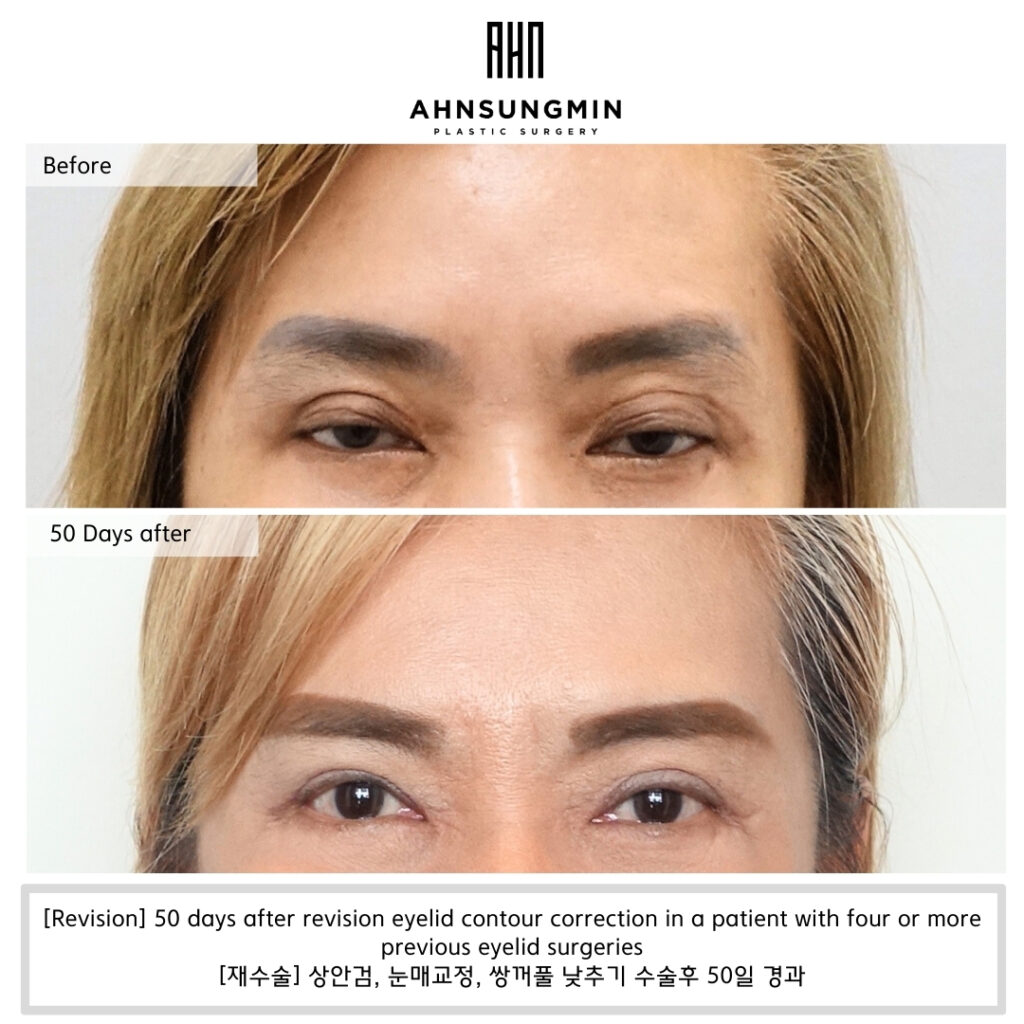
Preoperative Condition
This patient presented with multiple visible eyelid creases following four previous eyelid surgeries. Instead of forming a single, natural fold, the eyelid displayed several overlapping lines that remained visible even when the eyes were open.
In a well-formed double eyelid, the surgical crease should not be directly visible during eye opening. Instead, the fold should integrate naturally into the eyelid contour. In this case, the persistence of multiple crease lines indicated underlying structural issues that had not been properly addressed.
Understanding the Structural Problem
Repeated surgeries had resulted in severe internal adhesions and scar tissue accumulation within the eyelid. These adhesions disrupted the normal movement of the eyelid, preventing it from forming a smooth and stable crease.
Additionally, ptosis had not been properly corrected in previous procedures. As a result, the patient relied heavily on forehead muscle activation to open the eyes. This caused the eyebrows to elevate, making all existing crease lines more visible.
Rather than being a simple issue of crease design, this was a combined problem involving structural adhesion, muscle imbalance, and incomplete functional correction.
In complex cases like this, understanding whether revision is truly possible is critical.
For a deeper perspective, see:
Eyes That Are Suitable for Revision Surgery—and Those That Are Not
Surgical Approach
This case required a highly cautious and structured approach due to its complexity. As a fifth revision surgery, the goal was not aggressive correction, but restoration of stability.
During surgery:
– Adhesion tissues were meticulously released
– Scarred structures were carefully reorganized
– The eyelid layers were repositioned to allow natural movement
– A single, stable crease was reconstructed
Due to limited skin availability between the brow and eyelid, complete scar removal was not possible. Instead, the focus was placed on maximizing functional release and achieving the most natural possible outcome within safe limits.
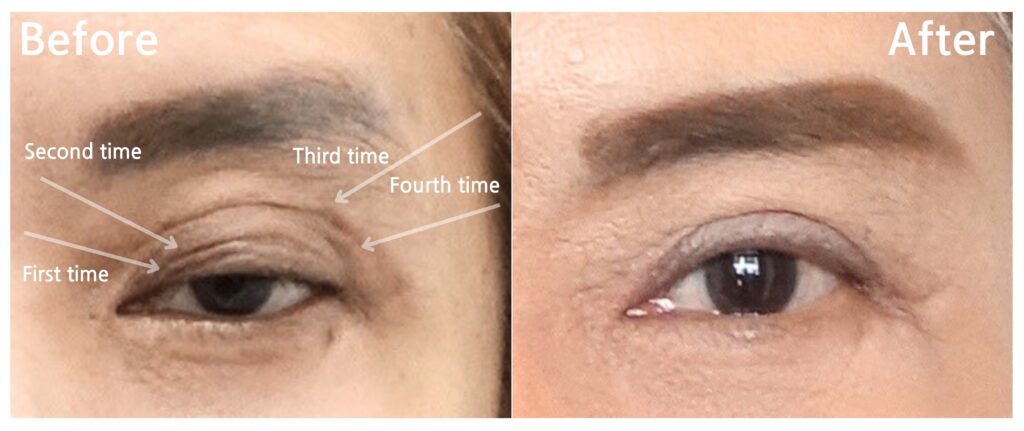
Postoperative Progress
After surgery, the multiple crease lines were significantly reduced, and the eyelid showed a more stable and unified contour. Although this case involved severe structural damage from multiple prior procedures, meaningful improvement was achieved through careful release and reconstruction.
Recovery in such complex revision cases requires time, and gradual stabilization is expected over several months.
In revision cases, results should not be judged too early.
To understand proper timing for evaluation, see:
Why Some Revision Surgeries Should Only Be Evaluated After Time Has Passed
Key Consideration
Eyelid revision surgery is not a procedure that can be standardized. Each case differs depending on prior surgical history, scar formation, and tissue condition.
In cases involving multiple prior surgeries, the most important factor is not how much correction is performed, but how safely and precisely the existing structures are restored.
Overcorrection or aggressive tissue removal can worsen the condition and reduce the possibility of future revision.
Final Thought
In complex revision cases, the goal is not perfection, but stability.
Each revision case requires careful structural evaluation based on previous surgeries and current tissue condition.
Request a Revision Eyelid Surgery Evaluation
Online consultation available for international patients
Seeing the Eye as a Whole, Not in Parts
A Clinic Dedicated to Eyelid Revision Surgery in Korea
Ahnsungmin Plastic Surgery
