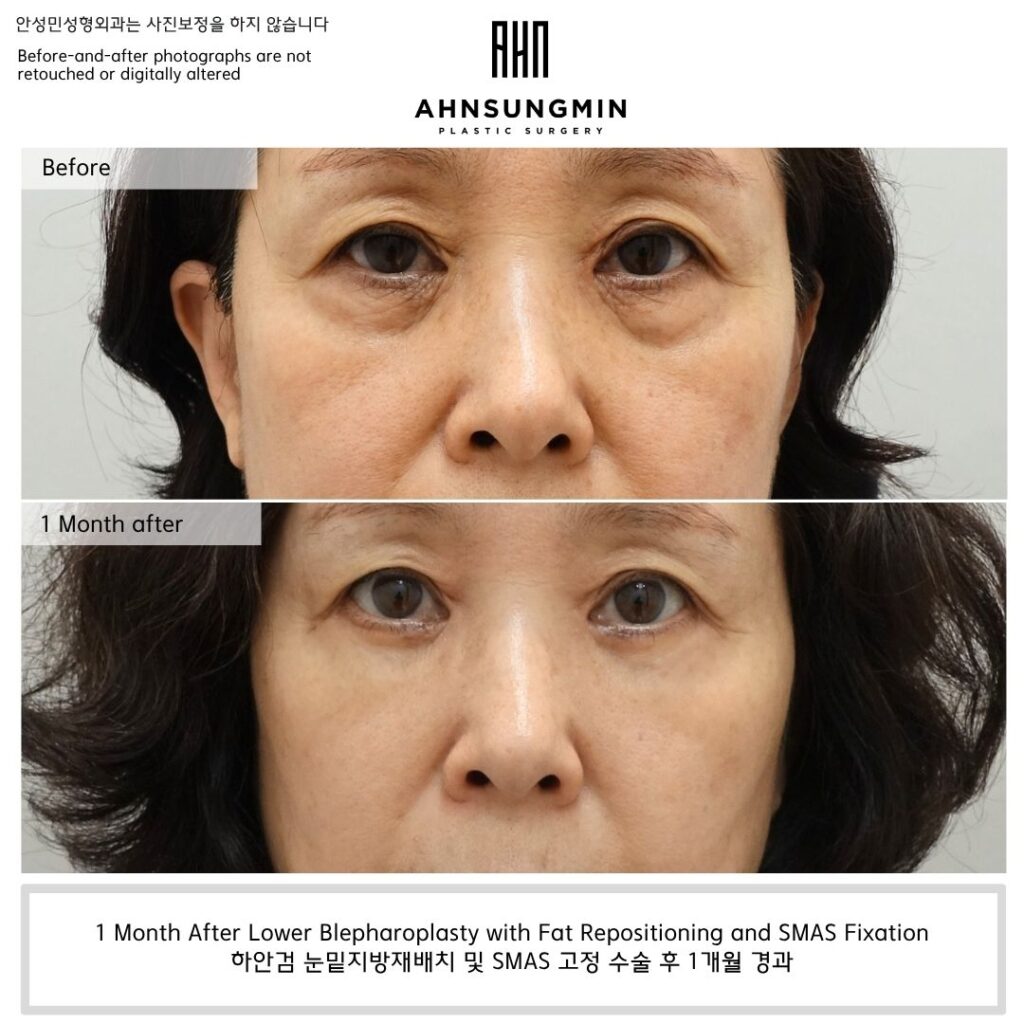
Volume was preserved and repositioned to prevent postoperative hollowing.
A Functional Problem
At first glance, the primary concern appeared to be under-eye bulging. However, the issue was not simply excess fat. The lower eyelid showed a structural imbalance, where protrusion and hollowing coexisted, creating a shadowed and unstable contour.
Why We Did Not Remove Fat
Fat removal was not the appropriate solution in this case. Removing volume from an already aging lower eyelid can lead to hollowing and a more fatigued appearance over time. The goal was not to flatten the area, but to restore structural balance.
This approach is especially important because aggressive fat removal can often lead to hollowing over time. For a deeper understanding, see
why lower eyelid fat removal can lead to hollowing
.
Structural Correction
Instead of removal, the protruding fat was repositioned to smooth the transition between the lower eyelid and the cheek. Structural support was reinforced using SMAS fixation to maintain stability and prevent downward tension on the lower eyelid.
This method focuses on restoring balance rather than removing volume. For a broader perspective, see
how lower eyelid surgery is based on structure and support
.
Results
At one month, the under-eye contour appears smoother and more continuous, without signs of hollowing. However, this stage reflects early structural improvement, and the final outcome should be evaluated over time as tissue stabilization progresses.
While early improvement is visible, preventing hollowing is a long-term consideration. You can learn more about this in
this guide on hollow under-eye after surgery
Choosing the Best Lower Eyelid Surgeon in Korea
Surgical Approach
Lower eyelid surgery was performed with a focus on structure, restraint, and long-term stability rather than aggressive correction.
