Before and After
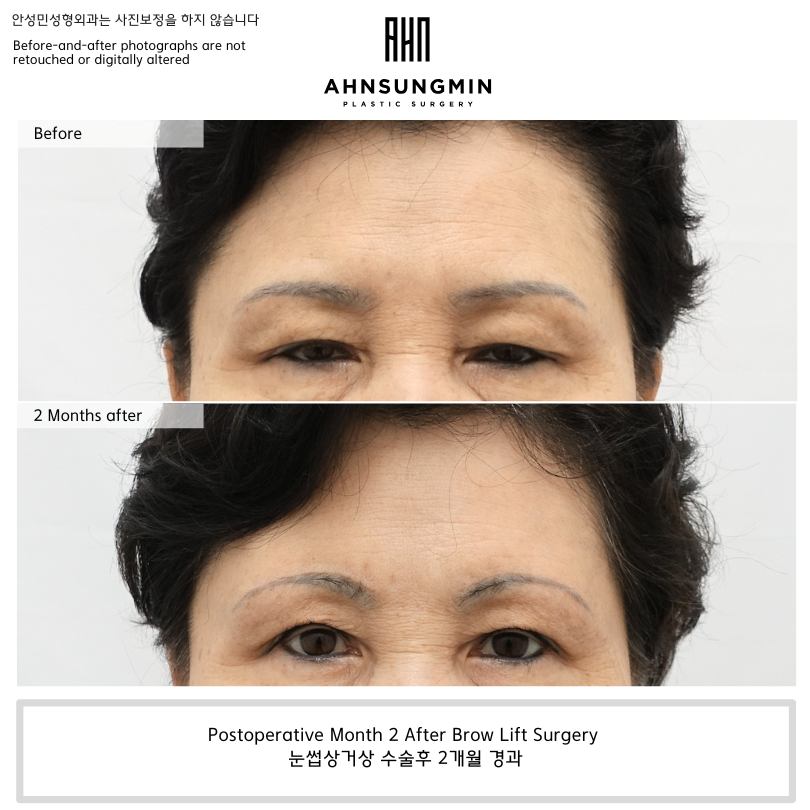
This patient presented with heavy upper eyelids, persistent forehead tension, and a tired appearance caused by chronic brow compensation.
Rather than a simple cosmetic concern, the brows were constantly elevated in order to help open the eyes. Over time, this compensation pattern created forehead strain and imbalance between the brows and upper eyelids.
At 2 months after brow lift surgery, the eyes appear more open and stable while maintaining a natural brow position and facial expression.
A Functional Problem
In many patients, brow heaviness is not simply caused by aging skin alone.
When the upper eyelids feel heavy or the eye-opening strength weakens over time, patients often unconsciously use the forehead muscles to compensate.
This compensation pattern is also commonly seen in patients with residual ptosis after previous eyelid surgery, where persistent forehead use continues because stable eyelid opening function was not fully restored.
→ Revision Ptosis Surgery Case: Correcting Residual Ptosis and Restoring Clearer Eyelid Opening.
This repeated elevation can create tension, fatigue, and an unnaturally elevated brow position.
As compensation continues, the brows and eyelids begin functioning together abnormally rather than independently.
In this case, the problem was not simply low brows, but the long-term compensation pattern affecting the entire upper facial balance.
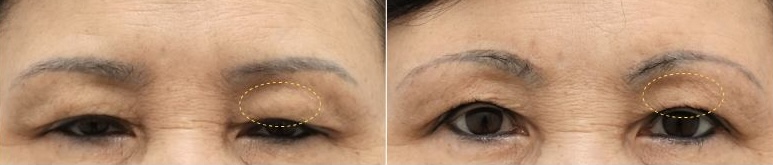
Why We Did Not Choose Excessive Elevation
An aggressive brow lift may create a surprised appearance, forehead stiffness, or imbalance between the brows and eyelids.
For this reason, the goal was not to raise the brows excessively, but to reduce compensation while restoring a more stable and natural relationship between the forehead and upper eyelids.
In brow lift surgery, long-term stability often depends more on restraint and balance than on maximal elevation.
Structural Correction
The surgical approach focused on reducing forehead compensation while preserving natural movement and expression.
Rather than creating an artificially elevated brow shape, the correction was planned according to the patient’s existing anatomy, skin condition, and upper eyelid balance.
Special attention was given to avoiding overcorrection and maintaining a smooth transition between the forehead, brows, and upper eyelids.
For more information about the relationship between brow position and upper eyelid balance, visit our brow lift surgery page.
Results
At 2 months postoperatively, the forehead appears more relaxed and the upper eyelids appear less heavy without an exaggerated brow position.
The eyes appear more comfortable and balanced while preserving a natural facial expression.
Although swelling and tissue adaptation continue during the recovery process, the overall direction already reflects improved structural balance rather than excessive lifting.
These changes reflect not only brow elevation itself, but reduction of the chronic compensation pattern that had affected the upper facial balance.
Understanding the Cause
This case demonstrates that brow lift surgery is not simply about lifting the eyebrows higher.
In many patients, the real goal is to reduce chronic forehead compensation, improve upper eyelid heaviness, and restore a more natural functional balance between the brows and eyelids.
Successful brow lift surgery depends not only on elevation, but on understanding why compensation developed in the first place.
Related Insight
→ Why Brow Position Matters More Than Eyelid Skin.
→ Why Do Eyelids Sag & How an Eyebrow Lift Can Help
→ Brow Lift Surgery in Patients in Their 60s: Improving Comfort Rather Than Eye Size
→ Is Brow Lift a Suitable Surgery for Men as Well?
Request a Brow Lift Evaluation
If you are considering brow lift surgery in Korea, you may request a personalized evaluation based on your forehead compensation, brow position, upper eyelid heaviness, facial balance, and long-term recovery goals.
