Recovery after epicanthoplasty is a gradual process.
Although the inner corner changes immediately after surgery, swelling, scar maturation, and soft tissue healing continue over the following months. Understanding each stage of recovery helps patients develop realistic expectations and avoid judging the outcome too early.
Recovery Timeline
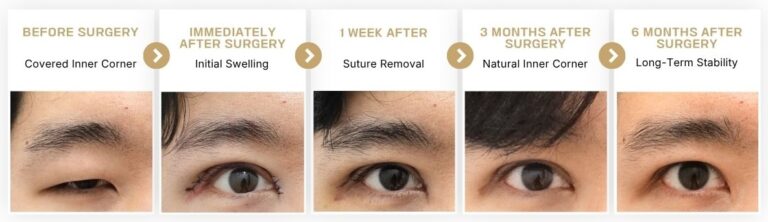
Before Surgery
The inner corner is partially covered by the epicanthal fold, making the eyes appear shorter horizontally.
Immediately After Surgery
Initial swelling and redness are expected. The new inner corner shape is already visible, but the tissues are still healing.
1 Week After Surgery
Sutures are typically removed around one week after surgery. Most patients notice that swelling has begun to improve, although the surgical area may still appear firm.
3 Months After Surgery
The inner corner becomes more natural as swelling continues to decrease and scar tissue softens. Most patients begin to appreciate the long-term shape at this stage.
6 Months After Surgery
Healing is largely complete. The scar continues to mature, and the inner corner reaches a stable, natural appearance that blends with the surrounding eyelid.
Why the Final Result Takes Time
Many patients become concerned during the first few weeks because the inner corner may appear swollen, firm, or slightly different from what they expected.
This is a normal part of healing. Scar maturation and tissue remodeling continue for several months after surgery, which is why the appearance gradually becomes softer and more natural over time.
The final result should never be judged based on the first few weeks alone.
Our Surgical Philosophy
Successful epicanthoplasty is measured not by the appearance immediately after surgery, but by how naturally the inner corner looks after complete healing.
Our approach focuses on careful planning, tissue preservation, and long-term stability rather than creating an overly aggressive change.
Natural healing is an essential part of achieving a balanced result.
Related Insights
Does Epicanthoplasty Make the Eyes Look Bigger?
Learn how epicanthoplasty creates a more open appearance by refining the inner corner rather than enlarging the eye itself.
Can Epicanthoplasty Leave a Visible Scar?
Understand how scar maturation continues throughout the recovery process and why careful surgical planning matters.
Who Is a Good Candidate for Epicanthoplasty?
Find out whether your anatomy is suitable for epicanthoplasty and why individualized evaluation is important.
Best Epicanthoplasty Surgeon in Korea
Learn what to consider when choosing an epicanthoplasty surgeon, including anatomical planning, natural results, and long-term stability.
How Epicanthoplasty Creates a More Open Appearance
Learn how epicanthoplasty enhances eye appearance through horizontal extension, upward definition, and reduction of the epicanthal fold.
FAQ
How long does it take to recover after epicanthoplasty?
Most patients recover from the initial swelling within the first few weeks, but complete healing, including scar maturation and soft tissue remodeling, typically takes several months. The final result is usually evaluated around 6 months after surgery.
When are the stitches removed after epicanthoplasty?
Sutures are generally removed about one week after surgery. At this stage, swelling has usually started to improve, although the inner corner continues to heal over the following months.
Is swelling normal after epicanthoplasty?
Yes. Swelling and mild redness are expected immediately after surgery. These gradually improve as healing progresses, and the inner corner becomes softer and more natural over time.
When can I see the final results of epicanthoplasty?
While noticeable improvement is often seen within a few months, the final appearance should be assessed only after the tissues have fully healed, which is typically around 6 months after surgery.
Why does the inner corner continue to change during recovery?
The appearance changes because swelling decreases, scar tissue matures, and the soft tissues gradually remodel. This natural healing process allows the inner corner to become smoother and more stable over time.
Request an Epicanthoplasty Evaluation
If you are considering epicanthoplasty or would like to understand what to expect during recovery, a personalized consultation can help you make an informed decision.
Online consultation available for international patients.
Seeing the Eye as a Whole, Not in Parts
A Clinic Dedicated to Eyelid Revision Surgery in Korea
Ahnsungmin Plastic Surgery
