Many patients considering epicanthoplasty ask the same question before surgery: Will the scar be visible?
Because the procedure involves the inner corner of the eye, concerns about scarring are understandable. However, the appearance of a scar depends on much more than the location of the incision. Surgical planning, tissue handling, individual healing, and time all influence how the scar ultimately matures.
In most cases, the scar becomes progressively less noticeable as healing continues.
Why the Inner Corner Requires Careful Planning
The inner corner of the eye contains delicate skin and complex anatomical structures. Simply removing more skin does not produce a better result. In fact, excessive tension can increase the risk of prolonged redness, visible scarring, or an unnatural appearance.
For this reason, epicanthoplasty should focus on releasing the epicanthal fold while preserving natural tissue balance, rather than creating the largest possible opening.
Before and After
Preoperative
Postoperative Month 3
Insert after photo
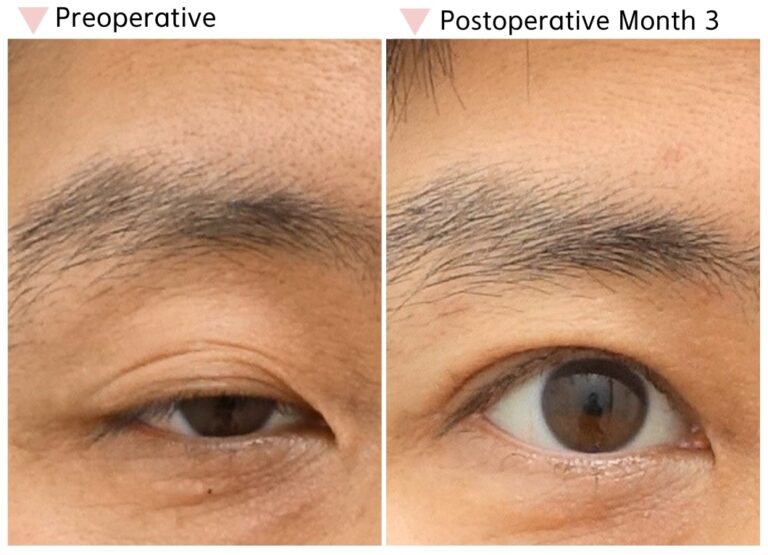
This patient demonstrates a naturally defined inner corner three months after epicanthoplasty. The epicanthal fold has been reduced while maintaining harmony with the overall eyelid shape. At this stage, the incision has healed well, although subtle scar maturation may continue for several more months.
Scar Healing Continues Beyond the Initial Recovery
Many patients evaluate their scar too early.
During the first several weeks, mild redness or firmness is part of the normal healing process. As collagen remodels and the tissue softens, the scar usually becomes less noticeable over time.
Because healing varies between individuals, the final appearance should not be judged only a few weeks after surgery.
Our Surgical Philosophy
A successful epicanthoplasty is not measured by how much the inner corner is opened. It is measured by how naturally the result blends with the rest of the eye while allowing the incision to heal with minimal long-term visibility.
Natural balance, careful tissue preservation, and long-term healing remain more important than aggressive correction.
Related Insights
Does Epicanthoplasty Make the Eyes Look Bigger?
Learn how epicanthoplasty changes eye proportions and why creating a more open inner corner often makes the eyes appear larger without increasing their actual size.
Best Epicanthoplasty Surgeon in Korea
Discover what to look for when choosing an epicanthoplasty surgeon, including natural-looking results, anatomical planning, scar management, and long-term stability.
How Epicanthoplasty Creates a More Open Appearance
Learn how epicanthoplasty enhances eye appearance through horizontal extension, upward definition, and reduction of the epicanthal fold.
Request an Epicanthoplasty Evaluation
If you are considering epicanthoplasty or are concerned about scarring after previous surgery, a careful anatomical evaluation is the first step toward determining the most appropriate treatment.
Online consultation available for international patients.
Seeing the Eye as a Whole, Not in Parts
A Clinic Dedicated to Eyelid Revision Surgery in Korea
Ahnsungmin Plastic Surgery
