Many patients expect to see the final outcome immediately after upper blepharoplasty.
In reality, early postoperative appearance rarely represents the final result.
Swelling, tissue stiffness, eyelid movement, and scar maturation all continue to change during the healing process.
For this reason, upper blepharoplasty should never be judged during the first few weeks after surgery.
Recovery Timeline After Revision Upper Blepharoplasty
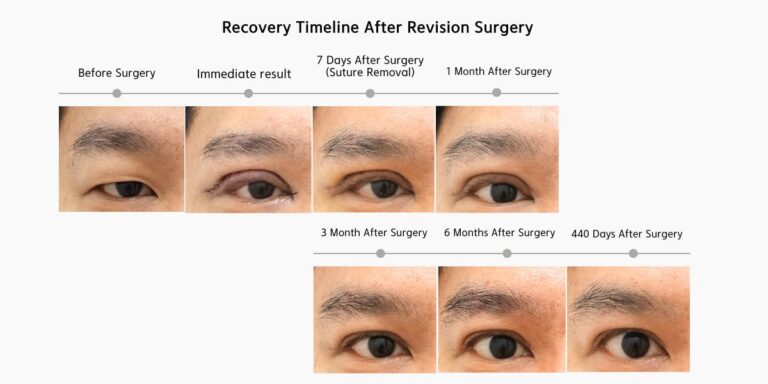
This timeline illustrates the gradual healing process following revision upper blepharoplasty.
Immediately after surgery, swelling and tissue tension temporarily affect eyelid shape.
At one week, the sutures have been removed, but the eyelid is still entering the early phase of recovery.
By one month, swelling has improved considerably, although the eyelid continues to soften.
At three months and six months, the eyelid crease becomes progressively more natural as scar tissue remodels.
More than one year after surgery, the eyelid demonstrates stable contour, comfortable function, and long-term balance.
Recovery Continues Long After Surgery.
Healing after upper blepharoplasty is not a single event.
The eyelid is one of the thinnest and most dynamic structures in the body.
Because it moves constantly throughout the day, the surrounding tissues require time to soften and adapt after surgery.
Natural movement and a balanced appearance develop gradually rather than immediately.
Patience Is Part of Successful Surgery.
One of the most common reasons patients become anxious after surgery is judging the eyelids too early.
Temporary asymmetry, swelling, or stiffness during the first several weeks does not necessarily indicate a poor result.
Successful upper blepharoplasty should be evaluated only after the tissues have matured and the eyelids have reached structural stability.
Time is an essential part of the treatment—not simply the recovery.
Related Insights
Why Heavy Eyelids Are Not Always Caused by Excess Skin
Learn why ptosis, brow compensation, and aging often contribute to heavy upper eyelids.
Why Eyes May Look Smaller After Eyelid Surgery
Discover why swelling, eyelid function, and healing influence eye appearance during recovery.
Upper Blepharoplasty in Korea
Explore our approach to individualized upper eyelid surgery focused on natural function and long-term stability.
Male Eyelid Surgery in Korea
Learn how male eyelid surgery is planned to preserve masculine features while improving eye opening, definition, and long-term balance.
Concerned About Your Upper Eyelids?
Recovery after upper blepharoplasty takes time. A personalized evaluation can help determine the most appropriate treatment based on your anatomy, eyelid function, and long-term goals.
Request an Upper Eyelid Evaluation
Online consultation available for international patients.
Seeing the Eye as a Whole, Not in Parts
A Clinic Dedicated to Eyelid Revision Surgery in Korea
Ahnsungmin Plastic Surgery
