Why Does Ptosis Surgery Look Uneven at First?
Ptosis surgery does not produce perfectly balanced eyes immediately after the procedure.
Even when the surgical correction itself is accurate, the early appearance of the eyelids can seem uneven, higher on one side, or unstable in shape.
This is not necessarily a problem with the surgery. In most cases, it reflects the normal healing process.
The Most Common Reason: Uneven Swelling
After ptosis surgery, swelling does not resolve at the same speed on both sides.
One eyelid may retain more fluid while the other settles faster, making the eyes appear asymmetrical.
This imbalance can change daily, sometimes making one eye look higher, then lower, then more balanced again.
This fluctuation is a normal part of recovery—not a surgical error.
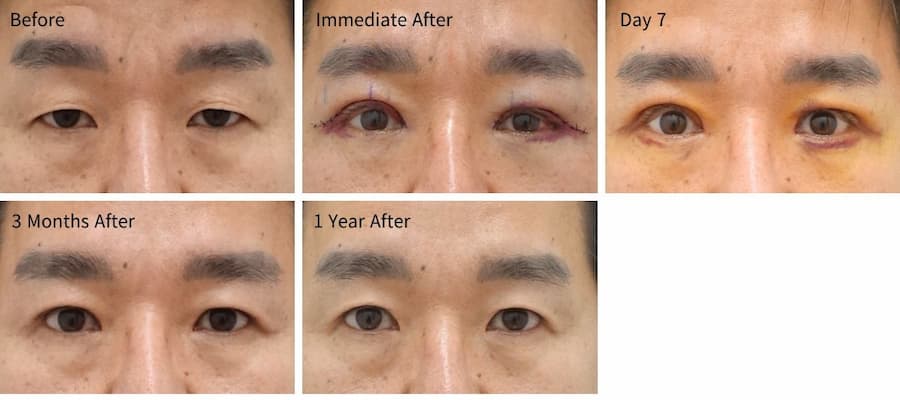
Uneven eyelid appearance immediately after ptosis surgery gradually improves over time as swelling decreases and eyelid position stabilizes
Muscle Adaptation Does Not Happen Simultaneously
Ptosis correction involves adjusting the muscle that lifts the eyelid.
After surgery, this muscle does not function identically on both sides right away.
Each side adapts at a different pace, which can temporarily create uneven eyelid height or opening.
The Structure Stabilizes Over Time
The eyelid is a combination of muscle, skin, fat, and connective tissue.
After surgery, these components do not settle at the same time.
Even if the muscle position is correct, the surrounding tissues may not yet reflect that balance.
This is why early asymmetry is common—and temporary.
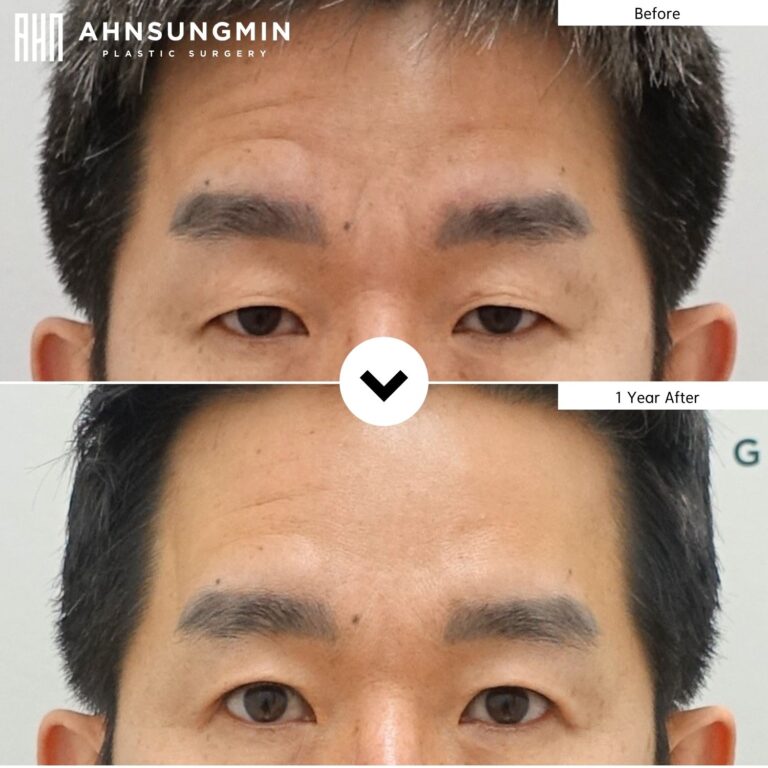
Pre-existing Asymmetry Becomes More Visible
Most faces are not perfectly symmetrical.
Subtle asymmetry often exists before surgery.
After ptosis correction, the removal of compensatory muscle use can make these differences more noticeable.
When Does It Improve?
In most cases:
– Early asymmetry is most noticeable within the first few weeks
– The eyelid position continues to adjust for up to 2–3 months
– More reliable symmetry appears as healing progresses
For a full recovery timeline, see:
Ptosis Surgery Recovery Timeline
For a deeper understanding of natural results, see:
When Does Ptosis Surgery Look Natural?
Learn how male eyelid surgery is planned to preserve masculine features while improving eye opening, definition, and long-term balance.
Male Eyelid Surgery in Korea
Key Consideration
Uneven eyes immediately after ptosis surgery are usually part of the recovery process—not a sign of failure.
Swelling, muscle adaptation, and structural stabilization all take time.
Judging the result too early can lead to unnecessary concern or misinterpretation.
For more about ptosis correction, see:
Ptosis Correction Surgery in Korea
Final Thought
In ptosis correction, symmetry is not created instantly—it develops gradually as healing progresses.
Frequently Asked Questions
Is it normal for eyes to look uneven after ptosis surgery?
Yes, uneven eyes are common in the early recovery period after ptosis surgery due to swelling and muscle adaptation. This usually improves over time.
How long does unevenness last after ptosis surgery?
Most unevenness improves within 2 to 4 weeks, with more stable eyelid balance developing over 2 to 3 months.
When should I worry about uneven eyelids after ptosis surgery?
Early asymmetry is normal. Persistent imbalance beyond several months may require evaluation, but early differences are usually part of healing.
Can uneven eyes after ptosis surgery be corrected?
In most cases, unevenness improves naturally during recovery. Additional correction is considered only after sufficient healing time has passed.
Online consultation available for international patients
Seeing the Eye as a Whole, Not in Parts
A Clinic Dedicated to Eyelid Revision Surgery in Korea
Ahnsungmin Plastic Surgery
