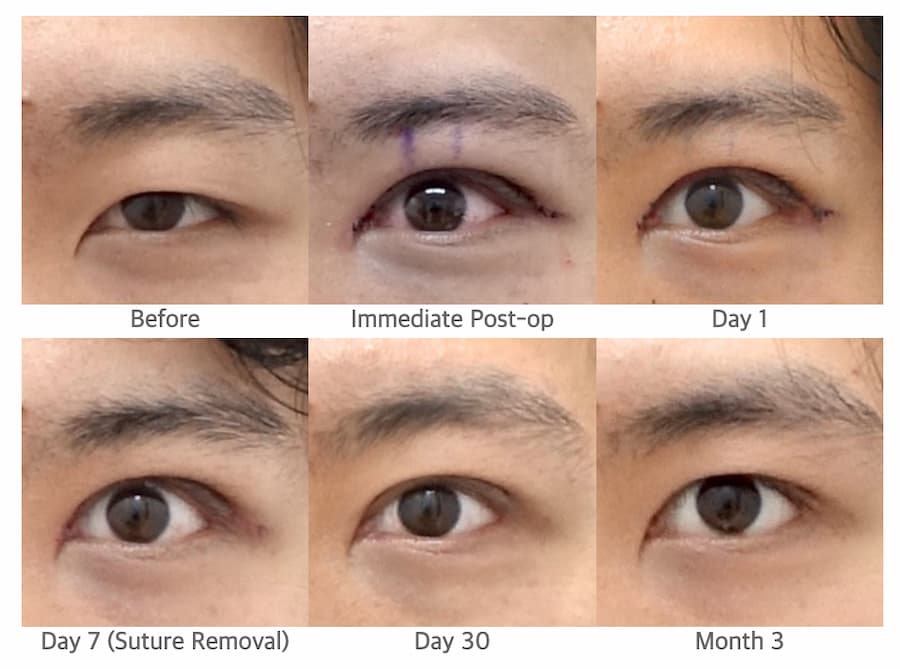
Understanding Ptosis Recovery
Ptosis surgery recovery is a gradual process, not an immediate transformation.
While the eyelid position is adjusted during surgery, the final result takes time to stabilize as swelling decreases and muscle function adapts.
Understanding each stage of recovery is essential to avoid misjudging early results.
Immediate Postoperative Stage
Immediately after surgery, swelling and asymmetry are common.
The eyelid may appear higher or uneven due to temporary inflammation and muscle response.
This stage does not reflect the final outcome and should not be evaluated prematurely.
Day 1 to Day 7
During the first week, swelling and bruising gradually begin to improve.
By the time of suture removal (around Day 7), the eyelid shape becomes more defined, although residual swelling is still present.
At this stage, the eyes may still feel tight or slightly unnatural.
Day 30
Around one month after surgery, the majority of visible swelling subsides.
The eyelid position becomes more stable, and symmetry improves significantly.
However, subtle changes may still occur as healing continues.
Month 3
At three months, the eyelid position is largely stabilized.
The eyes appear more natural, and muscle function has adapted to the corrected position.
This is typically the stage when early evaluation of surgical results becomes meaningful.
Key Consideration
Ptosis surgery should not be judged based on early postoperative appearance.
Swelling, muscle adaptation, and tissue healing all influence the final result.
Evaluating too early can lead to unnecessary concern or misinterpretation.
Male Ptosis Surgery
Although recovery follows a similar timeline in both men and women, the surgical approach is different.
Male ptosis surgery is planned to improve eye opening while preserving natural masculine facial features and overall facial balance.
Learn more about Male Eyelid Surgery in Korea
Best Ptosis Surgeon in Korea
Why Sleepy Eyes in Men Often Require Ptosis Correction.
Frequently Asked Questions
1. How long does it take to recover from ptosis surgery?
Most visible swelling improves within 2 to 4 weeks, but full stabilization of eyelid position typically takes around 3 months.
2. When can I see the final results after ptosis surgery?
Initial improvements can be seen within a few weeks, but meaningful evaluation is usually possible after 3 months.
3. Is asymmetry normal during ptosis recovery?
Yes, temporary asymmetry is common during ptosis recovery due to swelling and muscle adaptation. It usually improves as healing progresses.
4. Why do my eyes look uneven after ptosis surgery?
Swelling and temporary muscle imbalance can make the eyes appear uneven after surgery. This is part of the normal healing process and should not be judged too early.
5. Can I judge my ptosis surgery result within the first month?
No. Early postoperative appearance does not reflect the final outcome. Proper evaluation usually requires several months of healing and stabilization.
Online consultation available for international patients
Seeing the Eye as a Whole, Not in Parts
A Clinic Dedicated to Eyelid Revision Surgery in Korea
Ahnsungmin Plastic Surgery
