This eyelid revision recovery timeline shows how results change from day 1 to 6 months.
Before
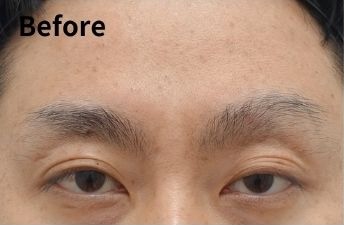
Before surgery, the issue was not simply a high fold.
The eyelid was not opening adequately due to underlying ptosis,
which led to compensatory effort and an unstable crease.
As a result, the fold appeared disconnected from natural eyelid movement
and increasingly unnatural over time.
At this stage, the key question is not how high the fold is,
but whether the eyelid can functionally support it.
If the eyelid cannot open properly,
proper evaluation for ptosis correction is essential.
Immediate After
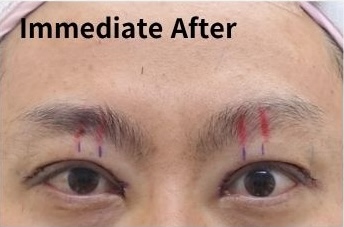
Immediately after surgery, the eyelids may appear tight, swollen, or overcorrected.
This is a normal tissue response following eyelid revision surgery
and reflects surgical adjustment rather than the final outcome.
In revision cases, these early changes may appear more pronounced.
Postoperative Day 1
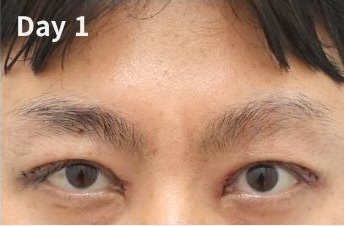
On the first day after surgery, swelling and bruising are most noticeable.
Eyelid opening may appear exaggerated or uneven,
and temporary asymmetry can be more visible.
These findings are part of the normal eyelid revision recovery process.
Postoperative Day 7
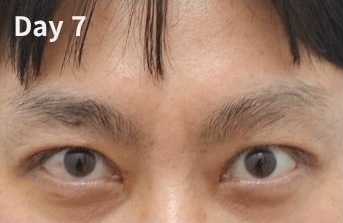
By one week, major swelling begins to decrease.
Eyelid function gradually stabilizes,
and the overall appearance starts moving toward a more balanced state.
However, it is still too early to evaluate the final surgical outcome.
Postoperative Month 1
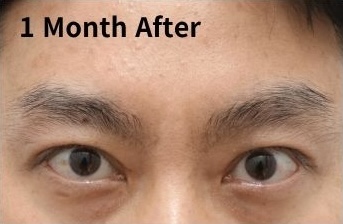
At one month, the eyes may appear more open than expected
or slightly tense.
This occurs as eyelid function is actively recovering and adapting.
This phase is a normal part of the eyelid surgery recovery timeline,
and the appearance gradually softens into a more natural state over time.
Postoperative Month 6
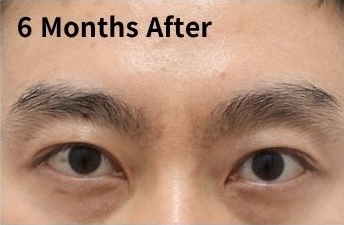
By six months, most structural stabilization has been achieved.
Eyelid function and crease position become aligned,
resulting in a more natural and stable appearance.
This is the stage when eyelid revision results can be properly evaluated.
Insight
Eyelid revision is not simply about adjusting the fold.
It is a process of restoring the function of the eyelid
and the structure that supports it.
In many cases, a high fold appears unnatural
not because of its height,
but because it is not supported by proper eyelid function.
Why high fold eyelids look unnatural
For this reason, results should not be judged immediately,
but over time, as the eyelid heals and stabilizes.
This eyelid revision recovery timeline demonstrates that
early changes do not represent failure,
but rather a normal progression toward stability.
Frequently Asked Questions
1. Is it normal for my eyes to look too open after eyelid surgery?
Yes. During the early recovery phase, the eyes may appear more open or tense. This is a temporary response as eyelid function recovers.
2. When can I see the final results of eyelid revision surgery?
Most results stabilize around 6 months after surgery, when swelling resolves and eyelid function becomes balanced.
3. Why do eyelid surgery results change over time?
Eyelid surgery results change as swelling decreases and eyelid function gradually stabilizes. The final appearance reflects both structural healing and functional recovery.
4. How long does eyelid swelling last after revision surgery?
Swelling is most noticeable in the first week and gradually improves over time. Residual swelling may remain for several months.
5. What is the most important factor in eyelid revision recovery?
The most important factor is restoring eyelid function and structural balance. A stable result depends on how well the eyelid can support the crease over time.
If your eyelids appear too high, uneven, or unstable,
the issue may not be the fold itself,
but how the eyelid functions.
See how high fold eyelid revision is performed in real cases.
If your eyelids appear too open, uneven, or unstable after surgery,
the issue may not be the fold itself,
but how the eyelid functions.
