Early Results After Lower Eyelid Surgery Are Often Misinterpreted
Lower eyelid surgery recovery is frequently misunderstood, especially in the early postoperative period.
Patients often expect to see a clear improvement within the first few weeks.
However, what appears during this stage does not represent the final result.
Swelling, tissue tension, and temporary structural imbalance can all influence how the lower eyelid appears.
The early phase is not a reflection of success or failure.
It is simply part of the recovery process.
Why the Lower Eyelid Changes Over Time
Unlike static structures, the lower eyelid is influenced by multiple layers—skin, muscle, fat, and supporting ligaments.
After surgery, these layers do not stabilize at the same time.
As swelling decreases and tissue adapts,
the contour of the lower eyelid may change gradually.
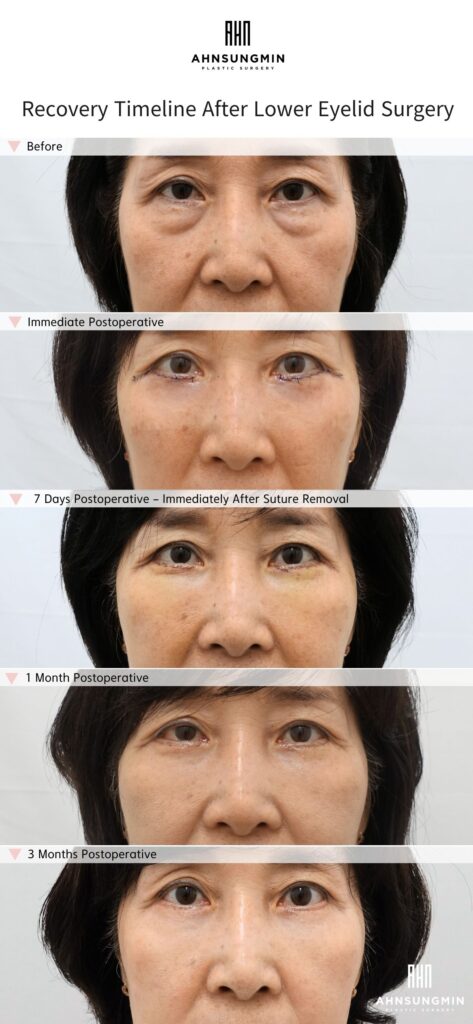
This is why the lower eyelid surgery recovery timeline
should be understood as a progression, not a single moment.
When Results Appear Worse Before They Improve
During recovery, some patients feel that the results look worse before they improve.
This may include:
- increased hollowing
- temporary asymmetry
- visible irregularities
These changes are often related to swelling redistribution and tissue adaptation.
They do not necessarily indicate a poor surgical outcome.
Why Early Judgments Lead to Unnecessary Revision
One of the most common mistakes in lower eyelid surgery
is evaluating the result too early.
Patients may become concerned and begin considering revision procedures
before the tissue has stabilized.
However, revision performed during this unstable phase
often leads to more complex structural problems.
Time is not a delay in recovery.
It is part of the healing process.
Structural Stability Matters More Than Early Appearance
The long-term success of lower eyelid surgery
is determined not by how the eye looks early,
but by how it stabilizes over time.
Support, tension, and tissue balance
must be evaluated after recovery—not during it.
This is why restraint in decision-making
is often more important than early intervention.
Surgical Approach
Lower eyelid surgery is evaluated over time, not by early postoperative appearance, but by how structure and support stabilize during recovery.
Seeing the Eye as a Whole, Not in Parts
A Clinic Dedicated to Eyelid Revision Surgery in Korea
Ahnsungmin Plastic Surgery
Internal References
→ Understand why early results after lower eyelid surgery can be misleading
→ Learn why lower eyelid changes often become visible months after surgery
→ Read why some revision surgeries should only be evaluated after time has passed
→ Choosing the Best Lower Eyelid Fat Repositioning Surgeon in Korea
Frequently Asked Questions
How long does it take to recover from lower eyelid surgery?
Initial swelling and bruising usually improve within the first few weeks, but the lower eyelid continues to change as tissues heal. Final contour and structural stability often require several months.
Is it normal for my lower eyelids to look uneven after surgery?
Yes. Temporary asymmetry is common during recovery because swelling and tissue adaptation do not occur evenly on both sides. Early asymmetry does not necessarily indicate a poor surgical outcome.
Why do my lower eyelids look worse before they look better?
Swelling, tissue tension, and the healing process can temporarily make the lower eyelids appear hollow, uneven, or unnatural. These changes often improve as the tissues stabilize.
When should the results of lower eyelid surgery be evaluated?
The outcome should be assessed only after adequate healing has occurred. Judging the result too early can lead to unnecessary concern and inappropriate decisions about revision surgery.
Should I consider revision surgery if I am unhappy with the early result?
Not necessarily. Most early postoperative concerns improve as healing progresses. Revision surgery should only be considered after sufficient recovery time and a thorough structural evaluation by an experienced surgeon.
