Upper Eyelid Revision Surgery
Upper eyelid revision surgery is commonly required when previous double eyelid surgery produces unstable or unnatural results.
Patients may experience excessively high eyelid creases, multiple folds, asymmetry, or thick eyelid lines caused by underlying ptosis or scar tissue from previous surgery.
Correcting these problems requires careful analysis of the eyelid structure, including skin thickness, muscle balance, the position of the existing crease, and the functional stability of the eyelid.
Rather than simply creating a new eyelid fold, revision surgery focuses on restoring a natural eyelid contour and stable eyelid function.
At Ahnsungmin Plastic Surgery, revision procedures emphasize structural analysis, conservative correction, and long-term stability rather than aggressive cosmetic change.
Case 1
Upper Eyelid Revision with Ptosis Correction and Double Eyelid Line Lowering
1 Year Postoperative
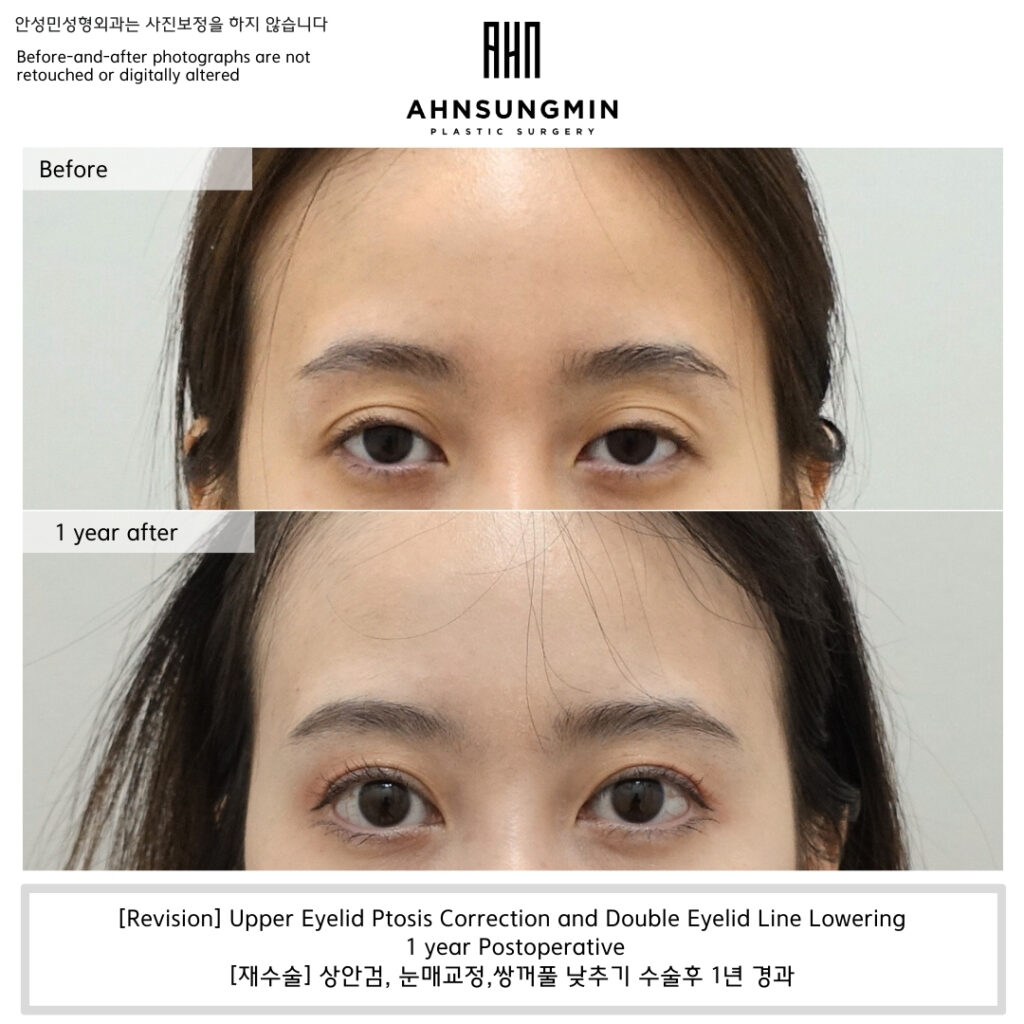
Upper Eyelid Revision with Ptosis Correction and Double Eyelid Line Lowering
1 Year Postoperative
This revision case involved correction of an excessively high double eyelid crease created by previous surgery.
The patient also showed signs of functional eyelid imbalance due to underlying ptosis.
Revision surgery focused on lowering the eyelid crease and restoring a more natural eyelid contour.
At one year after surgery, the eyelid fold appears stable and balanced.
In revision eyelid surgery, correcting the crease alone is often not sufficient.
Functional balance of the eyelid must also be considered.
When ptosis is present, combining ptosis correction with revision surgery can significantly improve eyelid stability.
Learn more about
Case 2
Upper Eyelid Revision with Ptosis Correction
6 Months Postoperative
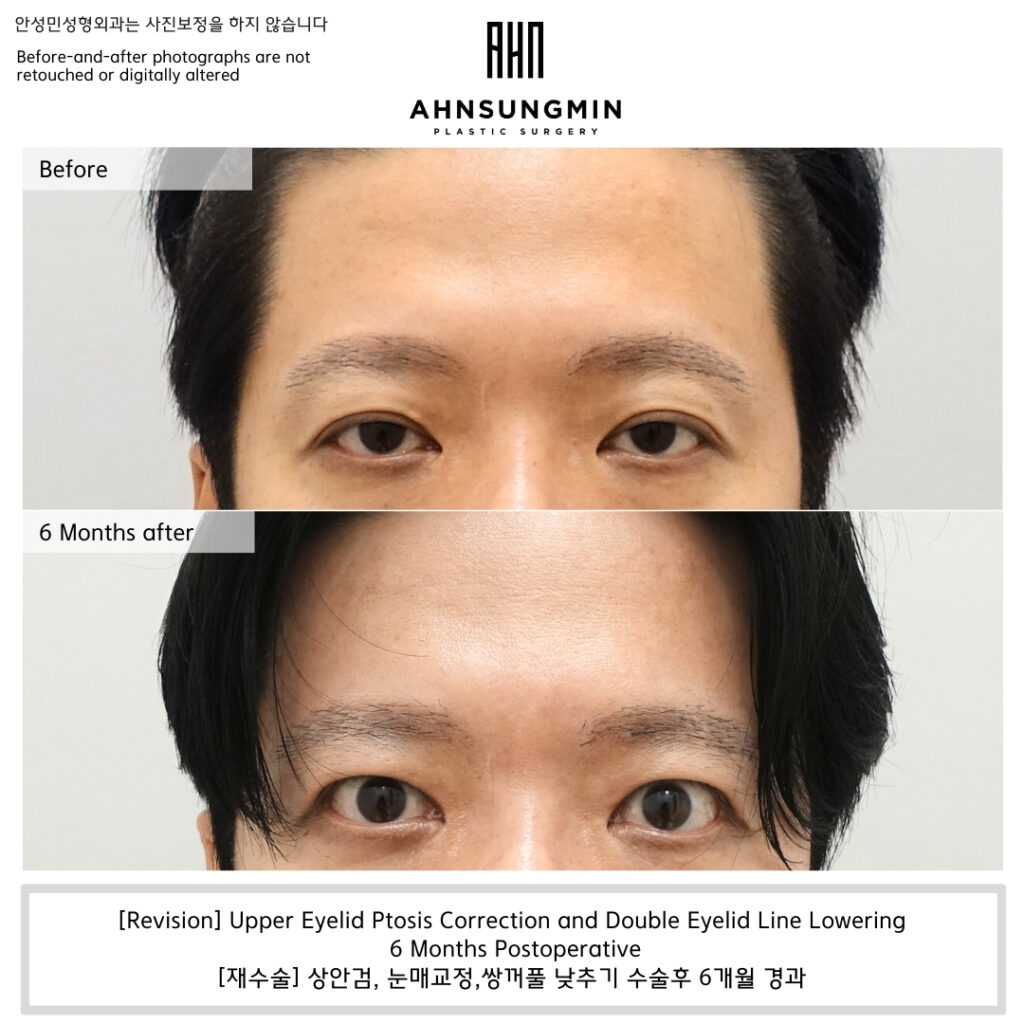
Upper Eyelid Revision with Ptosis Correction
6 Months Postoperative
This case demonstrates revision surgery performed to correct asymmetry and unstable eyelid folds following previous double eyelid surgery.
Scar tissue and altered eyelid structure from earlier procedures contributed to the imbalance.
Revision surgery involved careful structural analysis and ptosis correction.
Six months after surgery, the eyelids show improved symmetry and a more natural fold position.
Revision surgery often requires addressing deeper structural problems rather than simply modifying the visible eyelid crease.
Scar tissue, muscle imbalance, and previous surgical changes must be carefully evaluated.
Conservative surgical planning is essential to achieve stable long-term results.
Learn more about
Case 3
Revision Eyelid Contour Correction After Multiple Previous Eyelid Surgeries
50 Days Postoperative
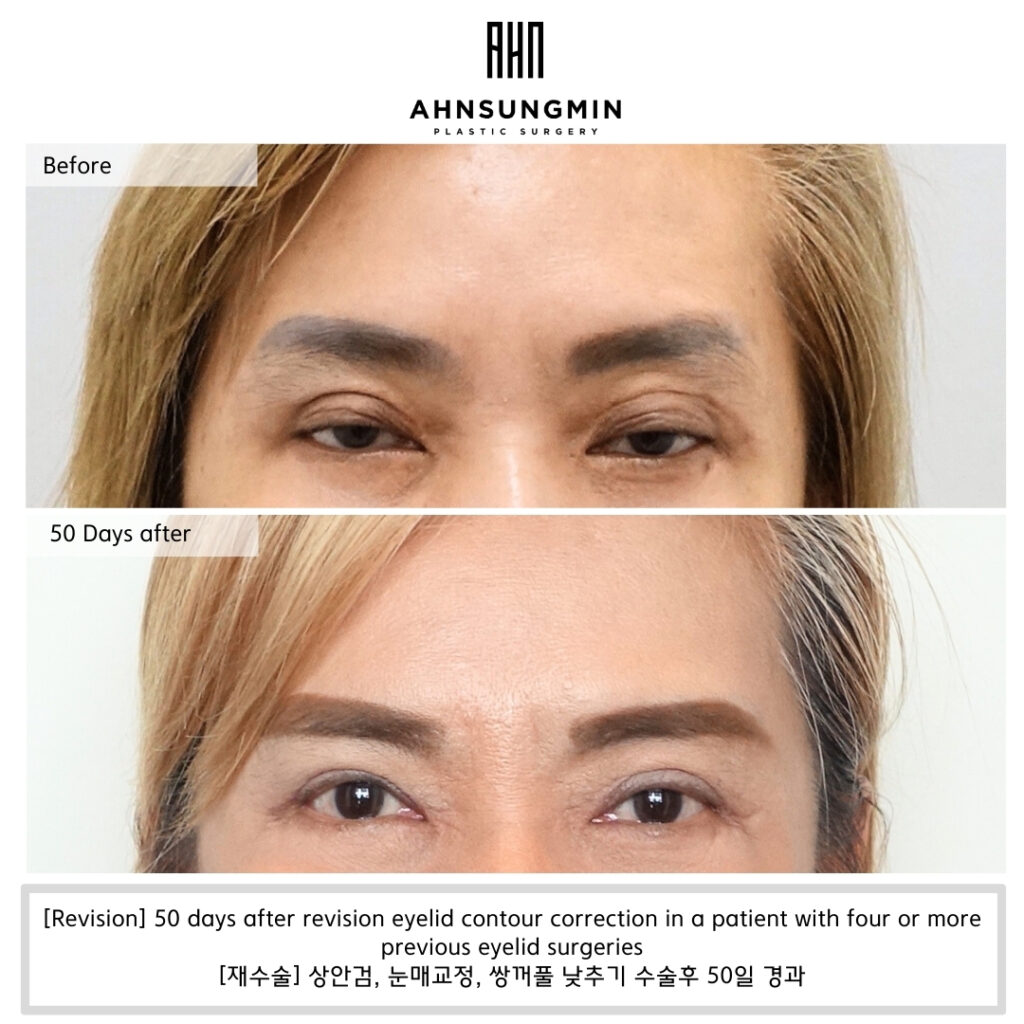
Revision Eyelid Contour Correction After Multiple Previous Eyelid Surgeries
50 Days Postoperative
This patient had undergone four or more previous eyelid surgeries before seeking revision treatment.
Multiple previous procedures had resulted in significant structural changes and eyelid instability.
Revision surgery focused on restoring eyelid contour and improving eyelid function.
At 50 days postoperative, the eyelid structure shows early stabilization.
Complex revision cases require careful release of scar tissue and preservation of remaining healthy tissue.
Excessive tissue removal during revision surgery can worsen structural instability.
For this reason, conservative correction and structural restoration are critical in complex revision procedures.
Learn more about
When eyelid surgery requires revision
Eyelid revision surgery is performed when the results of a previous eyelid procedure do not meet expectations or when structural problems develop after surgery. Unlike primary eyelid surgery, revision procedures must address scar tissue, altered anatomy, and changes created by earlier operations.
Because of these complexities, eyelid revision surgery requires a careful and conservative surgical approach.
At Ahnsungmin Plastic Surgery, revision procedures focus on identifying the underlying structural cause of the problem and restoring natural eyelid balance rather than simply modifying the appearance of the eyelid.
Why eyelid revision surgery is more complex than primary surgery
Revision eyelid surgery is often more technically demanding than the original procedure. Previous surgery may create scar adhesion, tissue imbalance, or structural changes that must be carefully released and reconstructed.
Each revision case requires detailed analysis of the eyelid structure, including skin condition, muscle function, fat position, and support of the lower eyelid.
Rather than removing additional tissue, revision surgery often involves restoring stability to the eyelid so that both appearance and function can improve.
Lower eyelid revision surgery
Immediately After Surgery / 7 Days Postoperative/
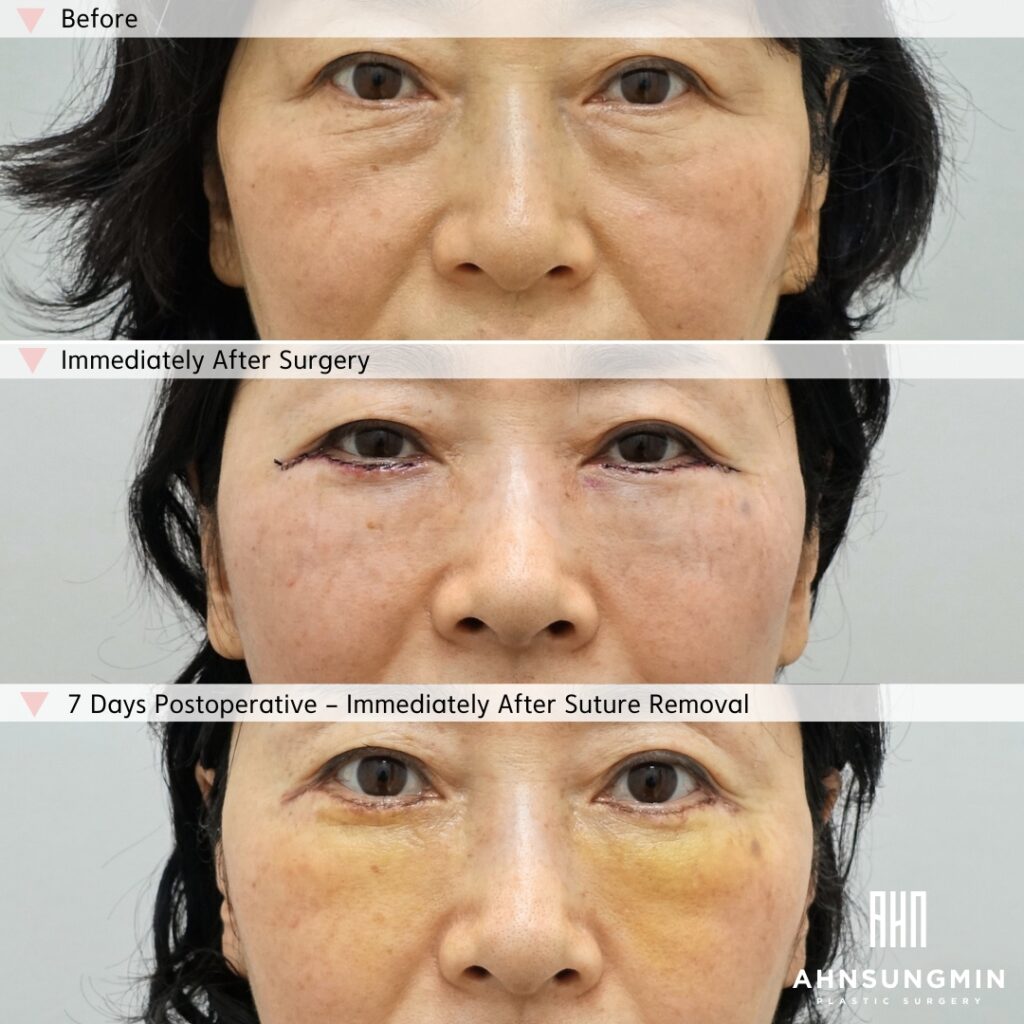
Before – Immediately After Surgery – 7 Days Postoperative (After Suture Removal)
Lower eyelid revision surgery
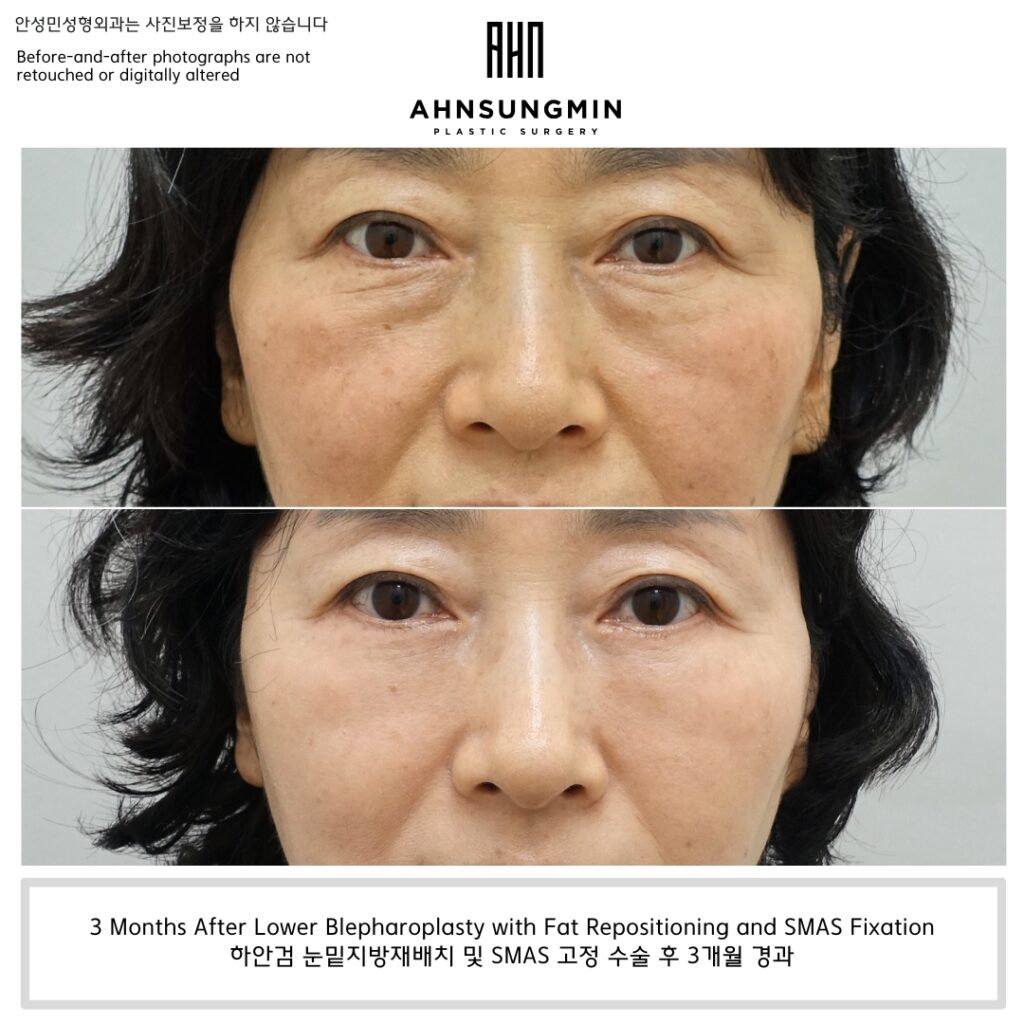
Lower eyelid revision surgery is commonly required when complications such as eyelid retraction, persistent eye bags, hollowing, or ectropion develop after previous surgery.
Correcting these problems often requires releasing scar tissue, repositioning fat, and restoring structural support of the eyelid.
Because the lower eyelid plays a critical role in protecting the eye, surgical planning emphasizes long-term stability and careful tissue preservation rather than aggressive correction.
1 Month After / 3 Months After
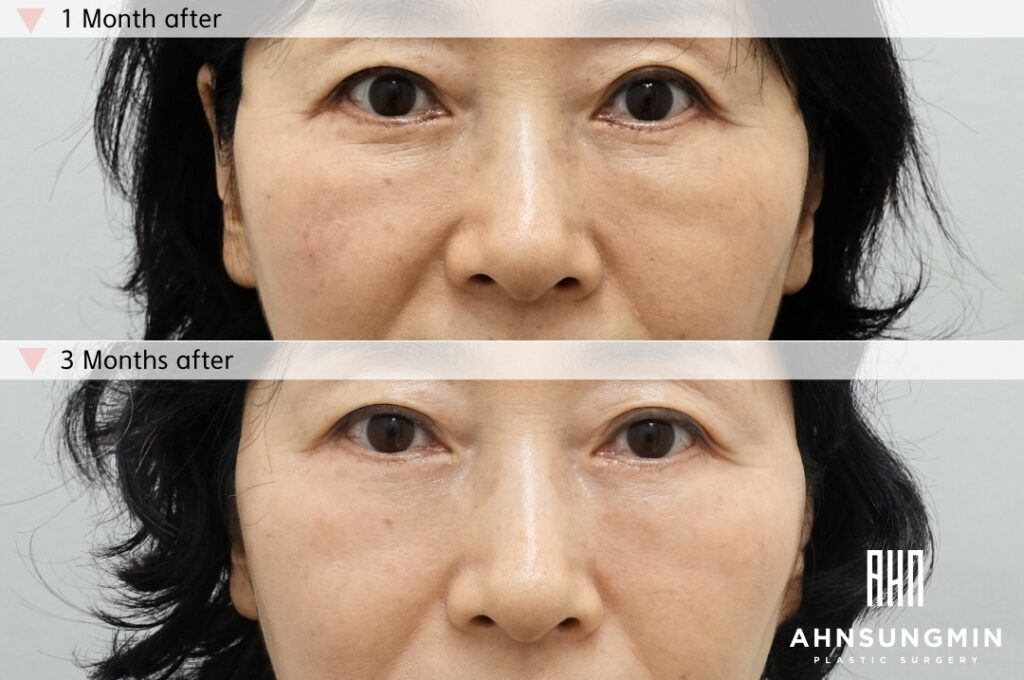
Postoperative Recovery – 1 Month and 3 Months After Surgery
Why choosing a revision specialist matters
Revision eyelid surgery requires experience in managing scar tissue, structural instability, and complex postoperative changes.
Each revision case must be approached individually, and conservative surgical planning is essential to avoid creating additional complications.
At Ahnsungmin Plastic Surgery, surgical planning focuses on restoring natural eyelid balance, preserving tissue stability, and achieving long-term functional results.
Eyelid Revision Insights
Understanding the structural causes of failed eyelid surgery can help patients make safer decisions before considering revision procedures.
Related Insights
Why Early Results After Lower Eyelid Surgery Can Be Misleading
Why Ectropion Often Appears Months After Lower Eyelid Surgery
Why Lower Eyelid Retraction Is One of the Most Difficult Problems in Revision Surgery
For patients considering complex revision procedures, it is important to understand how structural problems develop after eyelid surgery.
Learn more about our approach to revision eyelid surgery:
Eyelid Revision Surgery Specialist in Korea
Seeing the Eye as a Whole, Not in Parts
A Clinic Dedicated to Eyelid Revision Surgery in Korea
Ahnsungmin Plastic Surgery
