Why Eye Shape Correction Is Often Misunderstood.
Many patients come in asking for “bigger eyes,” believing that increasing the size of the double eyelid fold will automatically make the eyes appear larger. This is a common misunderstanding.
A double eyelid fold is created on the eyelid skin. Eye shape correction, however, goes much deeper. It addresses the muscles responsible for opening the eyes. These are two entirely different concepts. Making the fold higher may change the surface appearance, but it does not correct how the eye actually opens.
When patients confuse these two, the result is often disappointment—or unnecessary revision surgery.
When Eye Shape Correction Is Actually Necessary.
Eye shape correction is not indicated simply because the eyes look small. True candidates are those whose eyelids do not open properly due to muscle weakness, imbalance, or compensation from previous surgery. In such cases, adjusting the eyelid crease alone will never resolve the underlying problem.
This decision must be based on functional analysis, not aesthetic expectation.
Understanding Functional Ptosis Before Surgery
Many patients believe eye shape correction is simply about creating larger or more defined eyes.
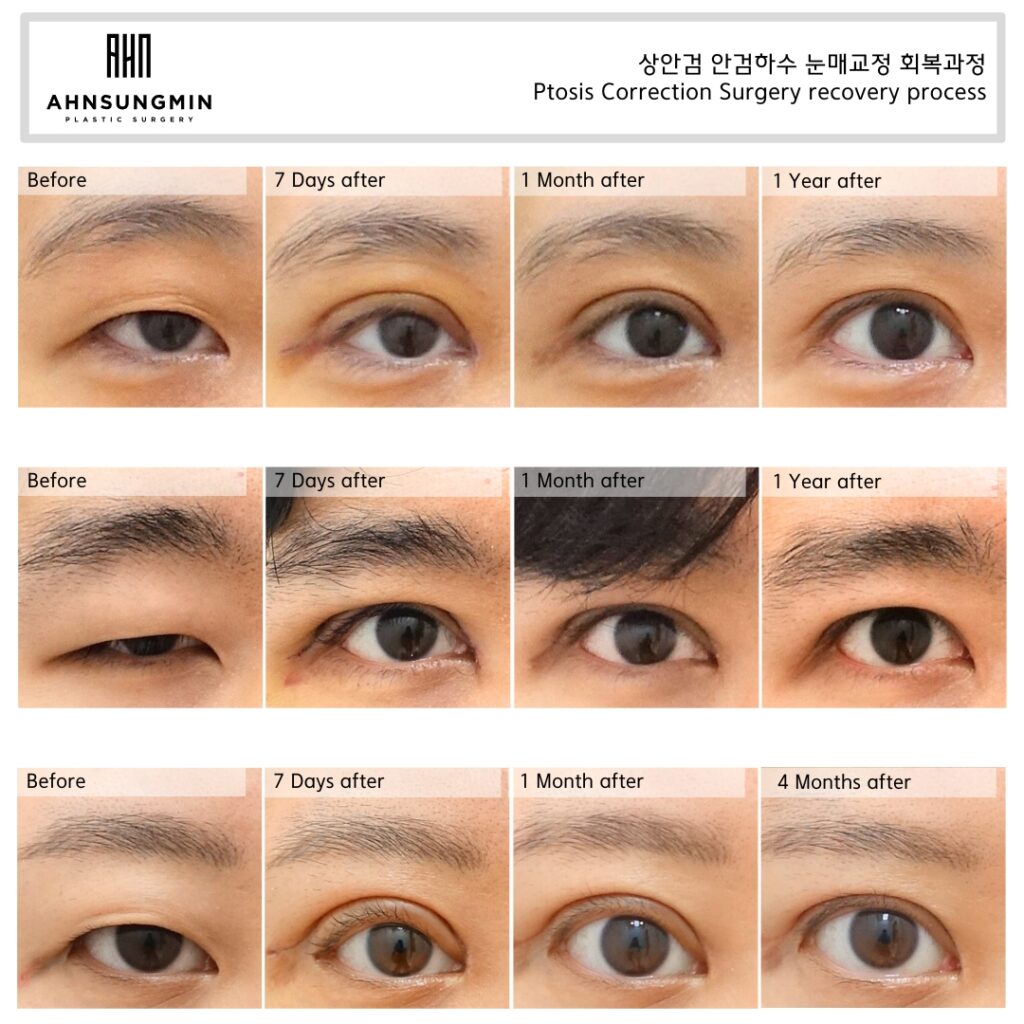
In reality, proper ptosis correction requires careful evaluation of eyelid opening function, compensatory muscle use, and long-term structural balance.
→ Ptosis Correction Surgery in Korea
Why Non-Incisional Eye Shape Correction Is a Risky Choice.
Patients frequently ask whether eye shape correction can be done without an incision. Anatomically, the muscles responsible for opening the eyes are accessed through an incision. A non-incisional approach implies manipulating these muscles without direct visualization, relying largely on estimation.
While this may not be absolutely impossible, it is not a method we choose to use.
Most revision cases we see involve patients who previously underwent non-incisional eye shape correction. The outcomes are often asymmetry or undercorrection—results that stem from the inability to accurately assess and adjust muscle function without proper exposure.
In surgery, what cannot be clearly seen cannot be precisely corrected.
Why Overcorrection Creates Long-Term Problems.
Another common mistake is excessive tightening. While this may create an immediate sense of openness, it frequently leads to dryness, discomfort, unnatural staring, and long-term instability. Over time, the eyelids compensate again, sometimes more severely than before.
Effective eye shape correction prioritizes balance, not maximal lift.
Related Insight
Excessive eye-opening correction or aggressive crease elevation may eventually create thick folds, unstable eyelid movement, or long-term imbalance.
→ High Fold Revision Surgery in Korea
Eye Shape Correction and Revision Surgery.
In revision cases, eye shape correction becomes even more delicate. Scar tissue, altered muscle pathways, and prior overcorrections must all be considered. At this stage, the question is no longer how much correction is possible, but how much correction is safe.
Restraint is often the most critical surgical decision.
What Patients Should Understand Before Choosing a Non-Incisional Approach.
If a patient is considering non-incisional eye shape correction, it is essential to first understand the limitations and risks of this approach. Without a clear anatomical understanding, expectations and outcomes rarely align.
Eye shape correction is not a procedure to be chosen lightly or simplified by terminology. It requires judgment, precision, and respect for anatomy.
What Eye Shape Correction Should Ultimately Achieve.
Proper eye shape correction allows the eyes to open comfortably, symmetrically, and sustainably. When done correctly, the result does not attract attention. Instead, it removes unnecessary effort from the face and restores a natural resting expression.
Quiet normalization—not dramatic enlargement—is the true measure of success.
Frequently Asked Questions
Can Double Eyelid Surgery Make the Eyes Function Better?
No.
Double eyelid surgery changes the crease appearance but does not directly restore eyelid opening strength.
Why Is Non-Incisional Ptosis Correction Less Predictable?
Because the eyelid-opening muscles cannot be directly visualized, adjustments are often based on estimation rather than precise structural evaluation.
Can Overcorrection Cause Long-Term Problems?
Yes.
Excessive tightening may lead to dryness, discomfort, unnatural eye appearance, and long-term instability.
Is Eye Shape Correction the Same as Making the Eyes Bigger?
No.
The goal of ptosis correction is restoring comfortable and stable eyelid opening—not exaggerated enlargement.
