Upper eyelid fat grafting is often expected to permanently correct hollow upper eyelids.
However, many patients experience recurrence over time.
This does not always mean the surgery failed.
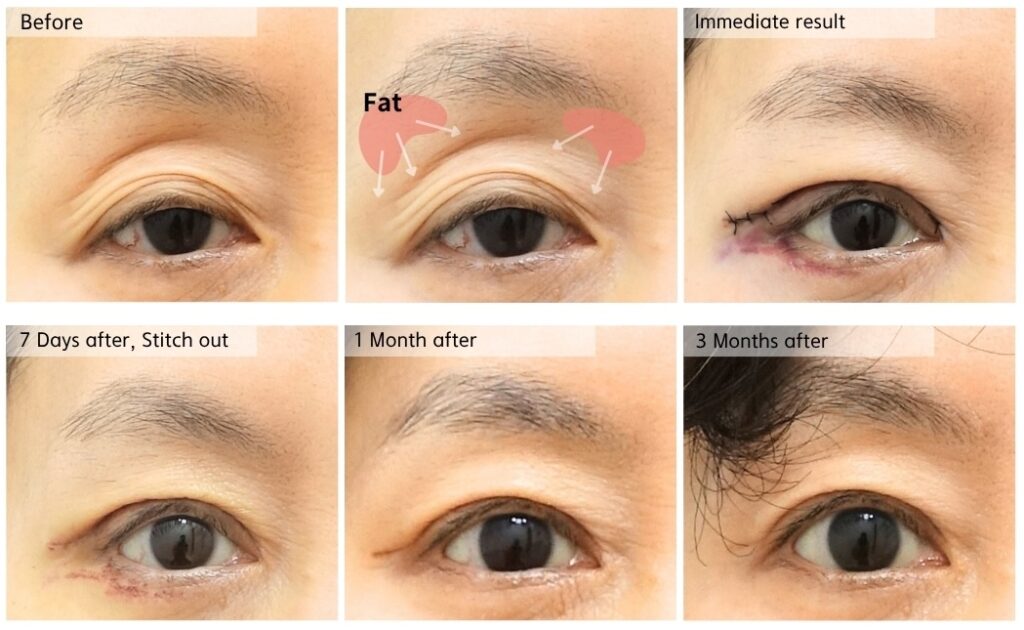
The eyelid is a highly dynamic structure.
Unlike other areas of the face, the upper eyelid is constantly moving.
Blinking, opening, and closing place repeated stress on transplanted fat.
Because transplanted fat depends on re-establishing blood supply in a constantly moving area, long-term fat survival may vary significantly from patient to patient.
Because free fat grafts are disconnected from their original blood supply,
long-term survival in the eyelid is inherently unpredictable.
Even when early results appear satisfactory,
partial resorption can occur months later.
Repeated fat grafting does not always solve the problem.
When hollowing returns, additional fat grafting is often suggested.
However, repeating the same approach does not change the underlying condition.
In some cases, repeated grafting can lead to irregular contour, stiffness,
or a heavier eyelid without improving function.
Recurrence often reflects an uncorrected cause.
Eyelid hollowing may recur not because volume was insufficient,
but because eyelid function and balance were never addressed.
If compensatory eyebrow elevation, excessive tension,
or structural imbalance persists,
the appearance of hollowing can return—even after volume restoration.
Long-term improvement requires a different approach.
Stable improvement in eyelid hollowing depends on understanding
why the hollowing occurred in the first place.
In revision cases, correcting function and restoring balance
often matters more than adding volume.
In eyelid surgery, durability comes from addressing cause—not repetition.
Related Insights
→ Why Upper Eyelid Hollowing Is Not Always Caused by Aging
→ Why Your Eyelids Look Hollow—And Why Filler May Not Be the Answer
→ Upper Eyelid Fat Reposition Surgery for Hollow Eyelids
→ Why Hollow Eyelids Are Not Always a Volume Problem
Frequently Asked Questions
Can upper eyelid hollowing return after fat grafting?
Yes. In some patients, transplanted fat may partially resorb over time, especially in the constantly moving upper eyelid area.
Does recurrence mean the surgery failed?
Not always. Fat survival in the eyelid is inherently variable, and recurrence may also reflect underlying structural or functional imbalance that was never fully corrected.
Why is the upper eyelid different from other fat grafting areas?
The upper eyelid is constantly moving through blinking and eye opening. This dynamic environment may affect long-term fat survival and stability.
Can repeated fat grafting completely solve hollow eyelids?
Not always. Repeating the same volume-based approach may not address the underlying cause of hollowing and, in some patients, may lead to contour irregularity or heaviness.
Why can hollow eyelids recur even after volume restoration?
If ptosis compensation, eyebrow elevation, excessive tension, or structural imbalance persists, the hollow appearance may gradually return over time.
What matters most for long-term improvement?
Long-term stability often depends on identifying the actual cause of hollowing and restoring structural and functional balance rather than simply adding more volume.
Request an Upper Eyelid Hollowing Evaluation
If you are experiencing hollow upper eyelids after aging, previous surgery, or fat grafting, you may request a personalized evaluation based on eyelid structure, support balance, ptosis compensation, and long-term stability.
Seeing the Eye as a Whole, Not in Parts
A Clinic Dedicated to Eyelid Revision Surgery in Korea
Ahnsungmin Plastic Surgery
