What the Patient Requested.
This male patient visited our clinic requesting a lower double eyelid line.
He reported that his eyelid crease had gradually become thicker over time, despite not appearing excessively thick immediately after his initial surgery.
This progression is a common concern in high-fold cases.
What We Identified During Evaluation.
Although the visible concern was crease thickness, the underlying issue was not the crease itself.
The eyelids showed signs of inadequate eye-opening function.
Subtle forehead compensation was present, and pupil exposure was insufficient at rest.
As eye-opening function weakened, the upper eyelid tissue was repeatedly pulled upward, making the crease appear thicker and heavier over time.
Why Ptosis Correction Was Necessary.
In this case, lowering the crease alone would not have addressed the root cause.
Without correcting the eye-opening mechanism, the eyelid would have continued to rely on compensatory forces, increasing the risk of recurrence.
Ptosis correction was necessary to restore stable eyelid movement before adjusting crease height.
Related Insight
Many patients believe lowering the crease alone will solve a thick or heavy high fold.
However, in many cases, underlying ptosis and unstable eyelid opening are part of the problem.
→ High Fold Revision Surgery in Korea
The Surgical Decision.
After correcting the eye-opening function, the double eyelid line was lowered and stabilized.
The goal was not to create a dramatic change, but to reduce eyelid thickness and achieve a cleaner, more natural contour.
In male patients, excessively thick double eyelids are rarely preferred.
A restrained crease with functional stability was the appropriate direction in this case.
What Changed After Surgery.
After surgery, pupil exposure improved and forehead compensation decreased.
The eyelids appeared lighter, and the crease no longer thickened during eye opening.
The result was not an exaggerated eye shape, but a balanced and natural appearance consistent with male anatomy.
Understanding Functional Ptosis
Ptosis correction is not simply about making the eyes look larger.
In many revision cases, restoring stable eyelid opening is necessary before adjusting the crease itself.
Ptosis Correction Surgery in Korea
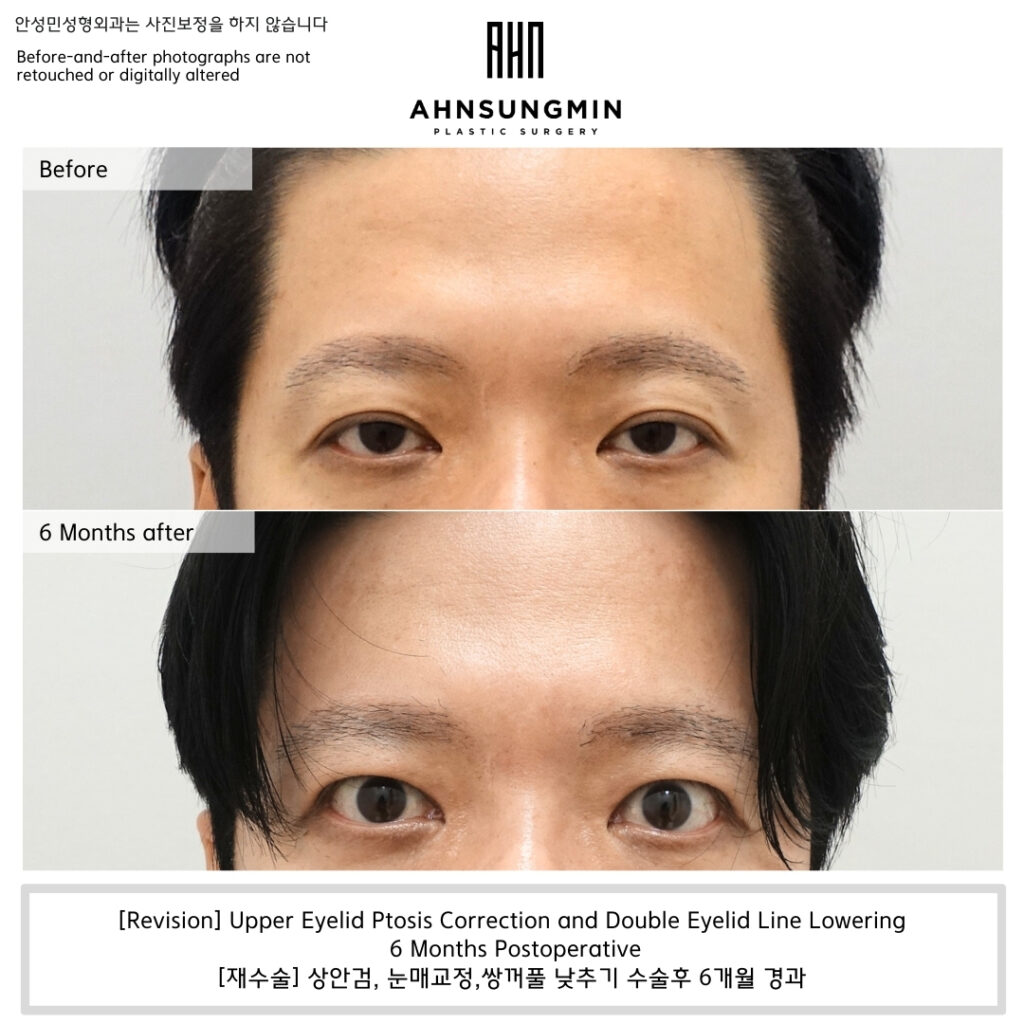
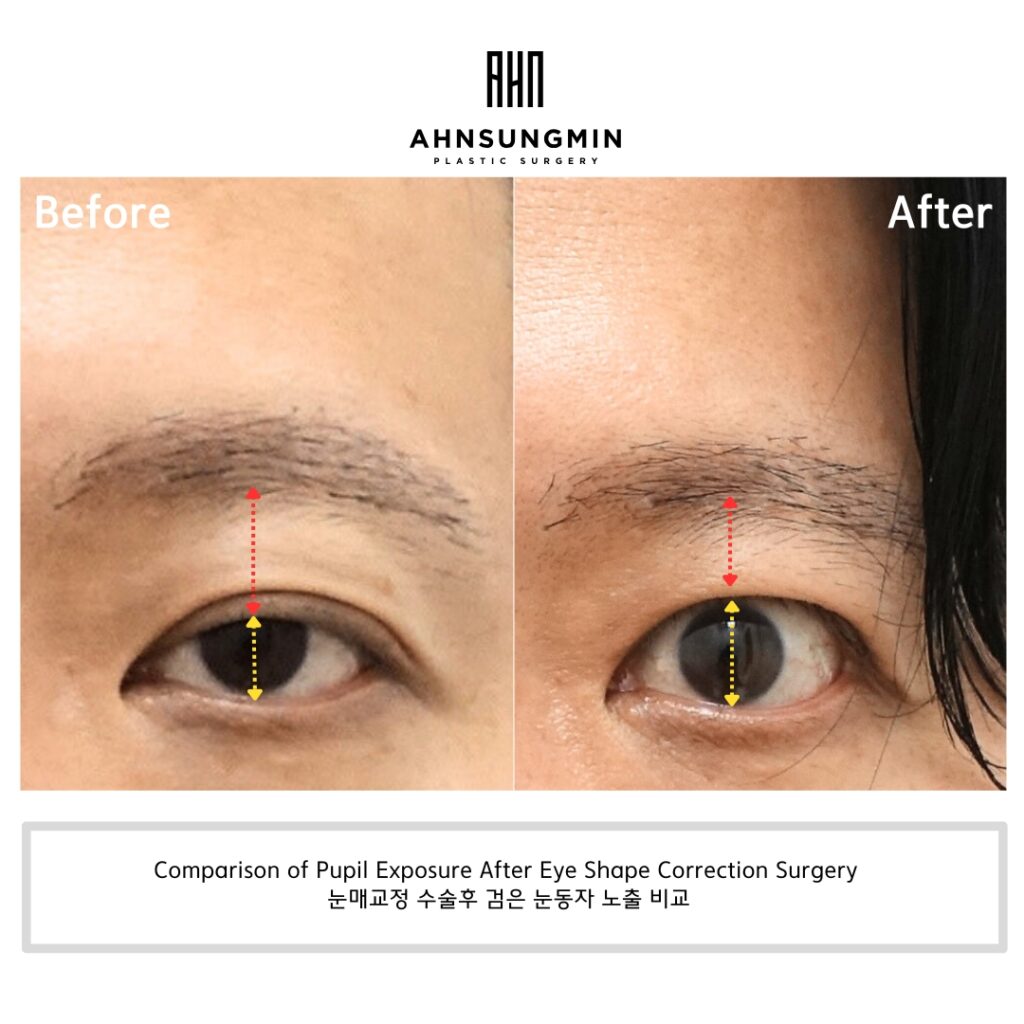
Comparison of pupil exposure after eye shape correction, demonstrating improved eye opening without compensatory muscle use.
Frequently Asked Questions
1. Can a High Fold Be Caused by Ptosis?
Yes.
In many patients, unstable eyelid opening and compensatory muscle use may gradually make the crease appear thicker or higher over time.
2. Why Is Lowering the Crease Alone Sometimes Not Enough?
If underlying ptosis is not corrected, the eyelid may continue relying on compensatory forces during eye opening, increasing the risk of persistent heaviness or recurrence.
3. Does Ptosis Correction Always Make the Eyes Look Bigger?
No.
The goal is not exaggerated enlargement, but restoring more stable and balanced eyelid opening.
4. Can Ptosis and High Fold Problems Exist Together?
Yes.
In many revision cases, functional ptosis and high fold imbalance coexist and must be evaluated together before surgery.
Seeing the Eye as a Whole, Not in Parts
A Clinic Dedicated to Eyelid Revision Surgery in Korea
Ahnsungmin Plastic Surgery
