Before and After
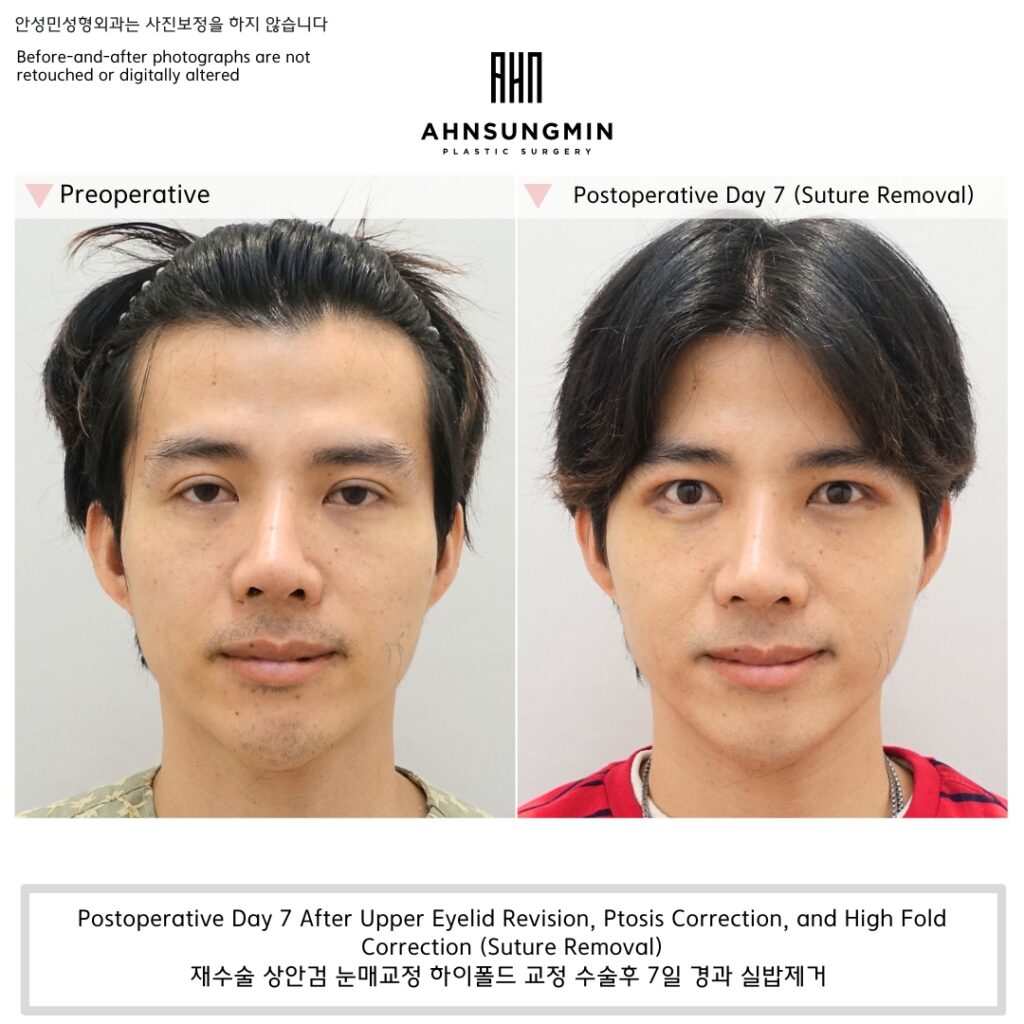
A Functional Problem
At first glance, the issue appears to be a high and deep eyelid crease.
However, the more important problem in this case was not simply the height of the fold, but how the eye was being opened.
Before surgery, the patient showed signs of ptosis. The eyelid did not open fully, and the forehead was actively used to compensate. This pattern of forehead compensation in ptosis patients often creates tension around the eye, making the crease appear thicker, deeper, and more unnatural.
Why We Did Not Focus on Lowering the Fold
Many patients assume that a high crease should be lowered.
But in this case, lowering the crease alone would not have addressed the underlying issue.
The problem was not just the height of the crease.
The eye was being opened with the forehead.
Without correcting ptosis, the heaviness and unnatural appearance would persist regardless of crease position.
Structural Correction
The primary focus of surgery was to correct ptosis and restore natural eyelid function.
By allowing the eye to open properly without compensation, the tension in the forehead was eliminated.
This change directly affected how the crease appeared.
Results
At postoperative day 7, the improvement is already visible.
The eye opens more naturally.
The forehead remains relaxed.
The crease appears softer and less heavy.
The key change is not just aesthetic, but functional.
Surgical Approach
Revision eyelid surgery performed with a focus on structure, restraint, and long-term stability.
→ High Fold Revision Surgery Korea
Seeing the Eye as a Whole, Not in Parts
A Clinic Dedicated to Eyelid Revision Surgery in Korea
Ahnsungmin Plastic Surgery
Request a Consultation for Ptosis and Eyelid Structure Evaluation
