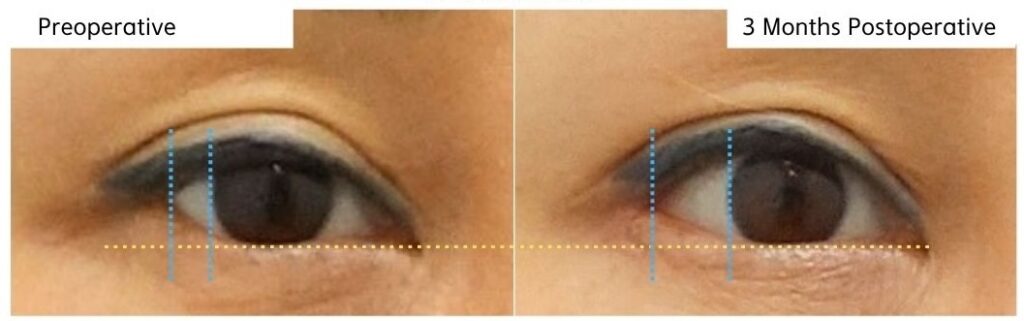
Preoperative Condition
This patient presented with a relatively narrow horizontal eye width, giving the eyes a closed and somewhat constricted appearance.
In addition, the outer corners of the eyes were slightly elevated, a common feature in many Asian patients, which can sometimes create a sharper or more intense impression.
There was also a noticeable asymmetry in the height of the lateral canthus between the two eyes, resulting in an imbalance in overall eye shape.
In cases like this, creating a double eyelid alone does not sufficiently address the underlying structural limitations.
Understanding the Structural Problem
The horizontal width of the eye plays a critical role in the final appearance of the double eyelid.
When the horizontal length is insufficient, the double eyelid line may appear short, interrupted, or unnatural.
An elevated outer corner can further contribute to a smaller and more closed appearance of the eyes, often making the overall impression appear sharper than intended.
In such cases, the goal is not simply to add a fold, but to expand the horizontal dimension and adjust the outer canthal position for better balance.
In cases like this, careful evaluation of eye structure is essential before deciding on surgery.
For a deeper understanding, see:
Eyes That Are Suitable for Revision Surgery—and Those That Are Not
Surgical Approach
The focus of this procedure was not aggressive enlargement, but controlled expansion and structural balance.
During surgery:
– The lateral canthus was extended to increase horizontal eye width
– The elevated outer corner was gently lowered to create a softer eye shape
– The asymmetry between both sides was carefully adjusted toward a more level alignment
– Overcorrection was avoided to maintain long-term stability
Rather than simply making the eyes appear larger, the goal was to create a more open, balanced, and naturally extended eye contour.
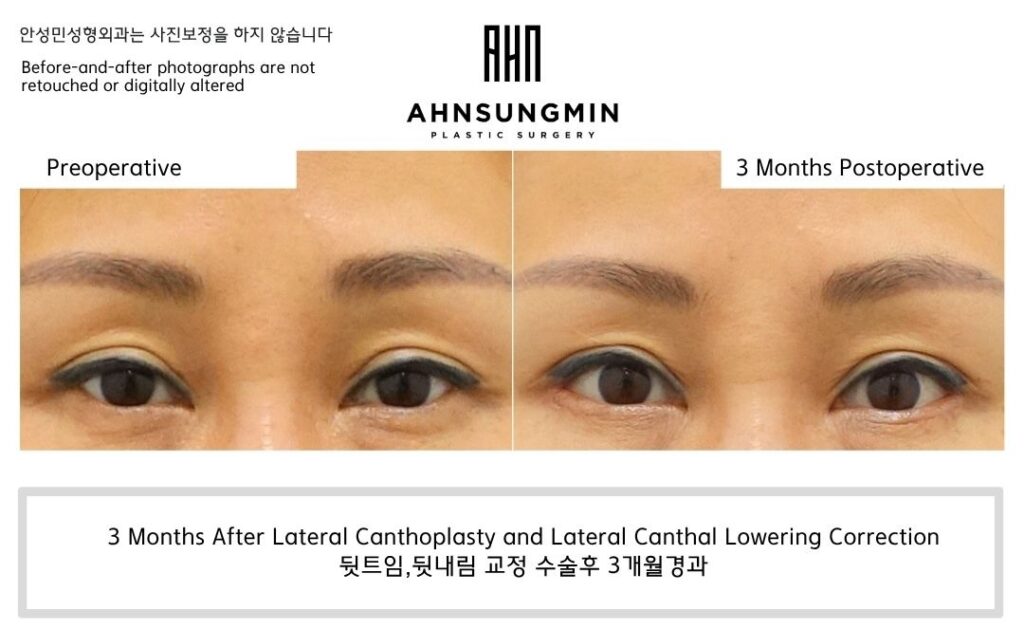
Postoperative Progress
At 3 months postoperative, the horizontal eye width appears more naturally expanded, and the outer corners have been repositioned to create a softer and more harmonious eye shape.
The asymmetry between both sides has improved, resulting in a more balanced overall appearance.
This type of structural correction can also provide a more stable foundation for future double eyelid surgery, allowing for a smoother and more continuous eyelid crease.
Key Consideration
Lateral canthoplasty is not simply a procedure to make the eyes larger.
It involves precise adjustment of eye width, outer canthal position, and bilateral balance.
Excessive extension or lowering can lead to complications, making controlled, anatomy-based planning essential.
Final Thought
In eye shape correction, the goal is not enlargement—but balance.
Online consultation available for international patients
Seeing the Eye as a Whole, Not in Parts
A Clinic Dedicated to Eyelid Revision Surgery in Korea
Ahnsungmin Plastic Surgery
