Before and After
Postoperative Month 3 After Ptosis Correction and Upper Eyelid Fat Repositioning.
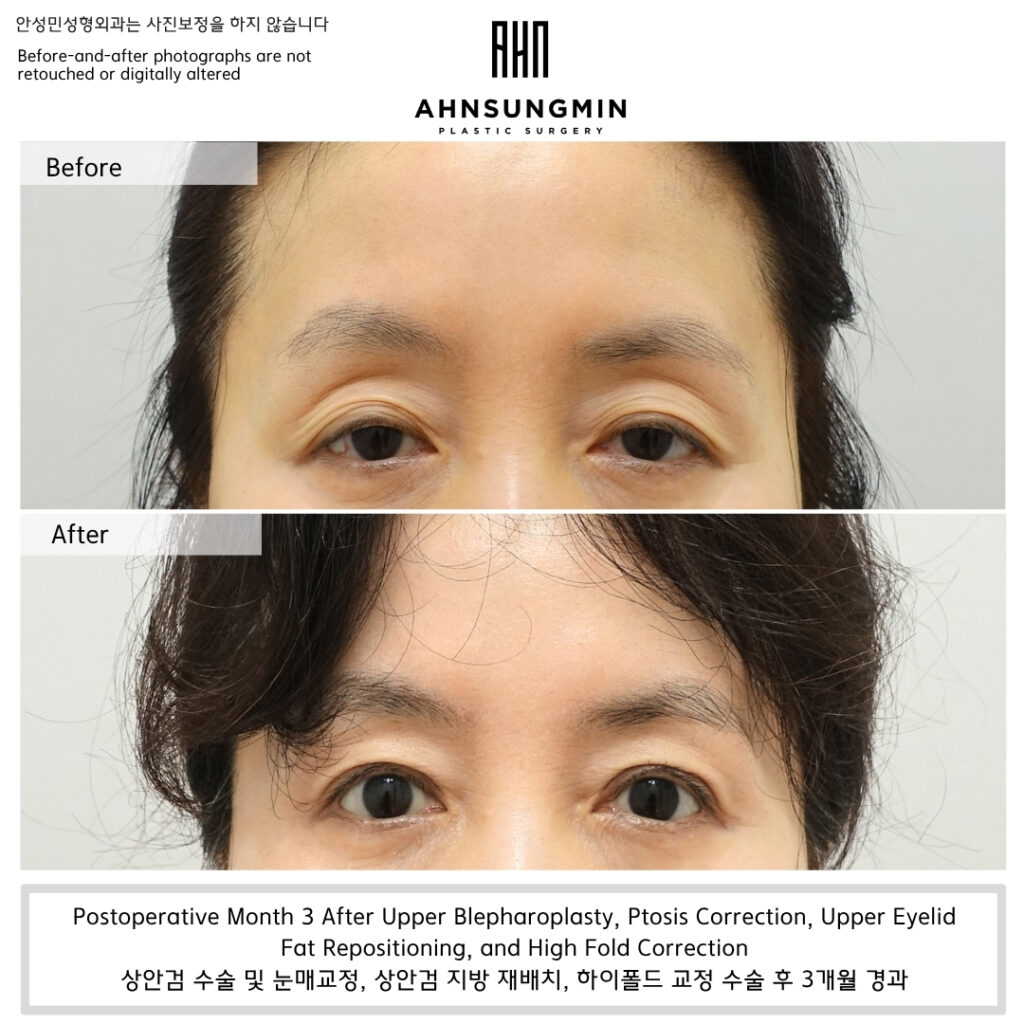
Not all eyelid hollowing is caused by volume loss—this case demonstrates how structural correction can improve hollowing without adding unnecessary volume.
Eyelid hollowing in this case was not simply a matter of volume loss.
Before surgery, the patient showed multiple overlapping folds in the upper eyelid.
These folds were not independent findings, but the result of underlying structural changes.
As ptosis progressed, the patient relied on compensatory effort to open the eyes.
Over time, this caused the eyelid skin to stretch and lose its natural tension.
The repeated strain led to redundancy in the eyelid skin, creating layered folds and a hollowed appearance.
In this context, hollowing was not caused by a lack of fat alone.
It was the result of functional imbalance and structural distortion.
Correction required more than volume restoration.
Ptosis correction was necessary to restore stable eyelid opening and eliminate compensatory strain.
At the same time, redundant skin needed to be addressed to allow the eyelid to return to a more natural contour.
Upper eyelid fat repositioning was also performed to support the hollowed area using existing tissue, rather than adding volume.
Why Ptosis Correction Was Essential
Before surgery, the patient had difficulty opening the eyes comfortably.
To compensate, the forehead and brow muscles were continuously engaged.
This compensatory effort created chronic tension in the upper eyelid and altered its resting position over time.
As a result, the eyelid appeared hollow—even without severe volume loss.
Ptosis correction changed the forces acting on the eyelid.
The first priority was to restore stable eyelid opening.
By correcting ptosis, the need for compensatory effort was reduced, and the distribution of force across the eyelid normalized.
Once excessive tension was relieved,
the eyelid was able to settle into a more natural position.
Structural Support Without Adding Volume
Orbital fat repositioning was used in a limited and supportive role.
Because functional correction alone did not completely resolve the hollowing,
existing orbital fat was carefully mobilized and repositioned to support the upper eyelid.
This approach is based on upper eyelid fat repositioning, which restores volume using existing tissue rather than adding new volume.
No additional fat or filler was introduced.
The goal was not to “fill” the eyelid, but to reinforce structural support within the limits of the patient’s anatomy.
Results at Three Months
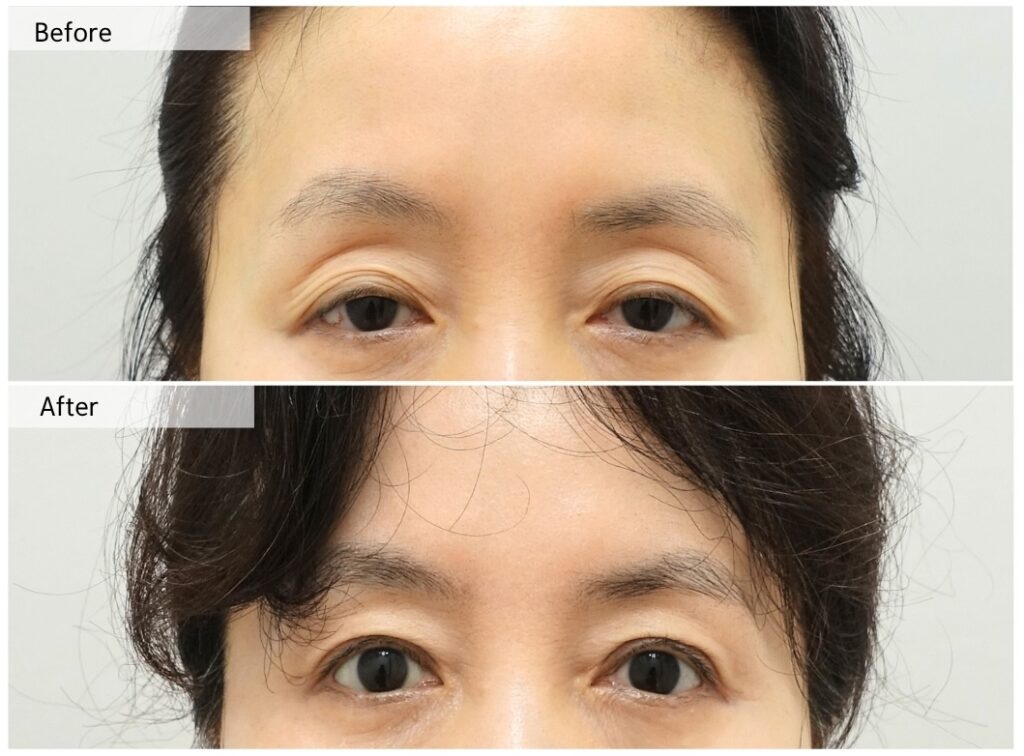
At three months after surgery, eyelid opening remains stable and comfortable.
The upper eyelid contour appears smoother and more balanced than before surgery.
While eyelid hollowing was not completely eliminated,
it improved to a realistic and stable degree without excessive intervention.
This is not the result of adding volume.
It is the result of restoring function and structure.
Insight
Hollow eyelids are not always caused by volume loss. In many cases, functional imbalance and structural changes play a more important role. This is discussed in more detail in our article, Why Your Eyelids Look Hollow—And Why Filler May Not Be the Answer.
High Fold Revision Surgery Korea
Frequently Asked Questions
Is eyelid hollowing always caused by volume loss?
No. Eyelid hollowing is not always caused by fat loss. In many cases, it is related to functional imbalance, such as ptosis, or structural changes in the eyelid.
Can ptosis make the eyelids look hollow?
Yes. Patients with ptosis often use their forehead muscles to compensate, which can stretch the eyelid over time and create a hollow appearance even without significant volume loss.
Is filler always necessary for hollow eyelids?
No. In some cases, hollowing can improve through structural correction rather than adding volume. Treating the underlying cause is often more important than filling the area.
When is fat repositioning used instead of adding volume?
Fat repositioning is used when existing orbital fat can be redistributed to improve contour. This approach avoids introducing new volume and maintains natural tissue balance.
If your eyelids appear hollow, identifying the underlying cause is more important than choosing a treatment.
Understanding whether structural correction is appropriate is the first step.
→ Request a Hollow Eyelid Evaluation
Seeing the Eye as a Whole, Not in Parts
A Clinic Dedicated to Eyelid Revision Surgery in Korea
Ahnsungmin Plastic Surgery
