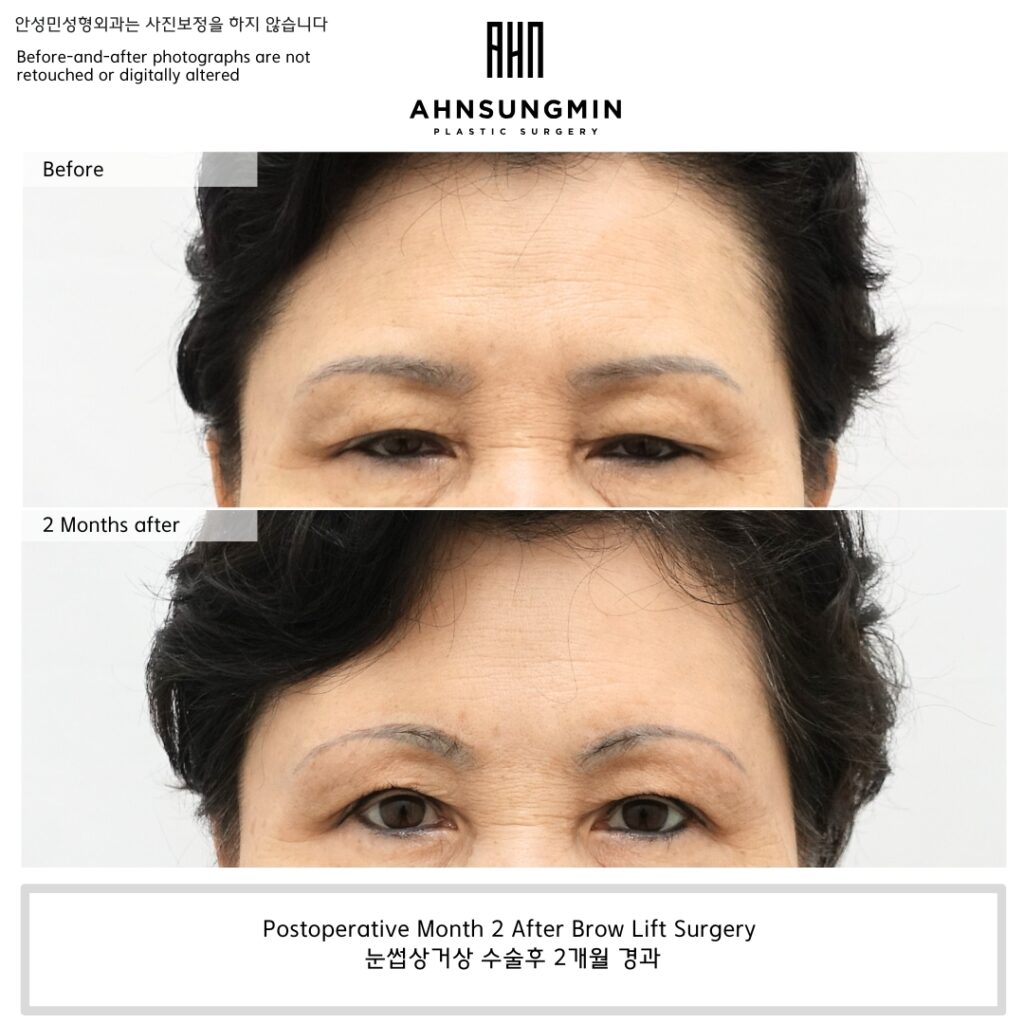
Preoperative Condition Before Supra Brow Lift Surgery Showing Brow Ptosis and Upper Eyelid Heaviness
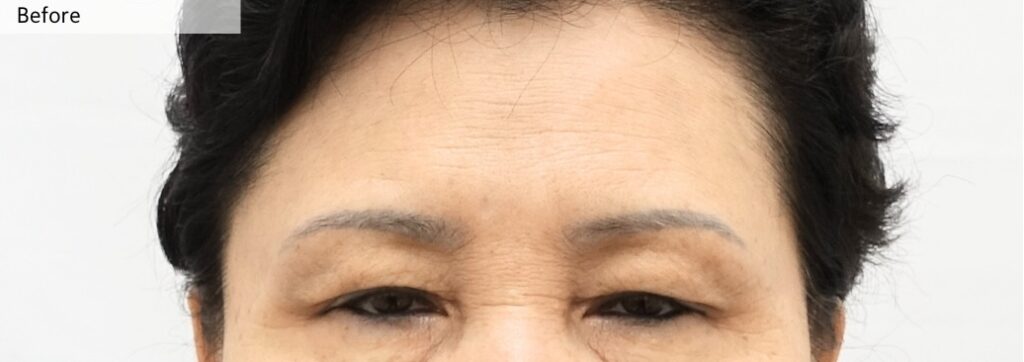
What Changed Was Not the Eyelid—But the Weight Above It.
In many patients, what appears to be excess upper eyelid skin is not truly a problem of the eyelid itself.
It is the result of brow descent gradually increasing the load on the upper eyelid.
This case demonstrates a typical pattern.
Before surgery, the brows had descended, compressing the upper eyelid and creating a heavy, tired appearance.
Rather than removing more eyelid skin,
the decision was made to correct the underlying cause—brow position.
At 2 months postoperatively,
the brow has been elevated to a more appropriate anatomical position,
allowing the upper eyelid to open more naturally without unnecessary tension.
Why This Approach Matters
When the problem originates from brow ptosis,
treating only the eyelid can lead to overcorrection, recurrence, or an unnatural result.
A Supra Brow Lift (Direct Brow Lift) allows for:
-
Direct correction of brow descent
-
Reduction of compensatory forehead muscle use
-
Improved upper eyelid opening without excessive skin removal
-
More stable long-term outcomes
This is not a procedure focused on making the eyes “bigger,”
but on restoring balance and function.
Learn more about our Direct Brow Lift (Supra Brow Lift) approach →
Postoperative Month 2 After Supra Brow Lift Surgery
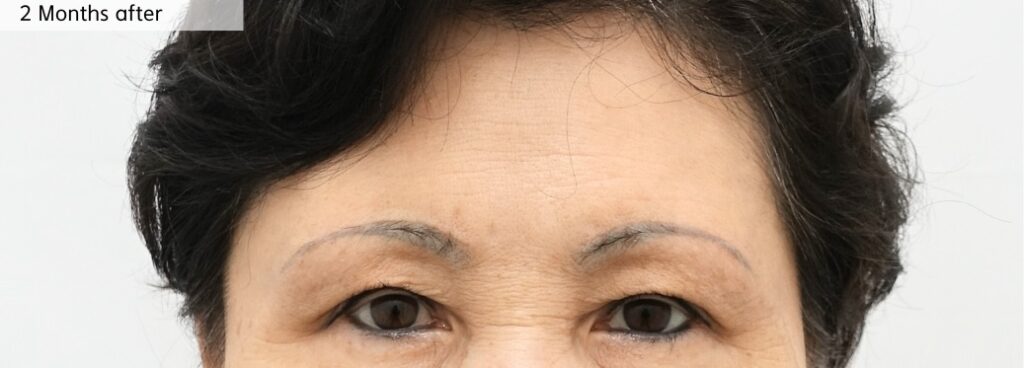
At this stage, swelling has largely stabilized,
and the brow position reflects a more natural contour.
The improvement is not only visible in the eyelid,
but in the overall expression—less strain, more clarity.
Why Direct Brow Lift Should Be Considered First
In cases where brow ptosis is the primary cause of upper eyelid heaviness,
addressing the brow position first is often a more appropriate approach than removing additional eyelid skin.
Excessive skin excision without correcting brow descent can lead to an unnatural appearance,
including a tight or hollow upper eyelid, and may increase the risk of recurrence over time.
By restoring the brow to its anatomical position,
the eyelid can function more naturally without unnecessary tension or overcorrection.
This approach reflects a principle of restraint—
treating the cause rather than overcorrecting the symptom.
A Structural Approach Leads to More Stable Outcomes
A direct brow lift (supra brow lift) is not simply a cosmetic adjustment.
It is a structural correction aimed at restoring balance between the brow and eyelid.
Long-term stability depends on:
-
Accurate identification of the cause
-
Avoidance of excessive tissue removal
-
Preservation of natural anatomy
-
Respect for functional movement
When these principles are followed,
the results are not only more natural but also more sustainable over time.
Why Direct Brow Lift Is Not Just a Cosmetic Choice
Direct brow lift (supra brow lift) surgery is often misunderstood as a simple lifting procedure.
However, its primary role is to correct brow ptosis and reduce the mechanical load placed on the upper eyelid.
When the brow descends, the eyelid must compensate,
often leading to a heavy appearance and functional discomfort.
By restoring the brow position through direct brow lift surgery,
the eyelid can return to a more natural and balanced state.
This is why direct brow lift is not simply about aesthetics,
but about restoring proper anatomical function.
This case demonstrates how direct brow lift surgery can achieve both functional improvement and natural aesthetic balance.
Seeing the Eye as a Whole, Not in Parts
A Clinic Dedicated to Eyelid Revision Surgery in Korea
Ahnsungmin Plastic Surgery
