The question is not which method is better.
Patients often ask whether lower eyelid surgery can be performed without an incision.
The real question, however, is not whether a non-incisional method is possible.
It is whether the eyelid structure requires direct surgical access to restore stability.
Incisional and non-incisional approaches are not competing techniques.
They are different responses to different anatomical problems.
When a non-incisional approach may be considered.
In selected cases, when skin elasticity remains strong and structural support is intact, a non-incisional approach may be reasonable.
These situations are uncommon.
They rely on preserved anatomy rather than structural correction.
A non-incisional procedure does not eliminate surgery—it simply avoids a skin incision.
Why non-incisional surgery is not always safer.
Many patients associate “no incision” with “less risk.”
In lower eyelid surgery, this assumption can be misleading.
Limited access means limited control.
Without direct visualization, it becomes more difficult to reposition fat, reinforce support structures, or address deeper instability.
What appears conservative may sometimes leave structural problems unresolved.
Limitations of the transconjunctival non-incisional approach.
In many transconjunctival procedures, access is limited to superficial fat compartments.
Reaching deeper structural layers through this route can be technically restricted.
Without sufficient access to deeper fat planes, true repositioning and stable fixation become difficult.
Underlying structural imbalance may remain, even if short-term improvement is seen.
In some cases, this limitation leads to recurrence and eventually requires revision surgery.
The issue is not the absence of an external incision.
It is the inability to fully reach and control deeper anatomical layers.
The following case illustrates why deeper structural access is sometimes necessary.
Through a transconjunctival route alone, repositioning deeper fat layers and achieving stable fixation can be limited.
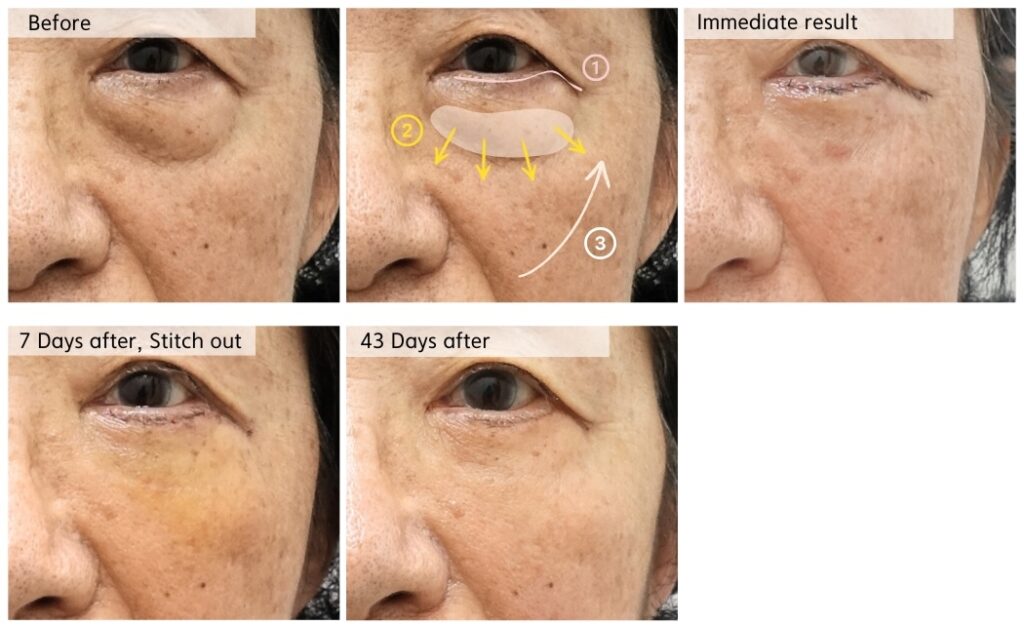
When an incisional approach becomes necessary.
An incisional approach allows direct evaluation of skin, muscle, and ligament support.
When tissue laxity, fat displacement, or structural imbalance is present, direct access becomes essential.
The goal is not to remove more tissue.
It is to restore balance with precision.
Why incision location matters more than incision itself.
Patients often focus on whether a scar exists, while overlooking where and how the incision is placed.
Strategic incision planning redistributes tension and helps maintain long-term stability.
Proper placement can reduce the risk of ectropion and improve healing dynamics.
How we decide.
At Ahnsungmin Plastic Surgery, the decision is never based on trends or preference alone.
We evaluate:
-
Skin elasticity and vertical length
-
Muscle balance and structural support
-
Fat position and tension direction
-
The risk of future revision
The surgical method follows the anatomy—not the other way around.
Our Perspective.
Lower eyelid surgery is not defined by whether an incision is made.
It is defined by whether the structure is respected.
Choosing the right approach is not about minimizing scars.
It is about maximizing long-term stability.
Related Insight:
What We Consider Before Touching the Lower Eyelid
Seeing the Eye as a Whole, Not in Parts
A Clinic Dedicated to Eyelid Revision Surgery in Korea
Ahnsungmin Plastic Surgery
