A Common Pattern Observed in Patients With Ptosis.
Patients with ptosis tend to share a common behavioral pattern.
When opening their eyes, they lift the forehead rather than relying on the eyelids themselves.
Because the eye-opening muscle does not function sufficiently, the forehead muscle is used instead to secure the visual field. This compensatory mechanism develops over time and becomes habitual. As a result, most patients are not aware that they are using their forehead to open their eyes.
The Original Eye Revealed When Compensation Is No Longer Possible.
When the forehead muscle can no longer participate in eye opening, the true condition of the eye becomes visible. This is frequently observed in patients who receive forehead Botox to reduce forehead wrinkles.
Patients who had previously relied on forehead elevation to secure their vision often report that their eyes feel heavier after Botox. As the forehead descends, the eyes may feel swollen, and opening the eyes becomes more difficult.
This change is not the result of a new problem caused by Botox.
Rather, it reflects the original eye condition that had been concealed by long-standing compensatory muscle use.
How Ptosis Can Be Evaluated.
Ptosis can be assessed relatively simply by evaluating the degree of black pupil exposure.
When the eyes are opened naturally without using the forehead, the normal range is considered to be when the upper eyelid covers approximately 2 mm of the pupil.
If the pupil is covered more than this amount, ptosis can be suspected.
Even in such cases, if there is no significant discomfort in daily life, the condition may not represent a major functional issue. However, aesthetically, the eyes often appear sleepy or fatigued.
When Surgery Becomes Necessary.
When more than half of the pupil is covered, patients tend to rely on stronger compensatory behaviors to maintain their visual field. This may include persistent forehead elevation or unconscious chin lifting.
As these compensatory patterns continue, unnecessary tension accumulates throughout the face. It is not uncommon for deep forehead wrinkles to develop even at a young age.
At this stage, the issue can no longer be considered a matter of appearance alone.
Eye shape correction becomes necessary—not to enlarge the eyes, but to restore normal eye-opening function and eliminate compensatory mechanisms.
Before-and-After Comparison of Eye Shape Correction.
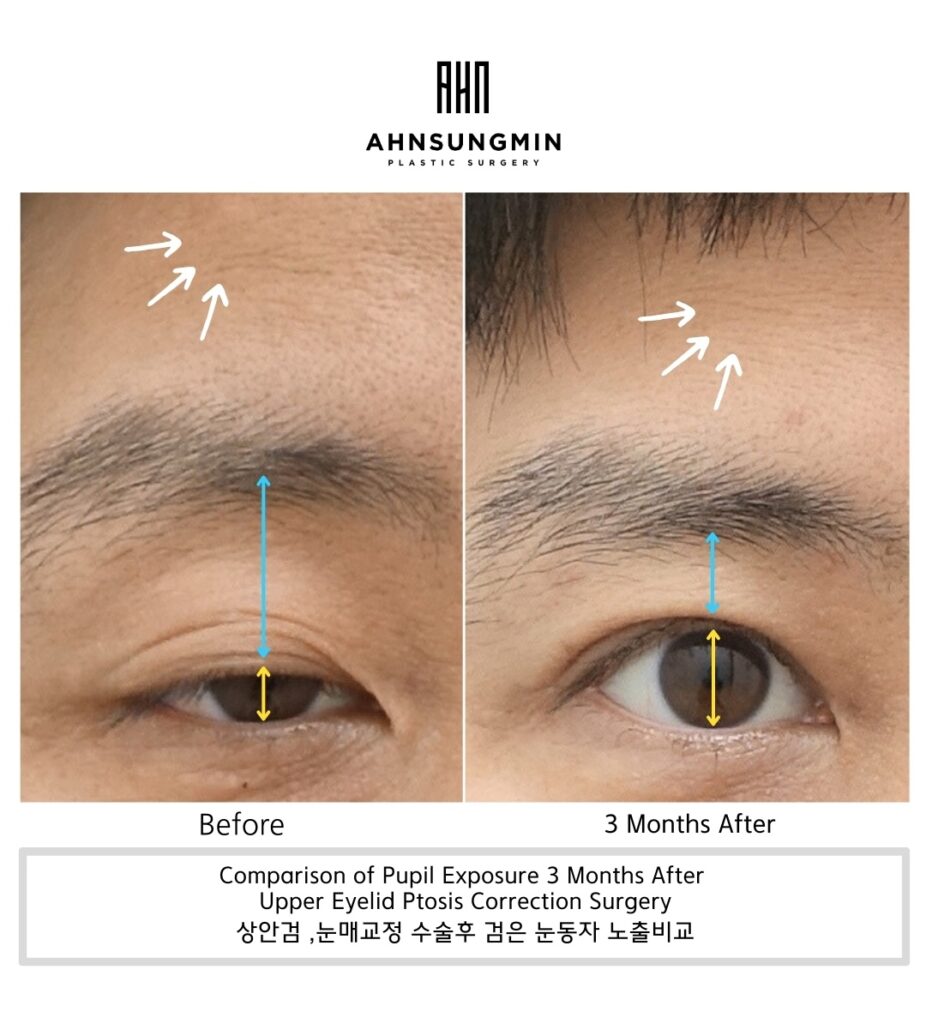
The following images compare pupil exposure before surgery and at 3 months after upper eyelid ptosis correction.
The comparison highlights improved pupil exposure with reduced reliance on forehead compensation. These changes do not represent an attempt to make the eyes appear larger. They demonstrate that the compensatory muscles previously required for eye opening are no longer needed.
Seeing the Eye as a Whole, Not in Parts
A Clinic Dedicated to Eyelid Revision Surgery in Korea
Ahnsungmin Plastic Surgery
