High fold correction must be considered in relation to ptosis surgery, as high fold eyelids are often driven by functional imbalance.
As discussed in our previous post on the structural causes of high folds,
high fold correction is closely related to ptosis surgery.
Why High Folds Form—and How They Should Be Corrected
High fold correction is not a single, uniform procedure.
Before deciding how to correct a high fold,
there are two critical factors that must always be evaluated together.
1. Restoring comfortable eyelid opening through ptosis correction.
One of the most common reasons high folds persist or worsen
is compensatory effort caused by insufficient eyelid opening.
When ptosis is not adequately addressed,
the eye continues to rely on excessive muscular effort to open.
Over time, this force repeatedly pulls the crease upward,
making the fold thicker and more fixed.
In such cases,
lowering the crease alone does not solve the problem.
The fold often returns to its previous position or becomes unstable.
For this reason,
the first priority in high fold correction is ensuring
that the eye can open comfortably without excessive effort.
This mechanism was explained in detail in our previous post on ptosis-related mechanisms.
Why Ptosis Correction Should Be Considered Before Revision Surgery
In many of these cases,
this excessive upward tension does not only elevate the crease.
It also contributes to a hollowed appearance of the upper eyelid.
Over time, the combination of high fold fixation and volume deficiency
can create a sharper, more skeletonized contour,
which is often mistaken as a separate aesthetic issue.
In reality, high fold and hollow eyelids
are frequently part of the same structural problem.
2. Lowering the crease at the level of the eyelid skin.
Not all high folds are driven purely by functional imbalance.
In some cases, even when ptosis is mild or adequately corrected,
the crease remains excessively high due to the existing skin and fixation pattern.
At this stage,
the key question is not how to lower the fold,
but where the original crease is positioned.
(Example of an excessively high preexisting crease)
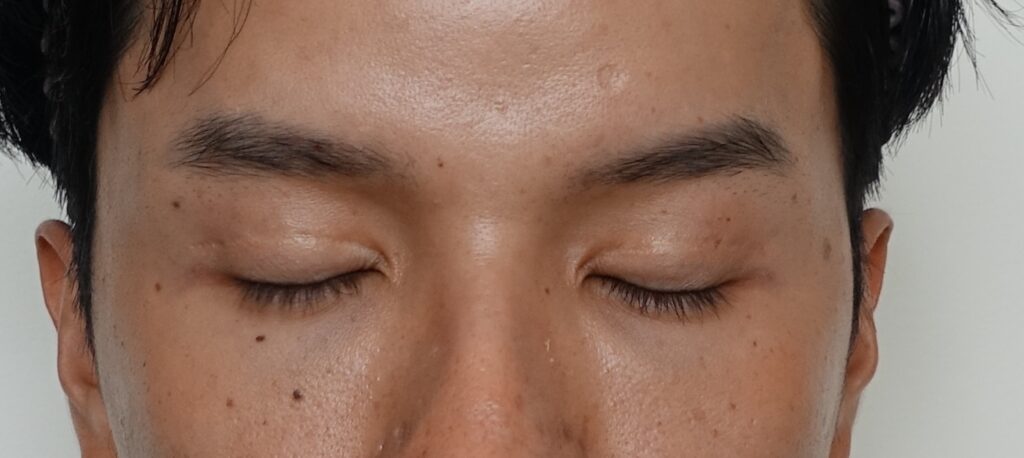
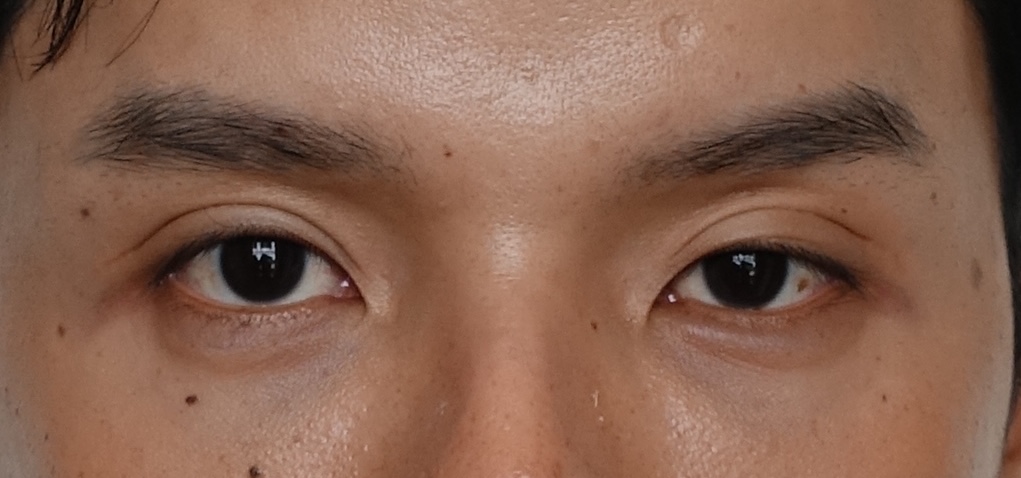
When the original crease is positioned very high,
lowering it becomes technically demanding.
In theory,
excising the existing crease and redefining the fold
is often the cleanest and most effective approach.
However, when the crease is fixed too high,
there may be insufficient skin to safely excise it.
Simply releasing the crease and leaving it in place
can result in visible scarring or the formation of multiple folds.
Scarring must be discussed realistically.
As a plastic surgeon,
every effort is made to minimize scarring.
However, it is important to understand that
once a scar has formed,
it cannot simply return to normal skin.
This reality must be clearly understood
before proceeding with high fold correction.
One of the most common challenges in high fold revision
is that the original crease has been fixed too aggressively.
Even after correction,
the tissue often attempts to return to its previous position,
leading to unstable folds or the appearance of double creases.
Eyelid volume is another critical variable.
When eyelid fat is insufficient,
the eyelid may lack the natural weight
needed to settle into a stable position.
Instead of gently draping downward,
the eyelid can roll upward,
making high fold correction even more difficult.
In such cases,
results tend to be less predictable
and require particularly careful judgment.
This is why, in certain cases,
volume restoration must be considered together with fold correction.
Without addressing volume deficiency,
even a well-positioned crease may appear unstable or overly sharp.
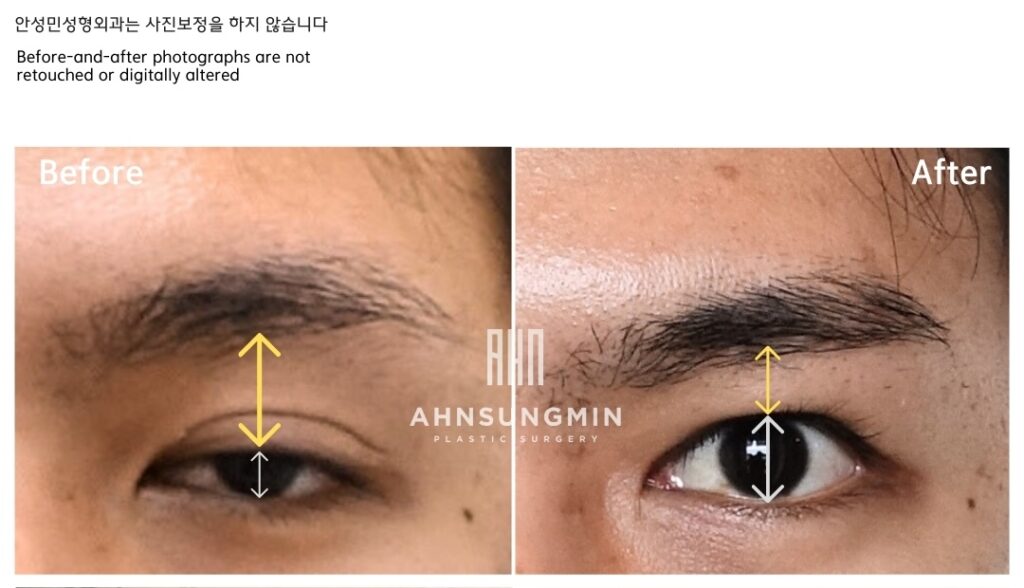
In high fold correction, identifying the cause is everything.
High fold correction is not defined by the technique used.
It is defined by
why the fold became high,
what forces are acting on the eyelid,
and what condition the tissue is truly in.
When these factors are not accurately identified,
high fold correction often leads to another revision.
For this reason,
in high fold correction,
accurate cause analysis is not optional.
It is essential.
Frequently Asked Questions
1. Why do high fold eyelids often return after correction?
High folds often return when the underlying cause—such as ptosis or excessive muscular tension—is not addressed. Simply lowering the crease without correcting the functional imbalance allows the same forces to persist.
2. Is high fold correction only about lowering the crease?
No. High fold correction is not defined by crease position alone. It requires understanding why the fold became elevated, including functional and structural factors.
3. How are high fold and hollow eyelids related?
High fold and hollow eyelids are often part of the same structural process. Excessive upward tension can both elevate the crease and create a hollowed appearance over time.
4. Why are some high fold corrections unstable?
When the original crease is strongly fixed or when eyelid volume is insufficient, the tissue may resist repositioning. This can lead to recurrence or multiple folds.
5. Can high fold correction be performed in all cases?
No. The condition of the tissue, previous surgery, and skin availability must be carefully evaluated. In some cases, limitations must be clearly discussed before surgery.
Insight
Why High Folds Form—and How They Should Be Corrected
Understanding the structural and functional causes behind high fold eyelids.
Why Lowering the Fold Alone Often Fails
Why crease repositioning without addressing underlying forces leads to unstable or recurrent results.
How Functional Imbalance Influences Eyelid Crease Position
The role of excessive muscular tension and incomplete eyelid opening in the formation of high folds.
Why Eyelid Volume Matters in High Fold Correction
How volume deficiency contributes to instability and affects long-term crease positioning.
When High Fold and Hollow Eyelids Are Part of the Same Problem
Understanding how upward tension and structural changes can create both high folds and hollow appearance.
→ Request a High Fold Correction Evaluation
Seeing the Eye as a Whole, Not in Parts
A Clinic Dedicated to Eyelid Revision Surgery in Korea
Ahnsungmin Plastic Surgery
