What Is a High Fold?
A high fold refers to a double eyelid crease that has become fixed at an excessively high position.
While some individuals are born with naturally high creases, the majority of problematic high folds encountered in clinical practice are acquired—most often following prior eyelid surgery.
In these cases, the issue cannot be approached as a simple design concern.
Revision becomes necessary not because the crease is high, but because the reason why it became high must first be understood.
High Folds Are Not a Single Problem.
When a crease is positioned too high simply due to surgical fixation,
releasing the existing fold and repositioning it lower may be sufficient to achieve a stable result.
However, when the high fold is the result of compensatory mechanisms related to ptosis,
simple crease adjustment alone is inadequate.
In such cases, a functional approach—including ptosis correction—is required.
In reality, a significant proportion of revision patients fall into this second category.
The Relationship Between Ptosis and High Folds.
When ptosis is present, patients often rely on the forehead muscles to open their eyes.
As this compensation is repeated over time, the eyelid crease is gradually pulled upward, becoming thicker and increasingly fixed in a high position.
This process is not the result of intentional design.
It is the consequence of how the eye is being opened.
When this pattern persists,
the eyelids remain under constant strain,
forehead wrinkles develop,
and ocular fatigue and discomfort become chronic complaints.
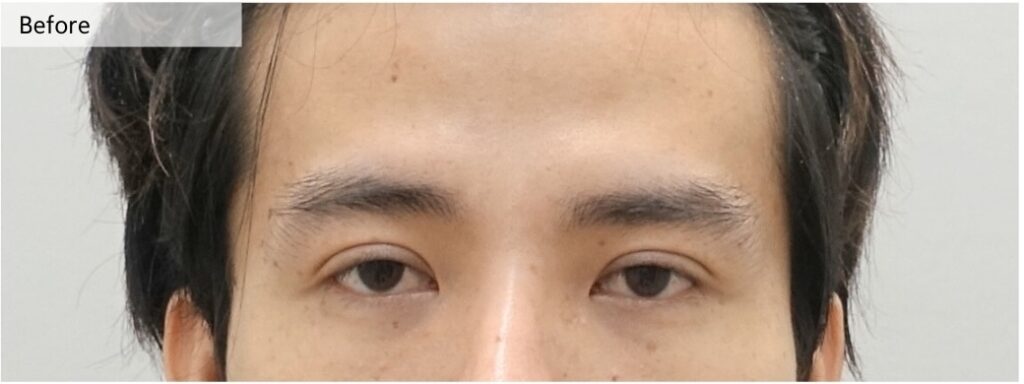
A High Fold Does Not Make the Eyes Look Larger.
Some female patients may request a higher crease based on personal preference.
In contrast, most male patients find high folds undesirable and unnatural.
One of the most common misconceptions is that a higher crease makes the eyes appear larger.
This is not true.
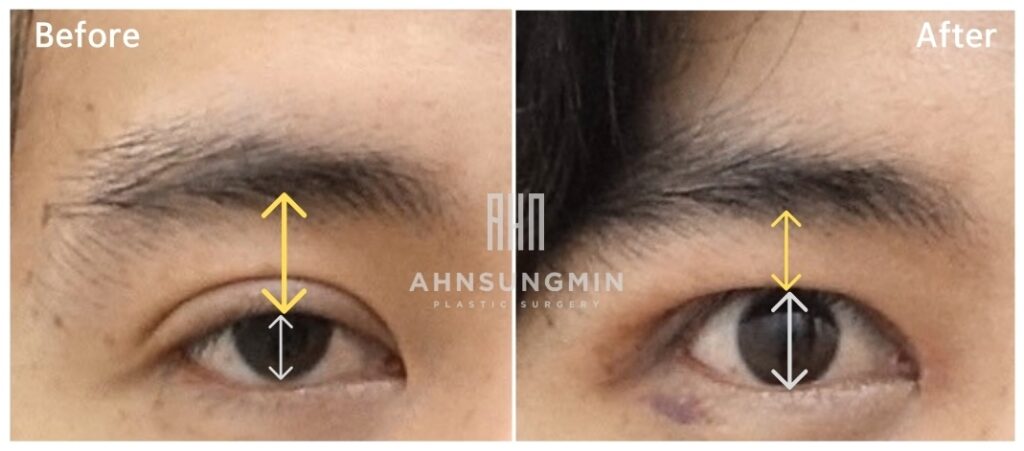
The perceived size of the eye is not determined by crease height,
but by how much of the pupil is exposed.
The severity of ptosis can be assessed by the degree to which the upper eyelid covers the pupil.
The more significant the ptosis, the more the pupil is obscured.
When a double eyelid crease is created under these conditions,
the fold often lacks stability and inevitably becomes thick and heavy.
In patients with thick skin or abundant eyelid fat,
this may result in the so-called “sausage-like” appearance that many revision patients describe.
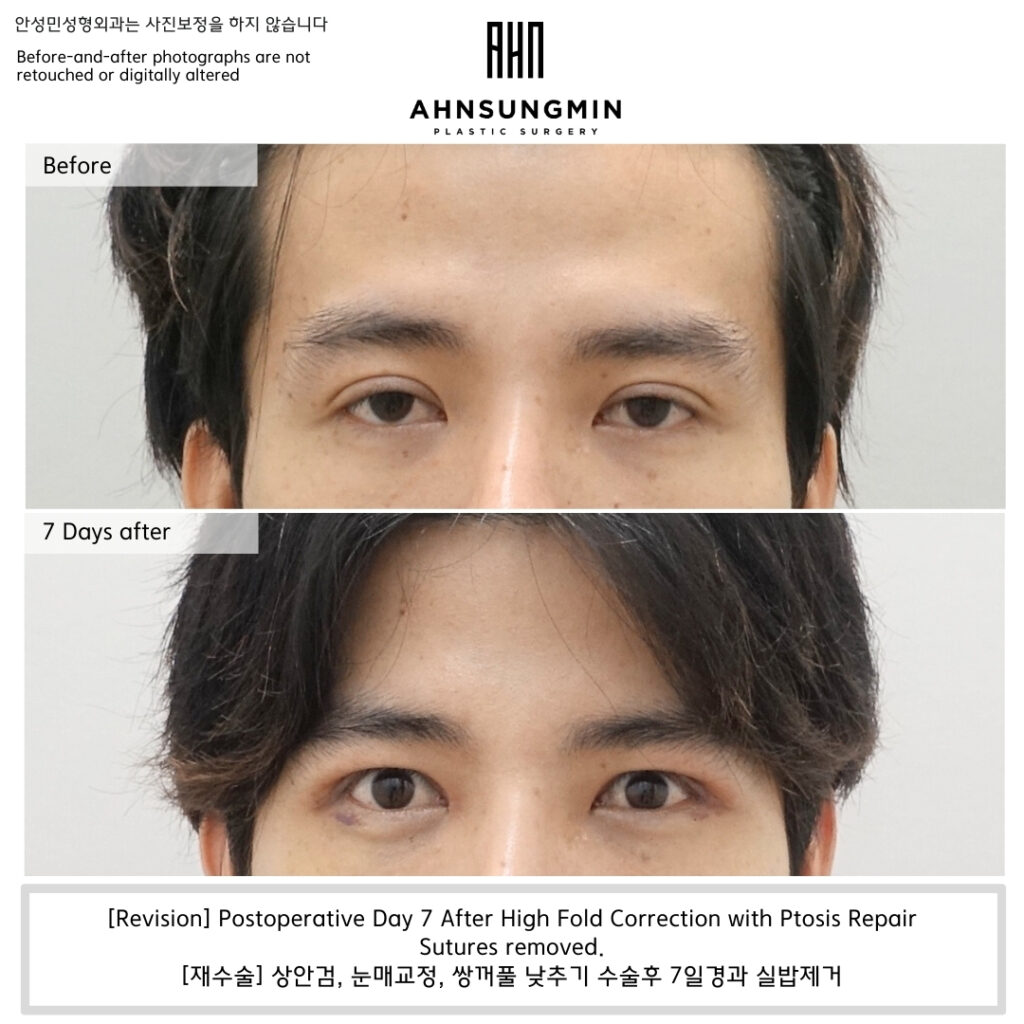
Sutures removed.
Why Patients Seek Revision.
Many patients initially assume the appearance is due to postoperative swelling.
However, when months pass without improvement—and the eyelids feel increasingly heavy and uncomfortable—concern grows.
For this reason, the decision to pursue revision surgery is far more common than expected.
Yet the core issue is not the crease itself.
It lies in the mechanics and balance of eyelid opening.
Many patients seeking correction for high fold eyelids eventually require revision eyelid surgery when structural imbalance, ptosis-related tension, or unstable fixation are present.
Learn more about our structural approach to revision eyelid surgery in Korea.
Correction Is About Balance, Not Position.
The goal of high fold correction is not to simply lower the crease.
It is to reduce excessive compensatory forces
and restore functional balance to the eyelid.
When this balance is reestablished,
the crease often settles into a more stable and natural position
without aggressive manipulation.
Comparison of Pupil Exposure After Ptosis Correction
High Fold Correction Is Restoration, Not Change.
High fold correction is not performed to make the crease smaller.
It is performed to allow the eyes to open comfortably.
Correction is meaningful only when the underlying cause is clearly identified.
When this is the case, external changes are often unmistakable.
However, these changes are not the result of deliberate aesthetic exaggeration.
They emerge naturally as a consequence of restored structure and function.
Request a High Fold Revision Evaluation
High fold correction should not begin with the question of how low the crease can be made.
The more important question is why the fold became high, unstable, or uncomfortable over time.
At Ahnsungmin Plastic Surgery, revision evaluation focuses on structural balance, ptosis-related compensation, tissue condition, and long-term eyelid stability rather than simple crease adjustment alone.
Online consultation available for international patients
Seeing the Eye as a Whole, Not in Parts
A Clinic Dedicated to Eyelid Revision Surgery in Korea
Ahnsungmin Plastic Surgery
