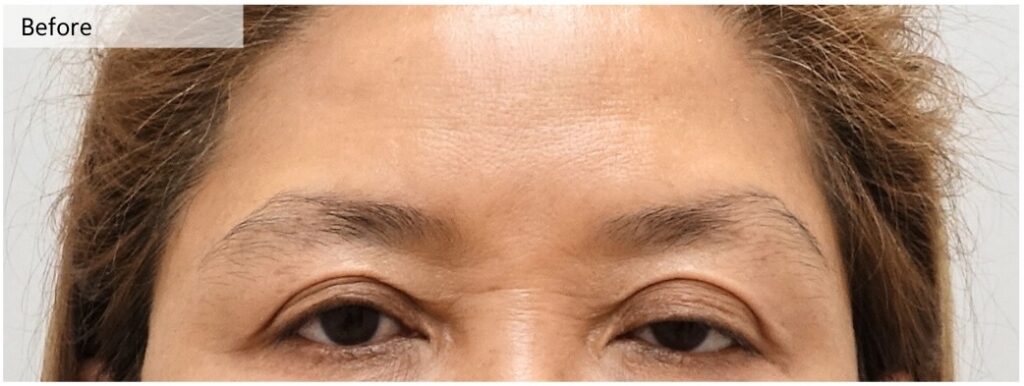
The patient presented after previous ptosis surgery and revision.
The patient came to us following prior ptosis surgery and revision performed elsewhere.
Despite treatment, asymmetry persisted and the result remained unresolved.
Given the surgical history and existing scarring, it was understandable that further correction had been considered difficult.
Our role was to reassess the cause, not accept the conclusion.
Our responsibility was not to accept that assessment at face value,
but to determine whether the underlying problem had been accurately identified.
At first glance, the most prominent feature was a high and thick double eyelid crease.
In revision ptosis cases, however, the crease itself is rarely the primary issue.
Many patients seeking revision eyelid surgery in Korea assume that the visible crease is the main problem. However, successful revision often depends on understanding ptosis imbalance, compensation patterns, and preserved eyelid function rather than crease appearance alone.
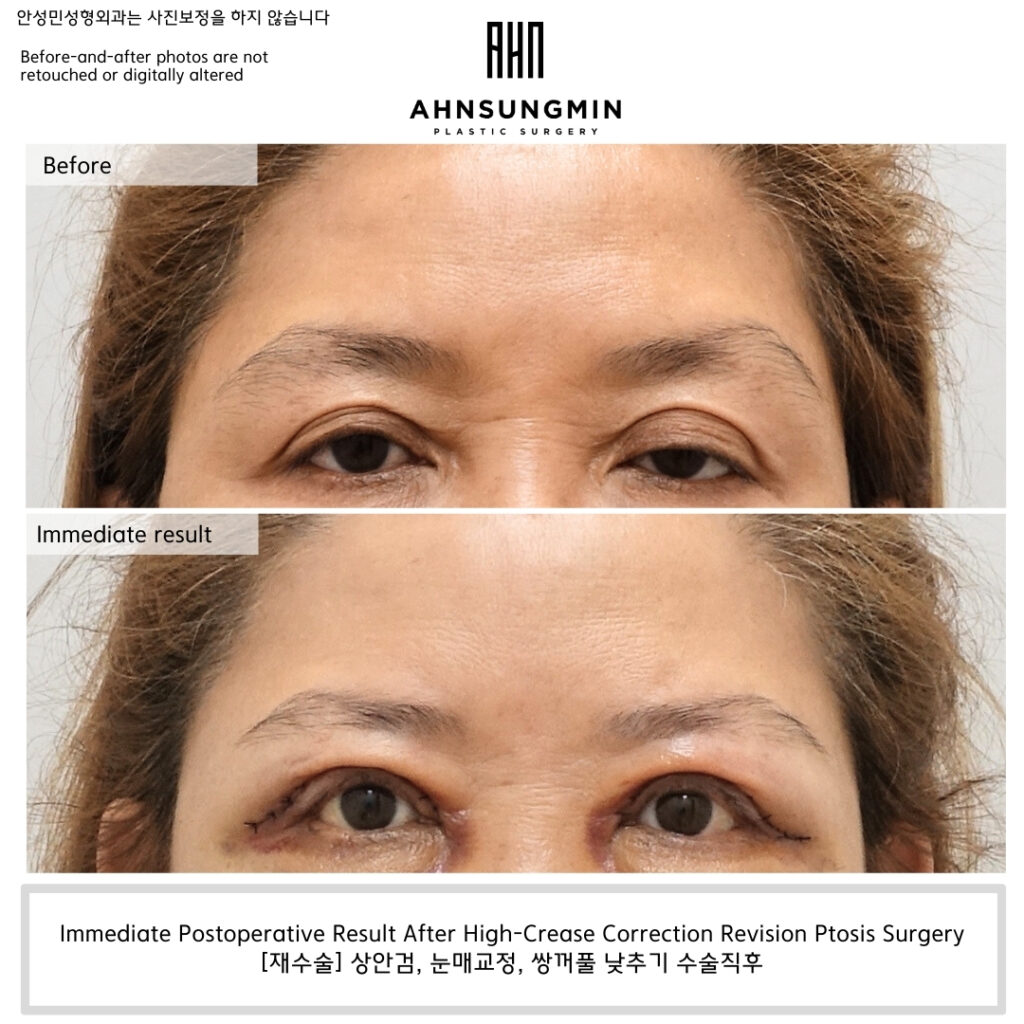
The procedure was performed with a focus on balance and restraint rather than further correction.
The crease reflected compensation, not the cause.
When ptosis is asymmetric, patients often rely on the forehead to lift the eyelids.
Over time, this compensation makes the crease appear higher and thicker than it truly is.
In such cases, the crease is not the cause.
It is the result of how the eye is being opened.
Structural evaluation showed remaining potential.
Evaluation revealed preserved levator function without fixation from severe fibrosis.
The asymmetry originated from unequal ptosis rather than irreversible tissue damage.
This distinction defined the case.
Correction focused on balance, not surface change.
Lowering the crease alone would not have addressed the problem.
Without correcting the ptosis imbalance, compensatory forces would have persisted.
Related Insight:
Why Lowering the Crease Alone Often Fails in Revision Surgery.
Correction was possible by restoring balance to eyelid mechanics,
while avoiding unnecessary intervention.
The outcome reflected stability.
Postoperatively, eyelid opening improved and asymmetry was reduced.
As reliance on the forehead diminished, the crease settled into a more stable position over time.
This case was treated not for dramatic change,
but because the cause of the problem was clearly identifiable.
Successful revision ptosis surgery depends not only on visible correction, but on determining whether functional balance and structural potential still remain within the eyelid.
Successful revision ptosis surgery depends not only on visible correction, but on determining whether functional balance and structural potential still remain within the eyelid.
Related Insight:
Why Lowering the Crease Alone Often Fails in Revision Surgery.
Frequently Asked Questions About Revision Ptosis Surgery
Why does a high fold often return after revision surgery?
In many cases, the issue is not simply the crease itself. If ptosis imbalance and compensatory forehead use are not corrected, the fold may gradually appear high and thick again over time.
Can revision ptosis surgery still be possible after previous failed surgery?
Some revision cases remain treatable if important eyelid structures and levator function are still preserved. The key is determining whether the problem is functional imbalance or irreversible structural damage.
Why is the crease not always the primary problem?
A high or thick crease is often the result of compensation rather than the original cause. When the eyes struggle to open naturally, increased forehead tension can make the crease appear deeper and higher.
What is evaluated before revision ptosis surgery?
Evaluation includes eyelid opening strength, levator function, asymmetry, scar condition, forehead compensation, and structural stability rather than crease appearance alone.
What makes some revision ptosis cases difficult to treat?
Severe fibrosis, tissue fixation, repeated surgeries, and reduced eyelid mobility can limit surgical options. However, some cases may still improve if functional structures remain intact.
Request a Revision Ptosis Evaluation
If your eyelids still feel heavy, uneven, or unstable after previous ptosis surgery, the problem may involve structural imbalance rather than crease appearance alone.
At Ahnsungmin Plastic Surgery, revision ptosis evaluation focuses on eyelid function, compensation patterns, scar condition, and long-term structural stability before additional correction is considered.
Seeing the Eye as a Whole, Not in Parts
A Clinic Dedicated to Eyelid Revision Surgery in Korea
Ahnsungmin Plastic Surgery
