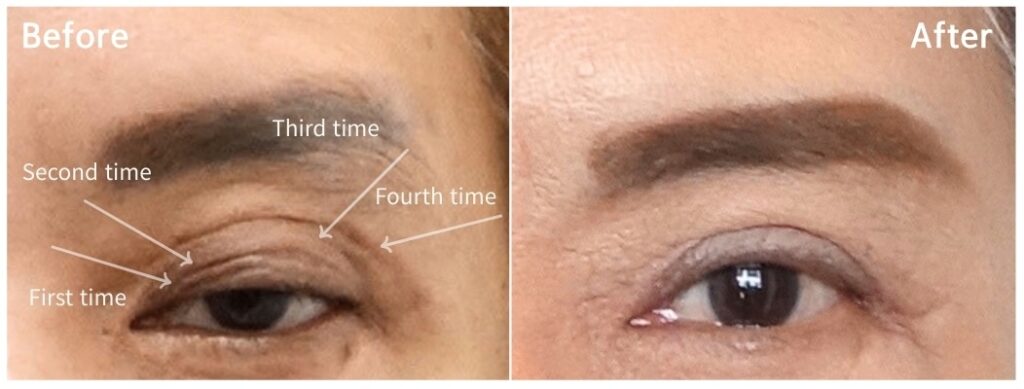
The patient had undergone four or more eyelid surgeries.
This patient had a long surgical history.
The upper eyelid showed multiple residual crease scars—each one a record of a previous attempt to “fix the line.” The scars were not subtle. They remained clearly visible even at rest, indicating repeated structural disruption rather than incomplete healing.
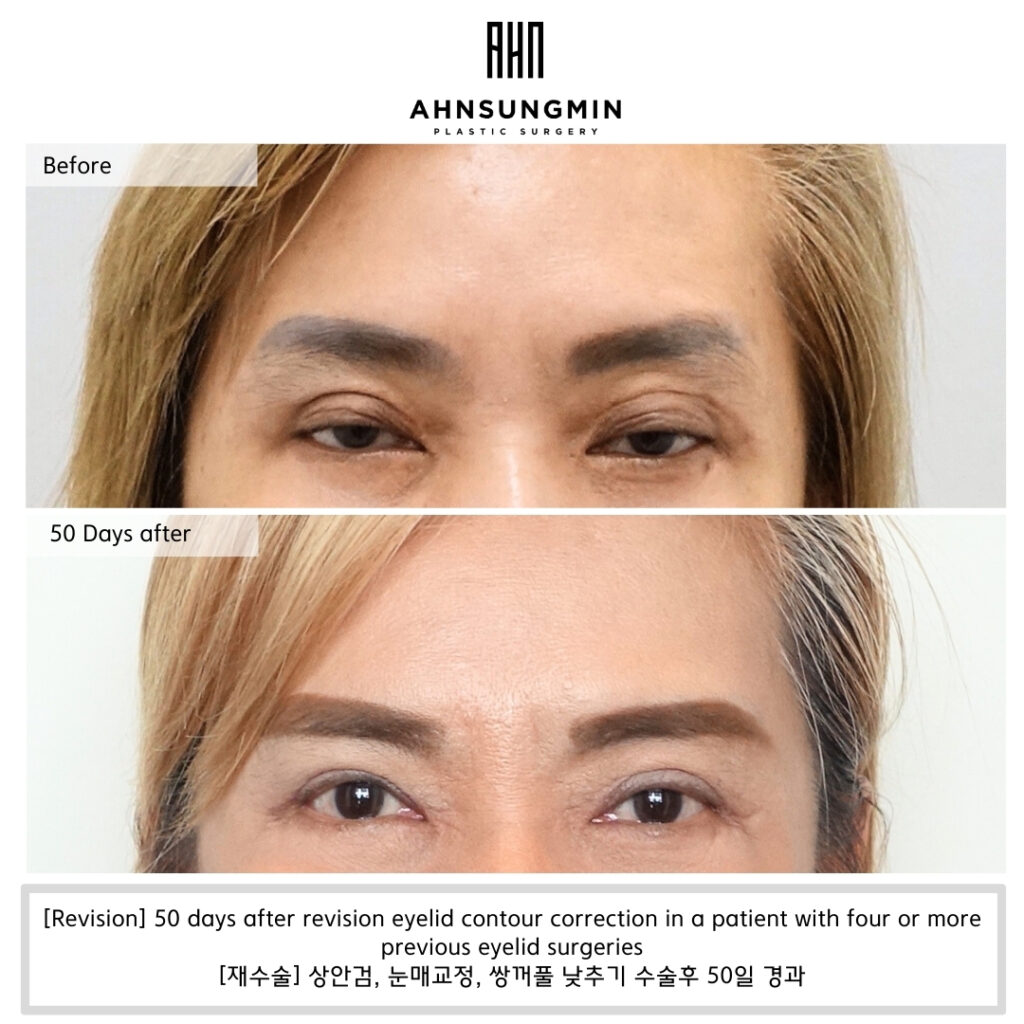
The problem was never the line itself.
Every previous surgery had focused on creating or adjusting a crease.
What had never been adequately addressed was the underlying eyelid mechanics. The ptosis correction was incomplete, so the eyelid continued to depend on an artificial crease for elevation. Each new line was added on top of an unresolved problem.
That is why the lines never disappeared.
The patient requested a higher, more defined crease.
This request was understandable.
When multiple scars already exist, patients often believe that making the line “bigger” will finally conceal the irregularities. However, in this eyelid, increasing the crease height would have required further tension, more fixation points, and additional scarring.
That choice would not have been corrective. It would have been accumulative.
We chose to erase, not to add.
Our decision was to remove the layered creases and reorganize them into a single, lower line.
This was not done to make the eye smaller. It was done to allow the eyelid to move as one structure again.
By lowering the crease and correcting the contour, the eyelid could finally open without relying on excessive scar-based traction.
This was not about preference.
This decision was not a compromise between aesthetics.
It was a structural judgment.
In revision surgery, the question is not how much more can be done, but how much should be undone.
In this case, stability required restraint.
Seeing the Eye as a Whole, Not in Parts
A Clinic Dedicated to Eyelid Revision Surgery in Korea
Ahnsungmin Plastic Surgery
