Ahnsungmin Plastic Surgery Does Not Edit Photos
At Ahnsungmin Plastic Surgery, we never retouch or digitally alter photographs.
All before-and-after images are used exactly as they are, with the full consent of each patient.
Brow Lift Surgery in Patients in Their 60s:
Why the Eyes Feel More Comfortable — Not Just Larger
When patients reach their 60s, one of the most common concerns they express is not necessarily how their eyes look, but how they feel. Many describe a persistent sense of heaviness around the eyes, difficulty keeping their eyes open, or being told they appear tired or sleepy in photographs.
In many cases, this is not solely a problem of excess upper eyelid skin. Rather, it is often related to age-related descent of the eyebrows and forehead tissues, which gradually press downward over the eyes. For these patients, a brow lift can be an appropriate surgical option to consider.
Preoperative Evaluation
Preoperative photograph
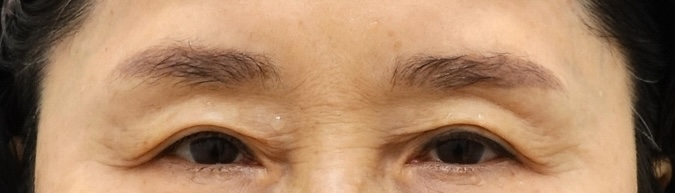
Before surgery, this patient presented with a low eyebrow position and a limited distance between the eyebrows and upper eyelids. This anatomical relationship contributed to a heavy appearance around the eyes and required increased effort to keep the eyes open.
In cases where the brow-to-eye distance is already narrow, excessive removal of upper eyelid skin alone may be insufficient or even counterproductive.
Understanding Age-Related Changes Around the Eyes
As skin elasticity decreases with age, the supporting structures of the forehead and eyebrows weaken. In patients in their 60s, brow descent often becomes more pronounced, placing downward pressure on the upper eyelids.
This can lead to:
-
A reduced visual field
-
Frequent activation of the forehead muscles
-
Deepening forehead lines over time
While upper blepharoplasty may be helpful in selected cases, addressing brow position is often essential for achieving both functional comfort and balanced facial proportions.
Surgical Approach: Brow Lift in Older Patients
A brow lift is performed by making an incision along the upper brow line, allowing repositioning of the descended tissues. In older patients, the goal is not aggressive elevation, but controlled correction that restores comfort and maintains a natural appearance.
Surgical planning considers:
-
Degree of skin laxity
-
Extent of brow descent
-
Left-right asymmetry
-
Muscle function related to eye opening
-
History of previous eyelid or brow procedures
Before-and-After Comparison
Before-and-after comparison following brow lift surgery
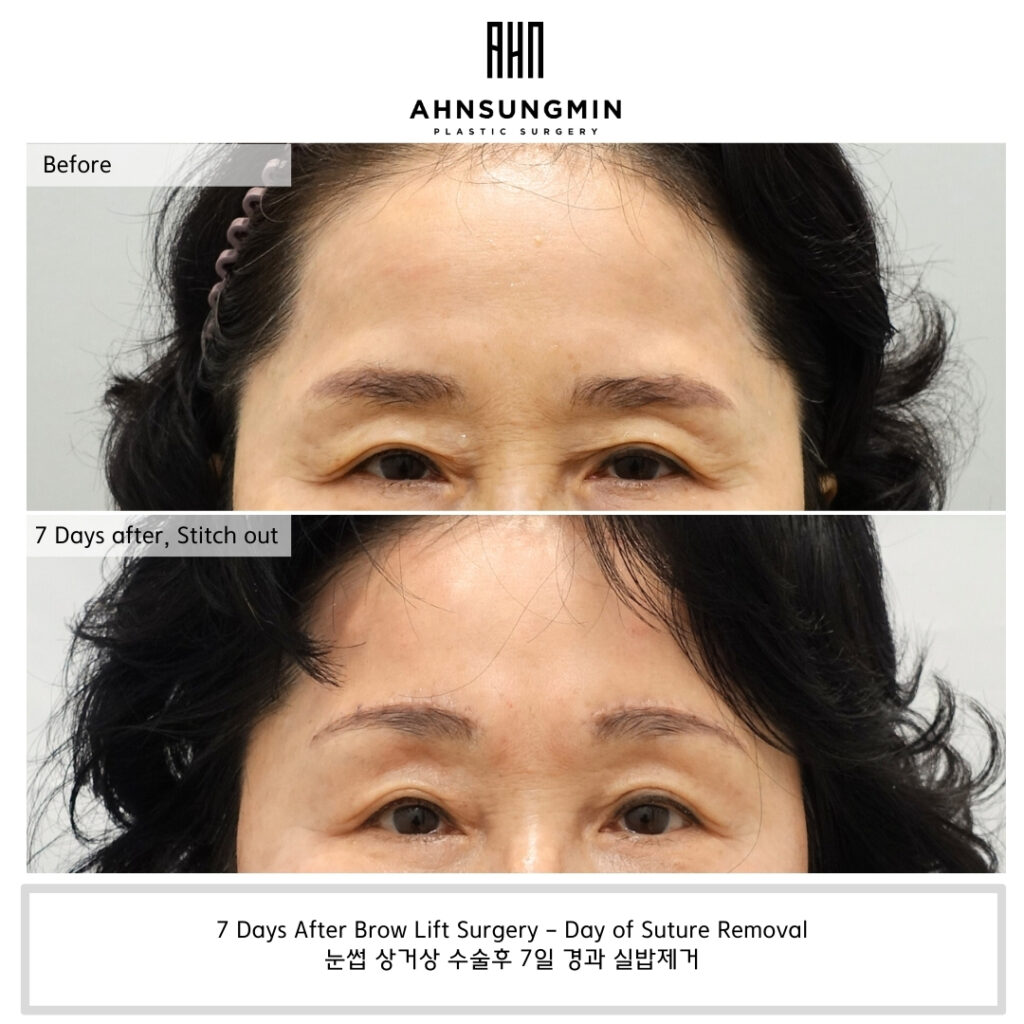
This comparison shows the periocular and forehead region before surgery and at 7 days postoperatively, following suture removal. Although this is not a full-face image, it allows for assessment of eyebrow position and forehead relaxation after surgery.
Compared to the preoperative state, the postoperative image demonstrates an improved eyebrow position and a more relaxed appearance of the upper facial region. At this stage, mild swelling may still be present, and final results continue to evolve over time.
Close-up Comparison of the Eye Region
Close-up comparison of the eye region before and after brow lift surgery
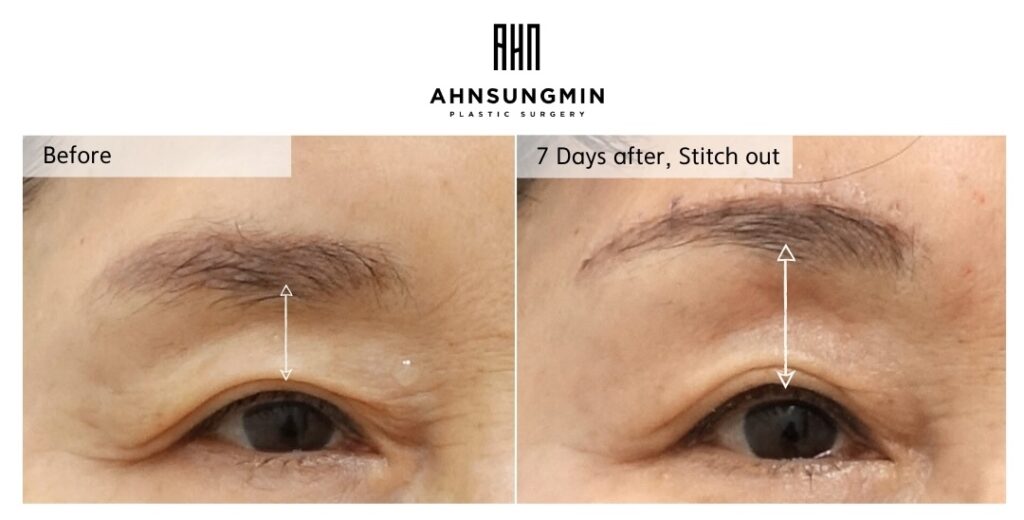
This close-up comparison highlights the change in distance between the eyebrow and the upper eyelid before surgery and at 7 days postoperatively, following suture removal. The arrows indicate the increased vertical space achieved through repositioning of the eyebrow.
An increased brow-to-eye distance reduces downward pressure on the upper eyelid and decreases the need for compensatory forehead muscle activation. Clinically, this change is often associated with improved visual comfort rather than a dramatic alteration in eye size.
At this early postoperative stage, mild swelling may still be present, and further refinement can be expected as healing progresses.
Recovery and Healing
Recovery timelines vary, but generally follow this course:
-
Suture removal at approximately 7 days
-
Reduction of swelling and bruising within 2–3 weeks
-
Gradual stabilization of brow position and expression over 1–3 months
Individual healing rates may differ depending on skin condition and surgical extent.
What Is Most Important in Brow Lift Surgery for Patients in Their 60s
In this age group, brow lift surgery often serves a functional purpose in addition to aesthetic improvement. Excessive elevation can result in an unnatural or startled appearance, making precise diagnosis and conservative surgical planning essential.
Experience with middle-aged and older patients, along with a detailed understanding of brow and forehead anatomy, plays a critical role in achieving balanced results.
Final Thoughts
The outcome of brow lift surgery in patients in their 60s is best described not as making the eyes larger, but as making them feel more comfortable.
For individuals experiencing heaviness or visual discomfort due to brow descent, a personalized evaluation is essential. Careful diagnosis and a restrained surgical approach form the foundation of natural, satisfying outcomes.
Seeing the Eye as a Whole, Not in Parts
A Clinic Dedicated to Eyelid Revision Surgery in Korea
Ahnsungmin Plastic Surgery
