The Question Is Not Where to Remove—But Where to Support.
Many patients visit our clinic believing that lower eyelid surgery is primarily about removing fat or smoothing wrinkles.
However, the true starting point of surgical planning is different.
Before deciding to operate, we first evaluate whether the lower eyelid structure can be stabilized without excessive removal.
Lower eyelid surgery is not about flattening the area like ironing fabric.
It is about restoring balance between support, muscle movement, and volume distribution.
Structural Evaluation Comes Before Any Incision.
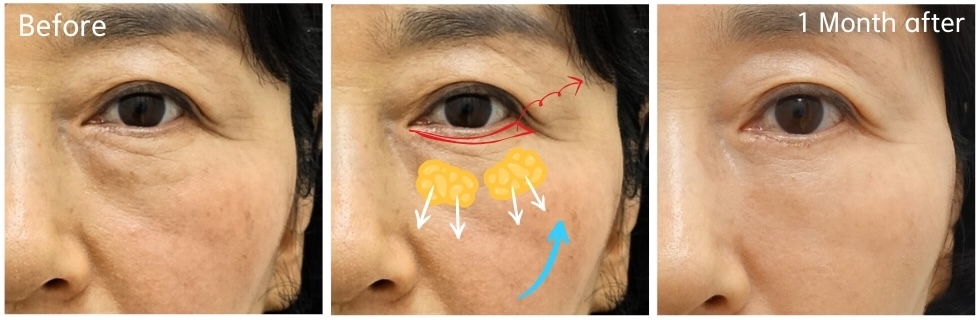
In this case, the lower eyelid showed both protruding fat and visible skin wrinkling.
Rather than removing tissue aggressively, the surgical plan focused on repositioning and structural support.
The diagram illustrates the direction of fat movement and the vectors of support.
The goal was not to eliminate volume but to redistribute it in a way that reduces downward tension.
When surgery begins with removal instead of structure, long-term instability often follows.
Why Fat Repositioning Matters More Than Fat Removal.
Once fat is removed excessively, it does not regenerate.
What remains is often loose skin without internal support—similar to a deflated balloon.
Aging already reduces natural volume over time.
Removing additional fat may create temporary flatness but frequently leads to hollowing and recurrence as surrounding tissues descend.
For this reason, repositioning and fixation were prioritized over removal.
One Month After Surgery: Support Without Overcorrection.
At one month postoperative, the lower eyelid appears smoother without looking overly tight.
Volume is redistributed rather than eliminated, allowing the eyelid to maintain a natural transition into the midface.
The result reflects controlled structural change—not aggressive correction.
What We Always Consider Before Surgery.
At Ahnsungmin Plastic Surgery, surgical decisions are based on anatomy rather than trends.
We evaluate:
-
Direction of tension and gravitational pull
-
Fat position and depth
-
Muscle balance and smile dynamics
-
Skin elasticity and vertical support
-
Long-term revision risk
Lower eyelid surgery begins with restraint.
Support—not removal—guides the decision-making process.
Related Insight:
Why Lower Eyelid Surgery Is About Support, Not Removal
Related Insight:
Why Fat Removal Leads to Recurrence in Lower Eyelid Surgery
Related Insight:
Why Excessive Skin Removal Is the Beginning of Failure in Lower Eyelid Surgery
Seeing the Eye as a Whole, Not in Parts
A Clinic Dedicated to Eyelid Revision Surgery in Korea
Ahnsungmin Plastic Surgery