Ptosis Surgery Results Are Not Immediate
Ptosis surgery recovery is often misunderstood, especially in the early stages after surgery.
Patients often look at their eyes within the first few days and assume that what they see reflects the final outcome.
But ptosis correction is not a single event.
It is a process that unfolds over time.
Swelling, tissue adjustment, and neuromuscular adaptation all play a role in how the eyelid stabilizes.
The early appearance is not the result.
It is only the beginning of the transition.
What to Expect After Ptosis Surgery
This is not a single result. It is a process over time.
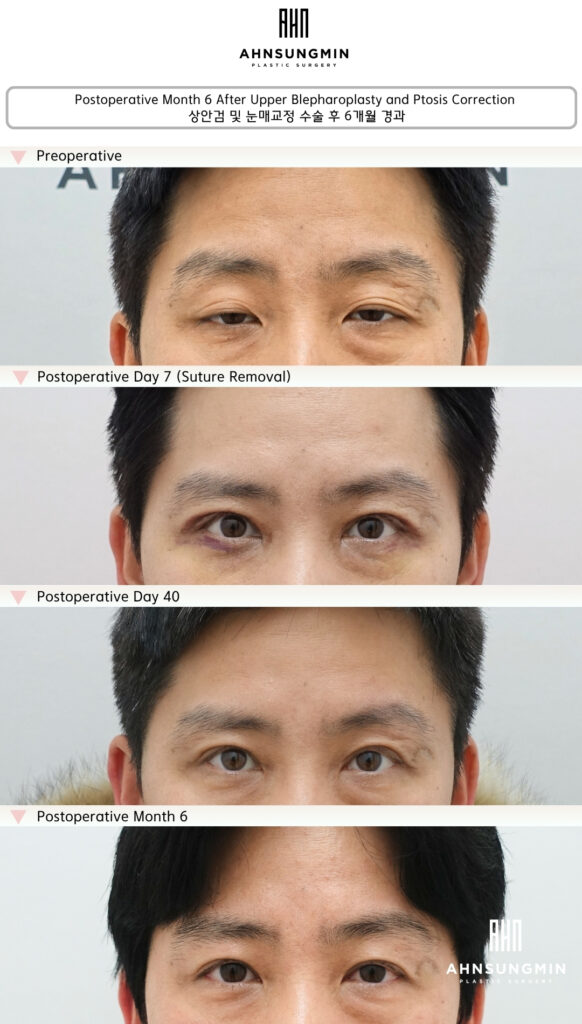
The First Week: Structural Change Without Stability
During the first 5–7 days, the eyelid position may appear exaggerated.
The eyes may look wider than expected, or asymmetrical.
Swelling, bruising, and temporary stiffness are common.
At this stage, the levator muscle has been adjusted,
but the surrounding tissue has not yet adapted.
This is not overcorrection.
It is an expected early phase.
Weeks 2–6: Visible Changes, Unstable Interpretation
As swelling begins to decrease, the eyelid position starts to settle.
However, this phase often creates confusion.
Patients may feel that the eyes look different from day to day.
One side may appear lower, then higher, then more balanced again.
This fluctuation is not a problem.
It reflects the process of internal stabilization.
Judging the result during this period often leads to unnecessary concern.
Around 1–2 Months: Partial Stability
By this stage, most of the visible swelling has resolved.
The eyelid position becomes more consistent,
but subtle asymmetries or tightness may still remain.
This is the point where patients begin to feel that the result is “close.”
But it is not final.
The deeper structural relationship between muscle, skin, and connective tissue is still evolving.
3–6 Months: Functional Stabilization
Between three and six months, the eyelid movement becomes more natural.
The eye opens and closes as a coordinated unit.
Tension decreases, and the fold becomes more integrated with the surrounding anatomy.
At this stage, the result is no longer driven by swelling or temporary adjustment.
It reflects the actual surgical outcome.
Why Timing Matters More Than Early Appearance
Many revision cases begin with a misinterpretation of early results.
Patients assume that something is wrong too soon.
Additional procedures are considered before the tissue has fully stabilized.
This is one of the most common causes of unnecessary revision surgery.
In ptosis correction, timing is not just part of recovery.
It is part of the decision-making process.
Why Recovery Differs Between Patients
The ptosis surgery recovery timeline can vary between patients.
Factors such as skin thickness, previous surgery, degree of muscle adjustment, and individual healing response all influence how quickly the eyelid stabilizes.
Some patients reach apparent stability earlier, while others require more time for subtle asymmetries to resolve.
This variation is normal and does not indicate a problem.
Surgical Approach
Ptosis surgery is evaluated not by early appearance, but by how the eyelid stabilizes over time.
Seeing the Eye as a Whole, Not in Parts
A Clinic Dedicated to Eyelid Revision Surgery in Korea
Ahnsungmin Plastic Surgery
Internal References
→ See ptosis correction cases
