Lower Eyelid Surgery Is Not About Erasing Volume.
Many patients believe that lower eyelid surgery should remove fullness under the eye.
But aging does not simply create excess tissue — it changes support, muscle balance, and fat distribution.
Removing volume without understanding structural support often leads to hollowing, instability, and an unnatural expression.
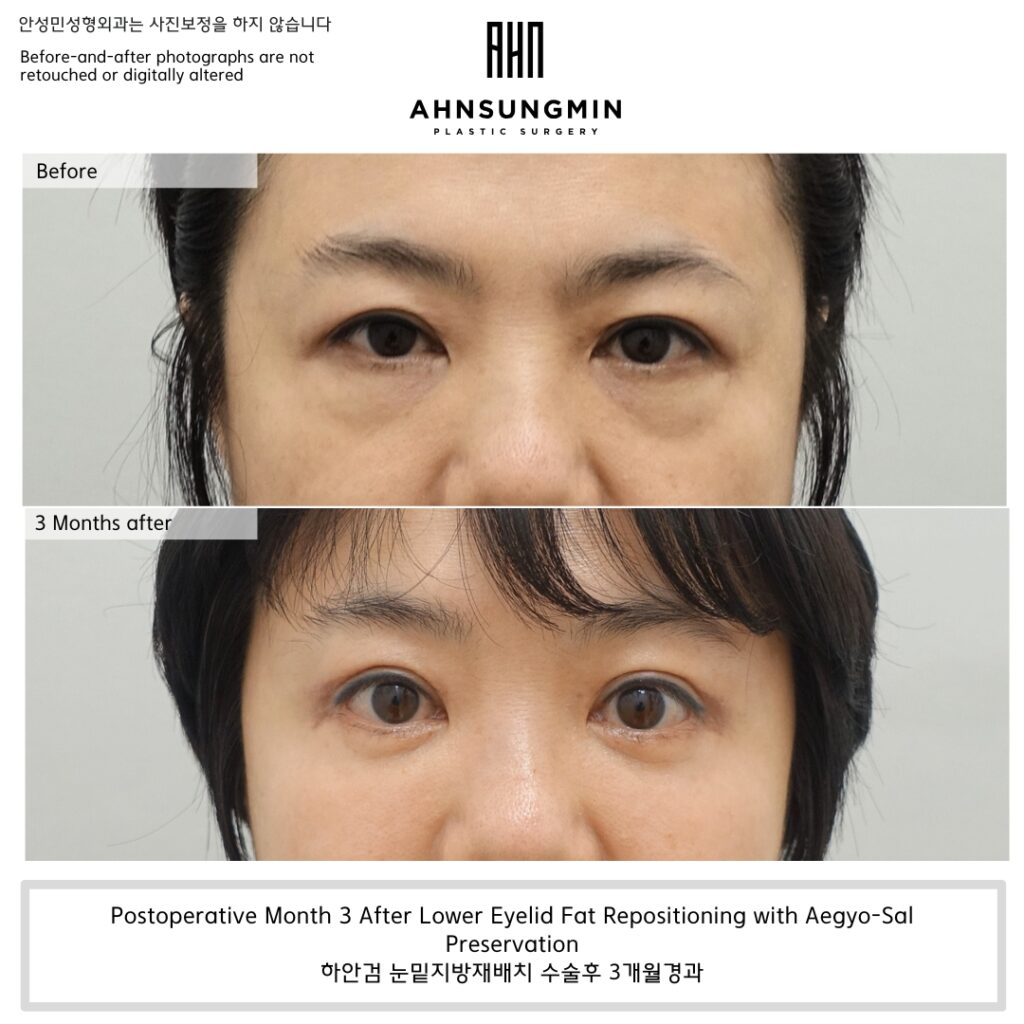
In this case, the goal was not to flatten the under-eye area, but to restore balance while preserving the natural contour of the lower eyelid.
Why Aegyo-Sal Should Not Be Removed.
Aegyo-sal is not excess tissue.
It represents dynamic muscle support and contributes to a natural, youthful eye expression.
When it is removed aggressively, the lower eyelid loses its soft transition zone.
The result may appear smooth at first, but over time it can look flat, aged, or structurally unstable.
Preservation allows the eyelid to maintain movement and harmony with facial expression.
What Changed After Surgery.
Instead of removing fat, the deeper fat pads were repositioned and stabilized.
Support was reinforced rather than reduced.
At three months, the lower eyelid appears smoother without looking overcorrected.
Volume remains natural, aegyo-sal is preserved, and the transition from eyelid to cheek looks balanced rather than hollow.
This was not an attempt to create dramatic change.
It was a decision to maintain long-term structural stability.
Structural Balance Matters More Than Immediate Smoothness.
Lower eyelid surgery should not aim to iron out every wrinkle.
Muscle differences, aging patterns, and natural anatomy must be respected.
A smooth appearance immediately after surgery does not always mean a stable long-term result.
Preserving supportive structures often ages better than aggressive removal.
Seeing the Eye as a Whole, Not in Parts
A Clinic Dedicated to Eyelid Revision Surgery in Korea
Ahnsungmin Plastic Surgery