Lower eyelid surgery is often performed to remove or reposition bulging fat beneath the eyes. Many patients expect that once the fat is treated, the problem will not return.
However, some patients notice that the under-eye bulging gradually appears again after surgery. This can be confusing and sometimes disappointing.
In reality, recurrent lower eyelid bags are not always a failure of surgery. They are often the result of structural factors that were not fully addressed during the initial procedure.
Understanding these causes is essential before considering revision surgery.
Before Revision Surgery
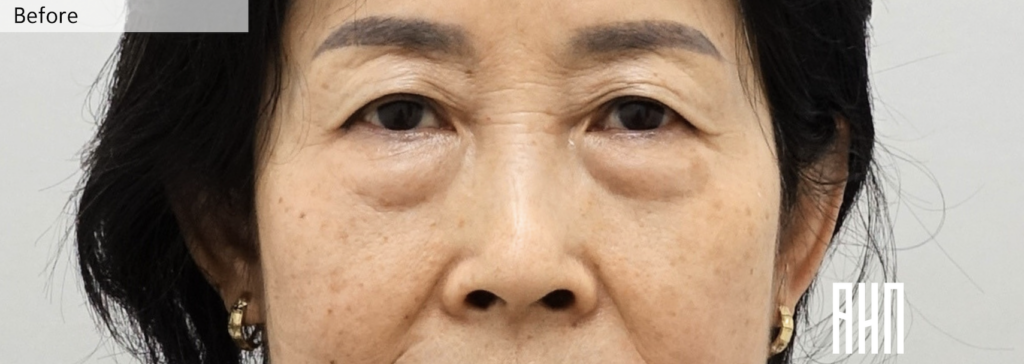
The patient previously underwent lower eyelid surgery elsewhere, but under-eye bulging gradually reappeared over time due to structural weakness and incomplete correction.
Not All Under-Eye Bulging Is Simply “Extra Fat”
The most common misunderstanding is that under-eye bags are caused only by excess fat.
In many cases, the fat itself is not the true problem. Instead, the issue is weakening of the supporting structures around the lower eyelid.
The orbital septum, which normally holds the fat in place, can weaken over time. When this support becomes loose, the fat gradually protrudes forward, creating the appearance of eye bags.
If the underlying support is not adequately addressed during surgery, the bulging may slowly reappear.
Incomplete Fat Repositioning
In modern lower eyelid surgery, fat is often repositioned rather than simply removed.
The goal is to redistribute volume and smooth the transition between the lower eyelid and the cheek.
However, if the fat is only partially repositioned, or if the fixation is not stable, the tissue may gradually shift over time.
When this occurs, patients may notice that the eye bags seem to return even though surgery was performed.
Aging Continues After Surgery
Another important factor is aging.
Lower eyelid surgery improves the existing condition, but it does not stop the natural aging process.
Skin elasticity gradually decreases, and the supporting structures of the eyelid may continue to weaken over time.
This means that even a technically successful surgery may show subtle changes years later.
Structural Balance Matters More Than Aggressive Removal
One of the most common causes of poor long-term outcomes is aggressive fat removal.
Removing too much fat may initially flatten the under-eye area, but it can disrupt the natural balance between the eyelid and the cheek.
A well-balanced lower eyelid should maintain smooth contour and adequate support rather than appearing excessively hollow.
Long-term stability often depends more on structural balance than on how much fat is removed.
Revision Surgery Requires Careful Evaluation
When lower eyelid bags appear to return, revision surgery is not always immediately necessary.
In some cases, the appearance may be related to swelling, skin quality, or changes in surrounding structures.
A careful evaluation of the eyelid support, fat position, and skin condition is essential before deciding on further surgery.
Revision surgery should always focus on restoring structural balance rather than simply removing more tissue.
Seeing the Eye as a Whole, Not in Parts
A Clinic Dedicated to Eyelid Revision Surgery in Korea
Ahnsungmin Plastic Surgery