Lower eyelid surgery is not about removing more skin.
One of the most common causes of failure in lower eyelid surgery is excessive skin excision.
While removing more skin may temporarily create a smoother appearance, it also introduces a powerful downward force on the lower eyelid. This force is often underestimated—and difficult to reverse.
Why excessive excision creates downward traction.
The lower eyelid depends on vertical skin length and support to maintain its natural position.
When too much skin is removed, the vertical height of the lower eyelid shortens.
As a result, the eyelid is pulled downward, away from its normal anatomical position.
This is not a subtle change.
It alters the direction of tension acting on the eyelid.
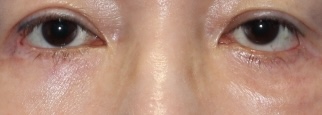
Vertical shortening of the eyelid increases the risk of ectropion and long-term instability.
This is not swelling or a temporary postoperative effect.
In many cases, patients are told to “wait for swelling to subside.”
However, downward traction caused by skin shortage is not edema-related.
It is a structural consequence.
Once the skin has been excessively removed, the eyelid has no reserve length to counteract gravity and muscle pull.
Why ectropion often begins this way.
As downward traction persists, the lower eyelid may begin to evert.
The sclera becomes more visible, eyelid closure weakens, and irritation increases.
This is often the starting point of ectropion.
At this stage, correction becomes significantly more difficult—because the fundamental problem is not muscle or fat, but missing skin.
Why revision becomes challenging.
Every revision surgery further increases scar formation and tissue adhesion.
The more the eyelid is manipulated, the stronger the downward pull becomes.
In revision cases, the single most limiting factor is skin shortage.
This is why responsible lower eyelid surgery must always consider not only the current operation, but the possibility of future correction.
Restraint is not conservatism—it is responsibility.
Removing less skin is not hesitation.
It is an intentional decision to preserve structure, stability, and future options.
Lower eyelid surgery is not about achieving maximum tightness.
It is about preventing irreversible failure.
Related Insight:
Skin Shortage Is the Real Limitation in Lower Eyelid Revision Surgery
Seeing the Eye as a Whole, Not in Parts
A Clinic Dedicated to Eyelid Revision Surgery in Korea
Ahnsungmin Plastic Surgery