The Importance of Preserving the Aegyo-Sal in Lower Blepharoplasty
Incision Design · Fat Repositioning Techniques · Recovery Process
When patients come in for lower blepharoplasty consultations, many ask, “Can’t you just remove the under-eye fat?” In reality, the procedure involves much more than simply removing fat. To achieve natural and long-lasting results, several anatomical factors must be considered together—the aegyo-sal muscle, skin laxity, orbital septum, and midface support structures.
Among these factors, preserving the aegyo-sal is particularly important.
The aegyo-sal is the natural muscle roll that appears when you smile. It plays a key role in creating a youthful, friendly, and lively expression. If it is mishandled during surgery, it can change a patient’s overall impression and lead to an unnatural or stiff appearance.
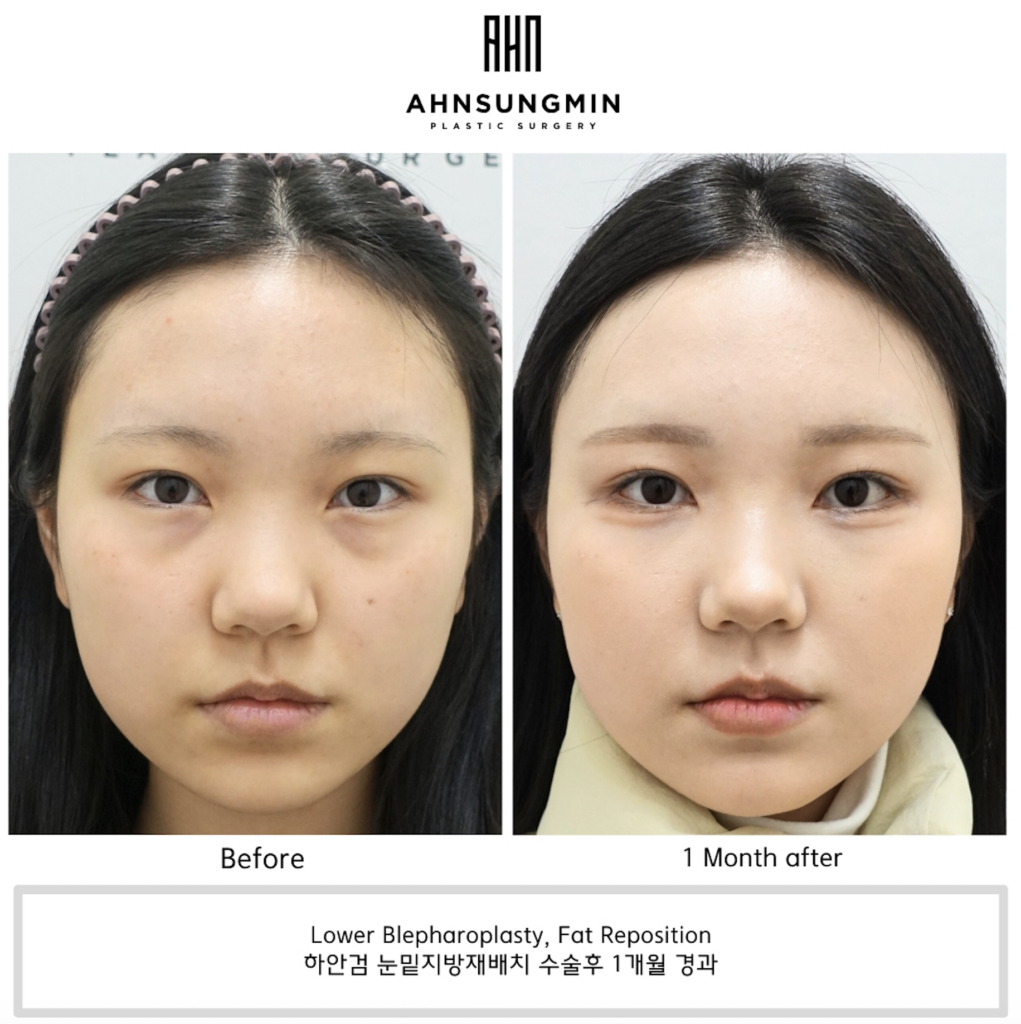
■ Incision Location and Basic Surgical Procedure
In lower blepharoplasty, the incision is made 2–3 mm below the lower lash line, where the scar becomes almost invisible. This approach provides both safe access and a highly aesthetic result.
After making the incision, the surgeon gently dissects beneath the skin and muscle to identify the protruding fat pads. These are then repositioned to smooth hollowness and correct bulging. At the same time, the weakened orbital septum is reinforced to prevent fat from pushing forward again in the future.
This process improves issues such as under-eye hollows, puffiness, and uneven contours.
A key point during this step is avoiding overly aggressive dissection or unnecessary removal of skin and muscle for surgical convenience. The muscle that forms the aegyo-sal must be preserved to maintain a soft, natural expression.
The incision is then meticulously closed to minimize visible scarring.
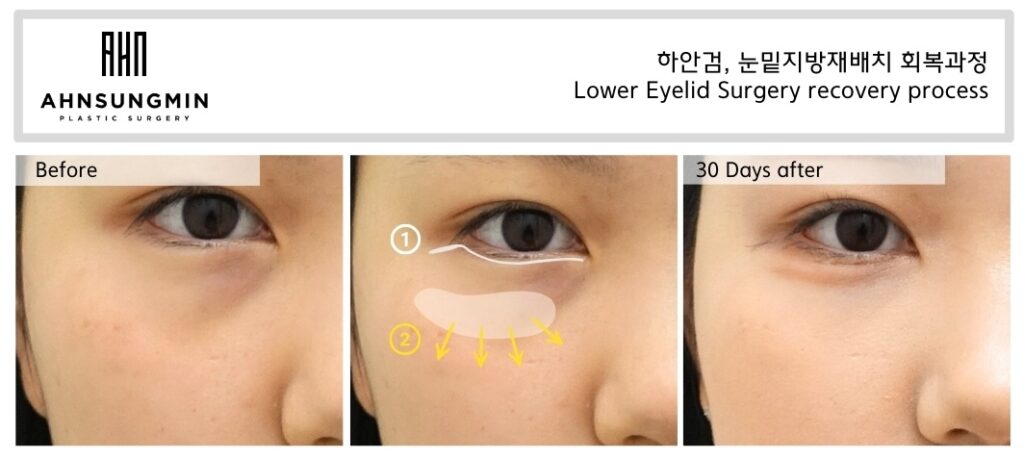
■ Why Preserving the Aegyo-Sal Matters
Lower blepharoplasty with fat repositioning does not create or remove the aegyo-sal.
Because the aegyo-sal is made up of your original skin and muscle, preserving it during fat repositioning is essential for achieving a natural result.
If the incision is placed too low or if the muscle is removed:
- the aegyo-sal does not form properly when you smile
- the lower eyelid can look flat and expressionless at rest
- the overall impression may become stiff or unnatural
Another important factor is skin flexibility.
For the aegyo-sal to fold naturally, there must be enough skin laxity. If too much skin is removed or tightened excessively, the aegyo-sal may not form correctly, leading to an unnatural appearance.
For this reason, adequate skin preservation is a key principle during surgery.
■ Recovery Process After Surgery
Stitches are removed around Day 7, marking the end of the initial healing stage. After stitch removal, most of the major swelling begins to subside. Mild swelling and bruising gradually improve over about one month, although this varies between individuals.
During the early phase, cold compresses are most effective for reducing swelling and heat.
A few days later, combining warm compresses can help promote circulation and support the healing process.
■ Postoperative Precautions
Removal of stitches does not mean full recovery.
Even if the surface appears healed, the deeper tissues are still fragile and sensitive to irritation.
- Avoid rubbing the eyes, excessive eye use, or allowing irritation from tears or dust, as these can cause inflammation.
- For 1–2 weeks after stitch removal, avoid putting pressure on the eyes or making exaggerated facial expressions, as this may stretch the incision line.
- Avoid makeup for at least 3 weeks, as pigments can cause inflammation or pigmentation before the wound fully heals.
- Avoid lowering your head to wash your hair or lifting heavy objects, as these actions increase intraocular pressure and may lead to postoperative bleeding.
- Try to avoid salty foods, as they prolong swelling.
- Activities that require sudden or strong movements—such as golf or tennis—should be avoided for 2–3 months.
Lower blepharoplasty is not simply about removing or repositioning fat.
Achieving a natural and long-lasting result requires careful consideration of the aegyo-sal, skin laxity, muscles, fat pads, the orbital septum, and the overall midface structure. Among these, preserving the aegyo-sal is one of the most critical factors and must be handled with precision and care.
No. 1 Clinic for Revision Surgery and Lower Blepharoplasty
AHNSUNGMIN Plastic Surgery
At AHNSUNGMIN Plastic Surgery, we specialize in revision procedures and lower blepharoplasty with fat repositioning, delivering results that look natural, balanced, and true to you.
Our focus is on creating subtle, refined changes that enhance your features without looking overdone.
We look forward to welcoming you to
AHNSUNGMIN Plastic Surgery in Seoul.
Thank you.