Time Is Not Delay. It Is Protection.
In revision surgery, impatience is often more dangerous than the original mistake.
This is especially true in lower eyelid surgery.
Patients frequently return within weeks or months, concerned that swelling remains, the contour feels uneven, or the eyelid does not yet look “settled.” The instinct is understandable. But the lower eyelid does not reveal its true condition early. It reveals it slowly.
Lower eyelid revision should not even be discussed before six months.
And in many cases, it should not be performed for one to two years.
That is not hesitation. That is judgment.
The lower eyelid is structurally delicate. Skin is thin. Support is limited. Scarring evolves quietly beneath the surface. What appears to be a problem at three months may be residual edema. What feels tight at four months may still be internal fibrosis softening with time.
Operating too early does not correct the problem. It compounds it.
Swelling Disguises Structure.
Lower eyelid tissue holds inflammation longer than patients expect. Even when visible swelling improves, microscopic scarring and contracture are still developing. The eyelid may appear retracted, but true lower lid position cannot be accurately assessed while tissue is still stiff.
If surgery is performed during this phase, the surgeon is not operating on the final anatomy. He is operating on a moving target.
And in revision surgery, that is dangerous.
Skin Deficiency Is the Real Risk.
Every lower eyelid revision must consider one central question: how much skin remains?
Over-excision in the primary surgery may not show its full consequence early. Only after months does downward traction become clear. Only after tissues soften can we measure true skin availability.
If revision is attempted before this stabilization, the risk is irreversible: ectropion, chronic exposure, structural instability.
Once skin is lost, it cannot simply be replaced.
That is why time is not optional. It is protective.
Waiting Is Part of Treatment.
Patients often interpret waiting as inaction. In lower eyelid revision, waiting is active management. It allows swelling to subside, scars to mature, support structures to stabilize, and the true condition of the eyelid to declare itself.
Six months is the minimum point at which evaluation may begin.
One year is often more realistic.
In complex cases, two years may be necessary before a responsible decision can be made.
Below is a case photographed six months after lower eyelid fat repositioning surgery. This is not a revision case. It is shown to demonstrate how structure settles over time. Early swelling and tissue stiffness would not have reflected the final contour.
Time clarifies anatomy.
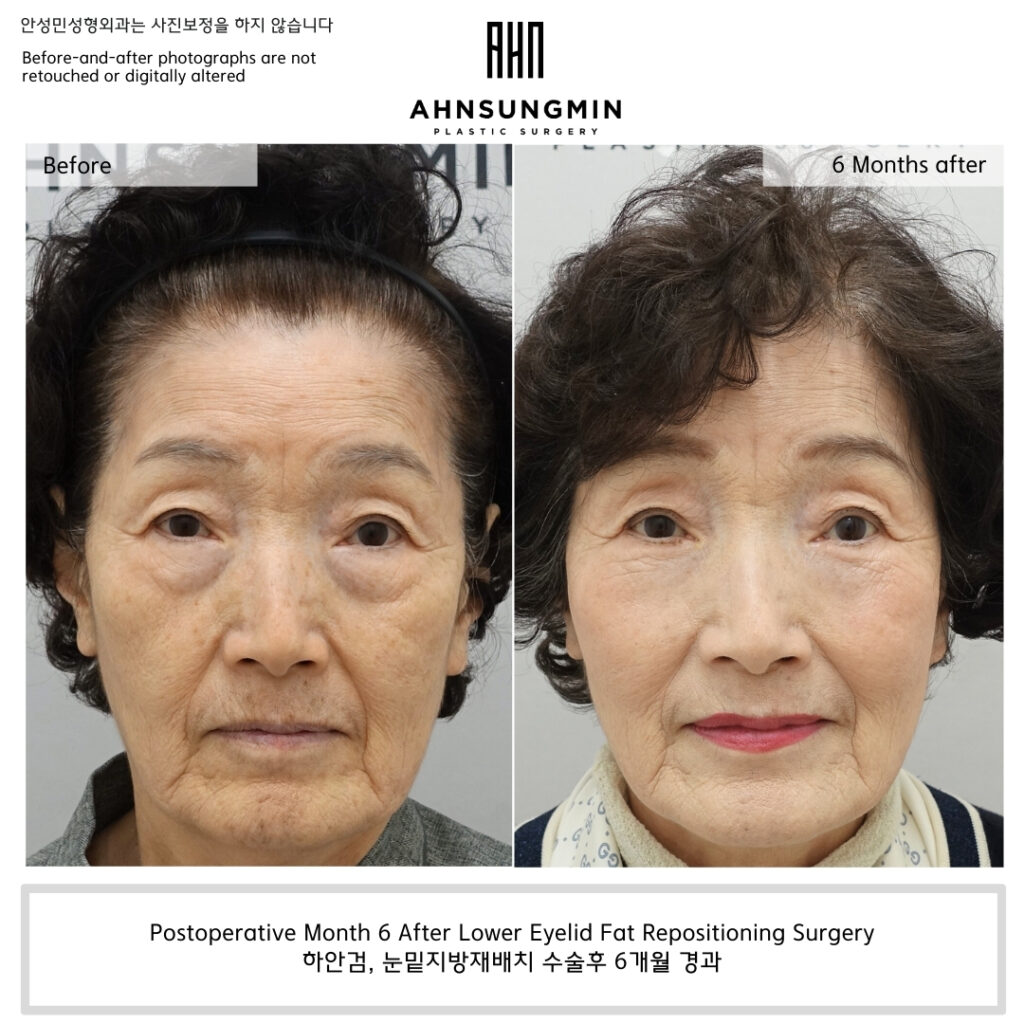
The under-eye bulging and shadowing have improved while maintaining natural lower eyelid support and skin integrity.
Before-and-after photographs are not retouched or digitally altered.
Surgery should never be driven by anxiety.
It should be driven by anatomy.
And anatomy takes time to declare itself.
Seeing the Eye as a Whole, Not in Parts
A Clinic Dedicated to Eyelid Revision Surgery in Korea
Ahnsungmin Plastic Surgery