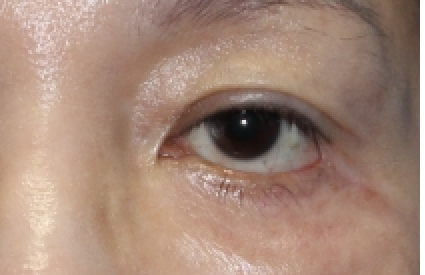
Example of lower eyelid tension after excessive skin removal. When surgeons attempt to remove every wrinkle, increased downward tension may pull the eyelid lower, leading to scleral show or early eyelid retraction.
When Trying to Smooth Every Wrinkle Creates a New Problem
One of the most common misunderstandings about lower eyelid surgery is the belief that every wrinkle under the eye must be removed.
Patients often focus on the small lines beneath the lower eyelid and assume that successful surgery means completely smooth skin.
But the lower eyelid was never designed to look like skin that has been pressed flat with an iron.
Fine wrinkles are part of the natural texture of the skin and the normal movement of the eyelid.
Trying to eliminate every wrinkle can create a different and more serious problem.
The Problem With Removing Too Much Skin
When surgeons attempt to erase every visible wrinkle, the usual method is to remove more skin.
At first, the lower eyelid may appear tighter and smoother.
But tightening the eyelid too aggressively introduces increased tension.
The more skin that is removed, the greater the downward pulling force placed on the lower eyelid.
This tension does not always appear immediately after surgery.
As swelling resolves and tissues soften over time, the eyelid may gradually begin to descend.
This is when changes such as scleral show, lower eyelid retraction, or ectropion may begin to appear.
Natural Skin Texture Is Not a Surgical Failure
The skin of the lower eyelid is extremely thin and constantly moving with facial expression.
Because of this, some degree of fine wrinkling is normal—even after well-performed surgery.
Lower eyelid surgery should not aim to erase every sign of natural skin movement.
The real objective is to restore balance while preserving the stability of the eyelid.
An eyelid that maintains its natural position over time is far more important than skin that appears perfectly smooth for a short period.
The Importance of Surgical Restraint
Experienced surgeons understand that successful lower eyelid surgery often depends on restraint rather than aggressive correction.
Removing only what is truly excessive helps preserve the natural support and flexibility of the eyelid.
When surgeons pursue perfectly smooth skin, the price may be long-term instability.
Respecting the natural limits of the lower eyelid is often what protects the eye from complications that may appear months after surgery.
Seeing the Eye as a Whole, Not in Parts
A Clinic Dedicated to Eyelid Revision Surgery in Korea
Ahnsungmin Plastic Surgery