High Fold Correction
Revision Upper Blepharoplasty
Many patients who visit our clinic for high fold correction—especially male patients—express similar concerns:
- “My eyes look too intense.”
- “It’s obvious that I’ve had surgery.”
- “People say my eyes look feminine.”
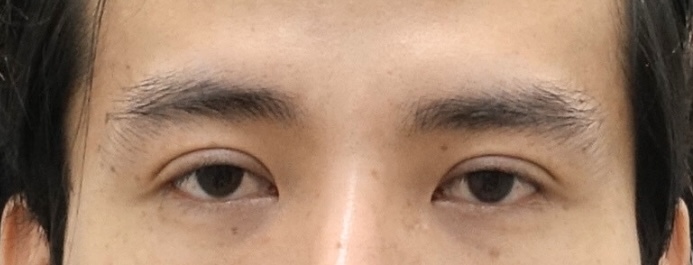
An excessively high eyelid crease is often the result of an improperly positioned fold during a previous surgery, overly strong fixation, or abnormal tension within the eyelid tissue caused by postoperative scarring.
Rather than enhancing the eyes, this type of high fold can create an artificial and unnatural appearance, as seen in the case below.
What Is High Fold Correction?
High fold correction is sometimes described as “lowering the double eyelid” or “removing the crease.”
In practice, however, it is not simply about eliminating a fold.
The goal is to carefully reposition the existing crease to a lower, anatomically appropriate level and reconstruct the eyelid structure so the fold appears subtle—often resembling a natural inner double eyelid.
For many East Asian men, a very high or deep crease does not harmonize well with the overall facial structure.
A low or minimal fold—or even a single eyelid—often creates a cleaner, longer, and more balanced eye shape.
With the growing influence of K-pop and contemporary Asian aesthetics, there has been a noticeable shift in preference. Rather than making the eyelids larger or more defined, many patients now seek to refine and soften an overly prominent crease.
The Relationship Between High Folds and Ptosis
A high eyelid crease is often not just a cosmetic issue.
High double eyelid folds are sometimes created without addressing the underlying eyelid function. When eyelid muscle weakness or ptosis is not properly evaluated, a higher crease alone may not improve the functional balance of the eyelid.
In clinical practice, we frequently see cases where eyelid ptosis was not adequately addressed during the original surgery. When double eyelid surgery is performed without correcting underlying ptosis, a high fold can develop or worsen over time.
To compensate, patients subconsciously recruit their forehead muscles to open their eyes. This increases tension in the eyelids, making the crease appear thicker, deeper, and higher than intended.
As time passes, this cycle can lead to progressively unnatural eyelid contours.
High Fold Correction at Ahn Sung Min Plastic Surgery
High fold correction at our clinic is not simply a procedure to lower the crease.
The surgery begins with meticulous release of abnormal adhesions and scar tissue created during prior operations. The internal anatomy and movement of the eyelid are then carefully evaluated, and the crease is repositioned to a height that is both anatomically sound and aesthetically balanced.
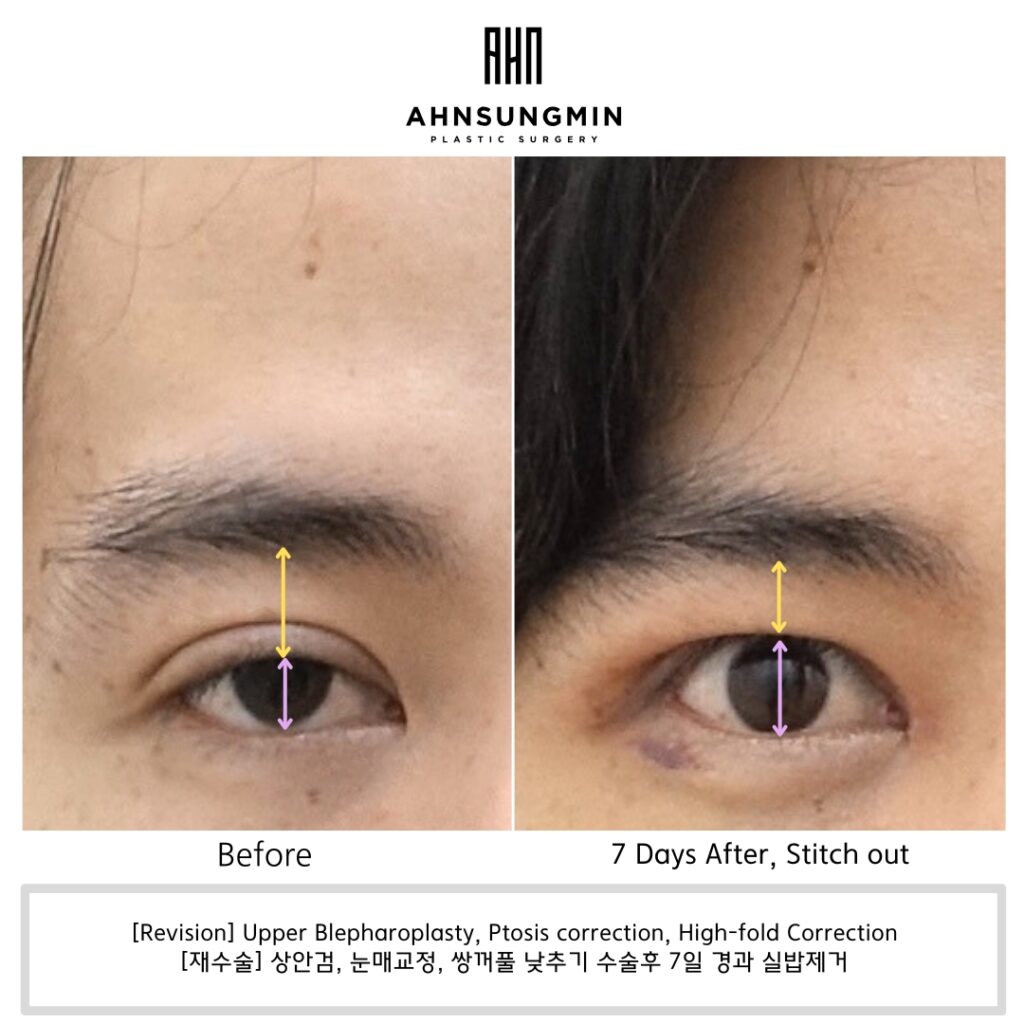
When necessary, eyelid ptosis is assessed and corrected at the same time, allowing eyelid function and crease formation to work in harmony.
Why Eyelid Function Matters
In many revision cases, the crease itself is not the main problem—the underlying eyelid function is.
most important aspect of high fold correction is not the crease itself, but eyelid function.
If the eyes can open comfortably without reliance on the forehead muscles, the crease is far less likely to thicken or migrate upward again over time.
The surgical design ensures that the eyelid fold forms naturally throughout the full range of motion—from eye opening to closure—without appearing excessive when the eyes are open or leaving visible surgical traces when they are closed.
Postoperative Changes
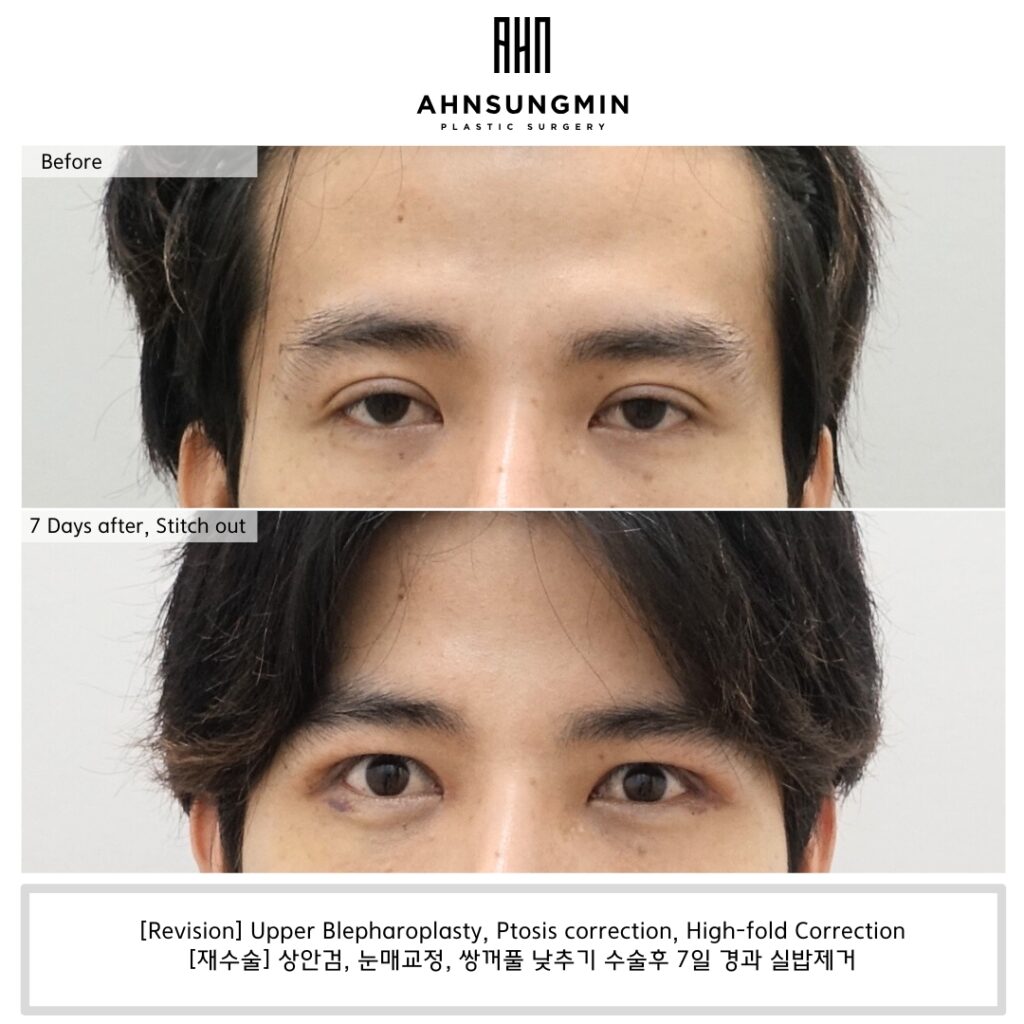
After surgery, patients typically notice that their eyes feel lighter and easier to open. The need to strain the forehead diminishes, and eye opening becomes more natural.
The eyes appear clearer and more alert without looking overdone. A tired or strained expression often improves, resulting in a calmer, more trustworthy overall impression.
Comparing pre- and postoperative photos, the difference in iris exposure is often clearly noticeable.
Recovery Timeline
Swelling and bruising are expected immediately after surgery and are part of the normal healing process.
Sutures are typically removed on postoperative day 7. After suture removal, discomfort decreases and major swelling begins to resolve.
- Week 1: Swelling and bruising are most noticeable
- Weeks 2–3: Eyelid contour gradually stabilizes
- 1–3 months: Eyelid opening becomes easier and more natural
- 6–12 months: Final eyelid shape is established
During recovery, patients are advised to avoid excessive rubbing of the eyes and strenuous physical activity. Regular follow-up visits are essential to monitor healing progress.
Dr. Ahn Sung Min approaches revision eyelid surgery with a conservative and function-first philosophy.
Rather than aggressive correction, the goal is to restore an eyelid shape that naturally complements the patient’s facial structure while preserving long-term stability and ocular health.
Aesthetic improvement should never compromise eyelid function. Every correction is planned with durability, balance, and patient safety as top priorities.
Ahn Sung Min Plastic Surgery
Ahn Sung Min Plastic Surgery is a clinic specializing in revision eyelid surgery and complex eye reconstruction.
Based on Dr. Ahn Sung Min’s extensive clinical experience and deep expertise in revision procedures,
we pursue stable, natural, and long-lasting results, even in the most challenging secondary and tertiary cases.
Each surgery is carefully customized to the individual patient, with a strong focus on function, balance, and long-term safety.
AHN SUNG MIN
EYE PLASTIC SURGERY
KOREA
Specialists in Revision & Complex Eyelid Surgery
Ahn Sung Min Plastic Surgery