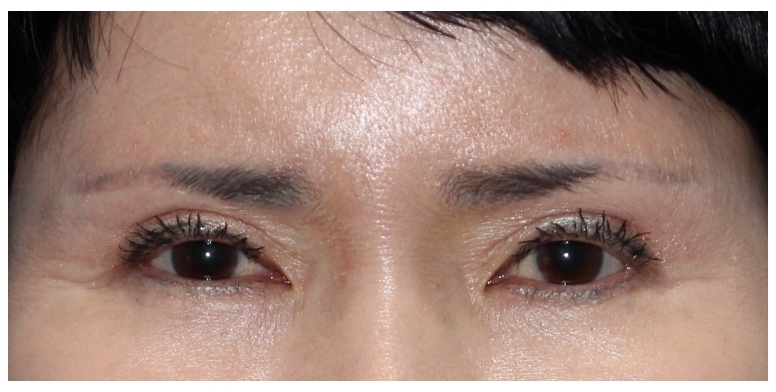
This patient had already undergone
two upper eyelid surgeries
and one additional procedure through a sub-brow incision.
From a surgical history alone, one question immediately arises:
why was more skin removed—again?
From our perspective, the sequence itself was difficult to understand.
Not because revision surgery is rare,
but because at a certain point,
continuing to cut becomes the problem.
There Was No Remaining Skin to Work With.
Upper eyelid skin is not excess material.
It is functional tissue.
It must allow the eye to close.
It must provide a natural distance between the eyebrow and the eye.
And it must age with the face.
In this patient, that reserve was gone.
Repeated excision had eliminated nearly all usable upper eyelid skin.
There was no remaining margin for correction—
not safely, and not responsibly.
At this stage, surgery was no longer an option.
More Surgery Would Have Created a Worse Outcome.
Some patients believe that if the appearance feels uncomfortable,
another surgery must be the solution.
This is not always true.
In this case, further excision would have pulled the eyebrow and eyelid even closer together,
creating a fixed, tense appearance
and increasing the risk of incomplete eyelid closure.
This is a pattern we see repeatedly:
when surgery continues past its limit,
the eye loses both function and refinement.
Aging Requires Allowing the Eyelid to Descend.
As patients age,
a certain degree of upper eyelid descent is not a defect.
It is what creates a calm, natural, and refined expression.
Trying to maintain a permanently elevated eyelid
by continuously removing skin
works against the face—not with it.
In many Asian patients,
excessive resection leads to a characteristic appearance:
the eyebrow and eye appear unnaturally close,
the upper face becomes crowded,
and the expression turns strained.
This is not rejuvenation.
It is structural imbalance.
The Surgeon Must Know When to Say No.
This case was not limited by technique.
It was limited by responsibility.
The patient had strong requests for further correction.
But part of being a surgeon is knowing when a request must be refused.
Continuing surgery would not have improved the eye.
It would have harmed it.
So we stopped.
A Non-Surgical Decision Was the Correct One.
With no remaining surgical skin reserve,
the only realistic option was not another operation.
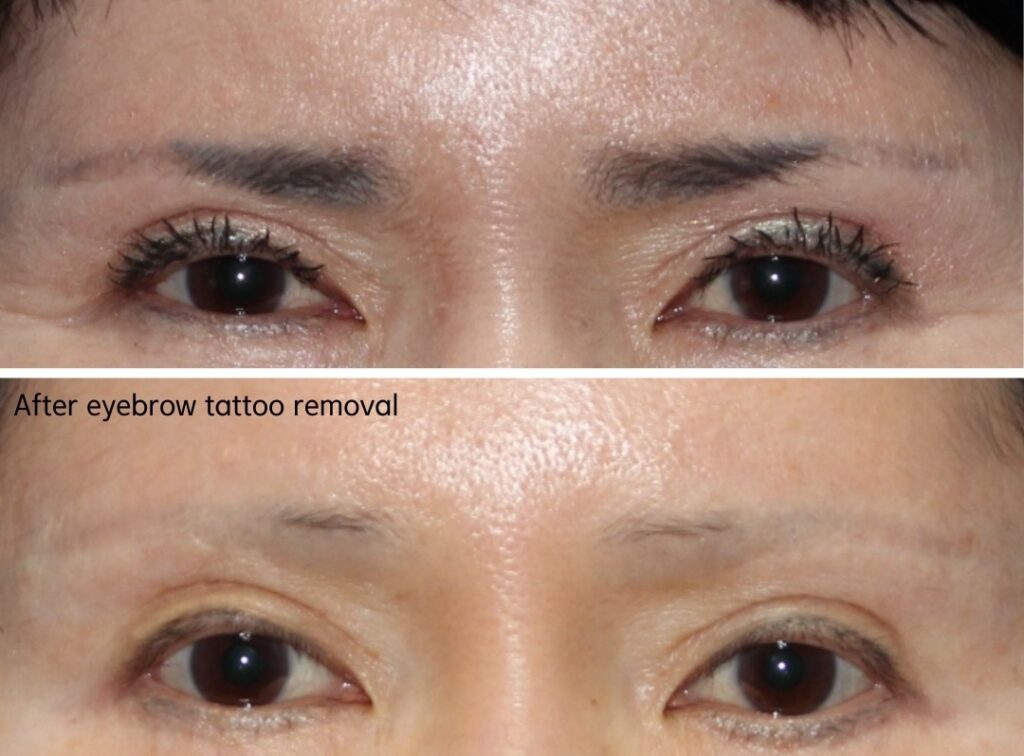
Instead, we recommended removing the existing eyebrow tattoos
and repositioning them higher.
This approach did not alter anatomy.
It respected what tissue remained.
And it addressed the visual imbalance without risking function.
Surgery was not avoided because it was difficult.
It was avoided because it was wrong.
Not Every Problem Requires a Scalpel.
This case illustrates an essential truth in revision surgery:
Sometimes the most professional decision
is not to operate.
Revision surgery is not about how much can be changed.
It is about knowing what must be preserved.
Seeing the Eye as a Whole, Not in Parts
A Clinic Dedicated to Eyelid Revision Surgery in Korea
Ahnsungmin Plastic Surgery