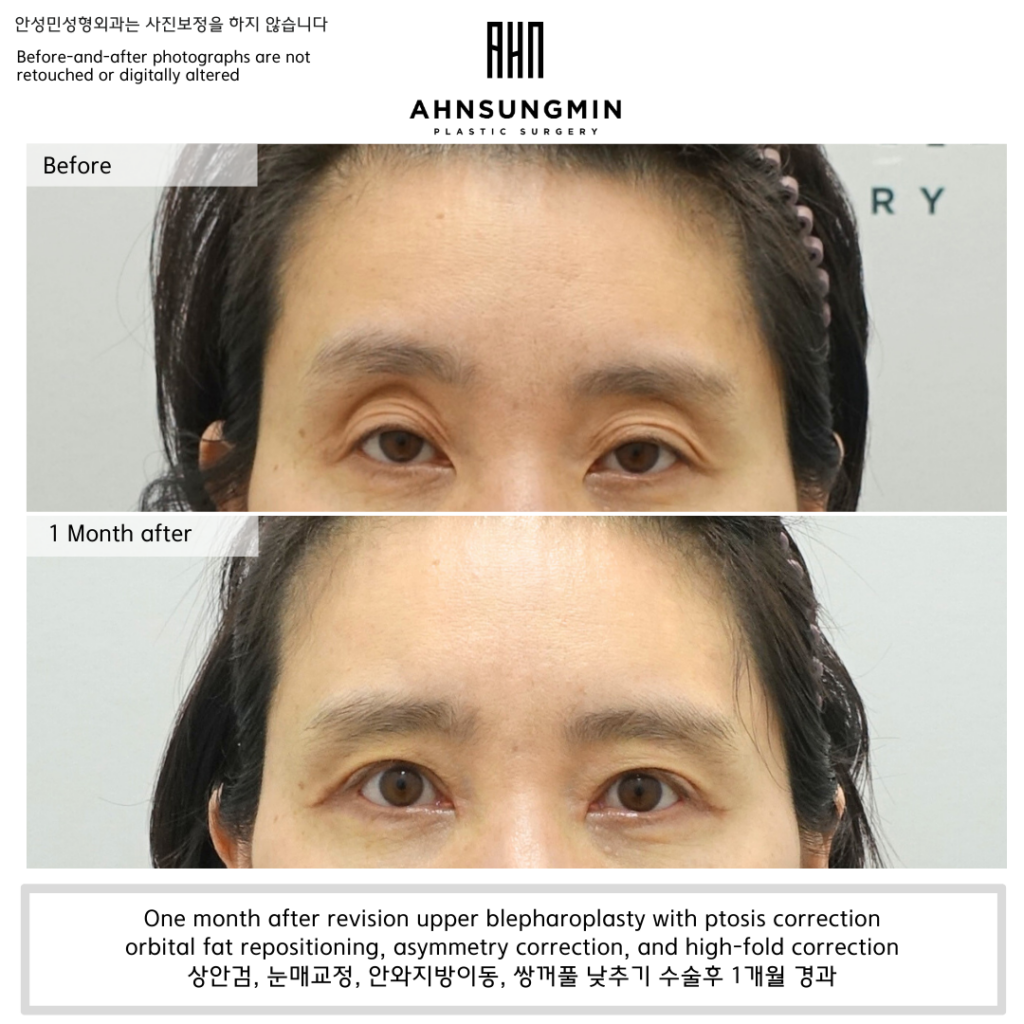
This case involved eyelid hollowing accompanied by significant ptosis asymmetry.
Because one eye was more difficult to open,
the patient relied heavily on one side of the forehead to compensate.
As a result, one eyelid was repeatedly pulled upward with excessive force.
Over time, this imbalance caused the hollowing on that side
to become noticeably more severe.
The mechanism was not simple volume loss.
It was a mechanical problem—
similar to repeatedly stretching an accordion in one direction.
Each time the eye opened, the eyelid tissue was overextended,
deepening the hollowed appearance.
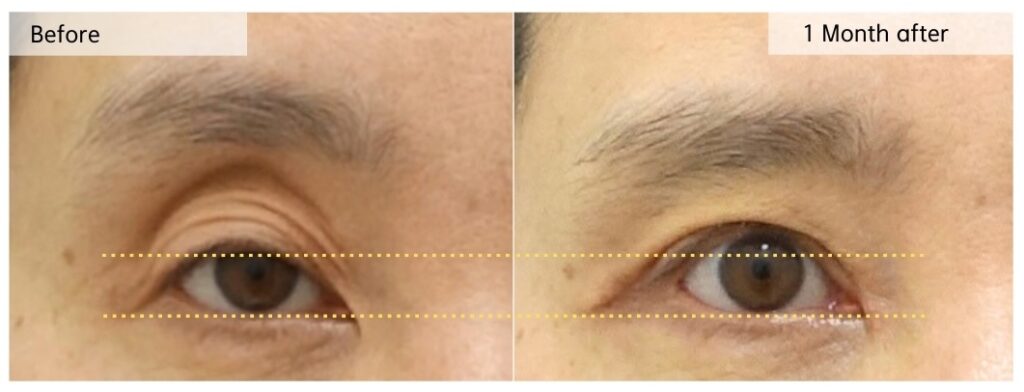
Ptosis asymmetry correction was the first priority.
In this case, correcting eyelid hollowing without addressing ptosis asymmetry
would not have led to a stable result.
The primary goal of surgery was to restore balanced eyelid opening
by correcting the asymmetric ptosis.
Once the excessive compensatory effort was eliminated,
the abnormal forces acting on the eyelid were normalized.
Orbital fat repositioning followed functional correction.
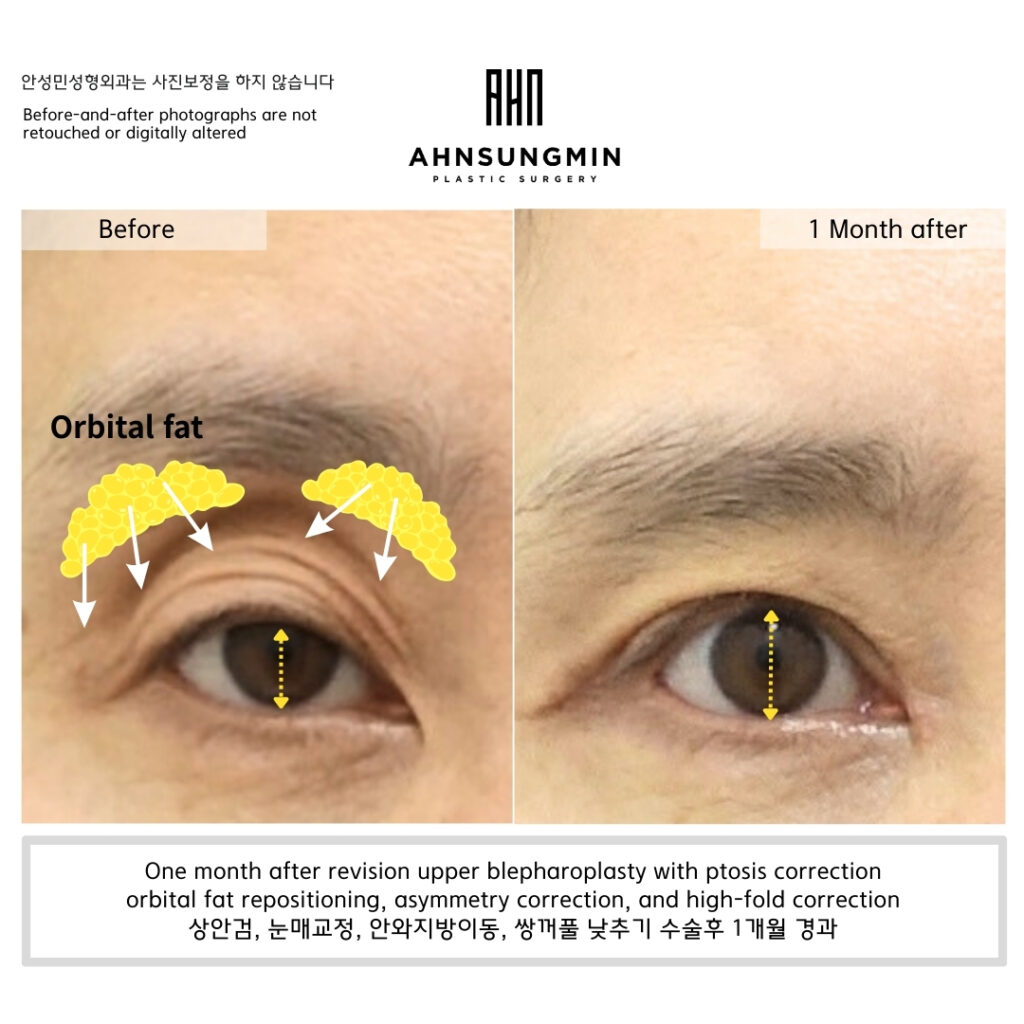
After eyelid balance was restored,
orbital fat repositioning was performed to support the hollowed area
using the patient’s own remaining orbital fat.
Rather than adding volume,
existing tissue was carefully mobilized and repositioned
to restore contour while preserving blood supply.
A stable result after surgery.
After surgery, eyelid opening became balanced and stable.
The hollowed appearance improved naturally
once excessive tension was removed.
At one month postoperatively,
the eyelids show improved symmetry,
a smoother upper eyelid contour,
and no signs of recurrent overuse or instability.
This case highlights an important principle in eyelid revision surgery:
Eyelid hollowing must be evaluated in the context of eyelid function.
When asymmetry and compensatory mechanisms are present,
functional correction must come first.
Seeing the Eye as a Whole, Not in Parts
A Clinic Dedicated to Eyelid Revision Surgery in Korea
Ahnsungmin Plastic Surgery