Still Feeling Heaviness After Upper Eyelid Surgery?
How a Brow Lift May Be the Solution
Some patients report that even after upper blepharoplasty, their eyes still feel heavy or uncomfortable.
Common concerns include:
- “My eyes still look tired or heavy.”
- “Opening my eyes doesn’t feel as comfortable as I expected.”
- “I had surgery, but my eyes don’t feel refreshed.”
In many of these cases, the upper eyelid surgery itself was technically successful, yet the anticipated improvement is limited.
When this happens, the underlying issue is often not the eyelid or double-fold, but the position of the eyebrows.
Why Upper Eyelid Surgery Alone May Not Be Enough
Upper blepharoplasty is designed to remove excess eyelid skin.
However, if the primary cause of a heavy appearance is downward descent of the eyebrows and forehead tissues, the eyelids may continue to be compressed from above—even after eyelid skin removal.
Repeating upper eyelid surgery in these situations can lead to excessive skin removal, discomfort when closing the eyes, or an artificial appearance. In some cases, the distance between the eyebrows and eyelids becomes unnaturally short, resulting in an awkward facial balance.
For this reason, it is essential to reassess the true cause of heaviness rather than simply removing more skin.
When a Brow Lift Should Be Considered
A brow lift may be appropriate if you experience any of the following:
- Persistent heaviness after upper eyelid surgery
- Habitual lifting of the eyebrows when opening the eyes
- Noticeable drooping of the outer corners of the eyes
- Low eyebrow position despite minimal forehead wrinkles
- A double eyelid fold that is obscured by overhanging skin
In these cases, restoring the eyebrows to a normal anatomical position alone can significantly improve comfort and appearance.
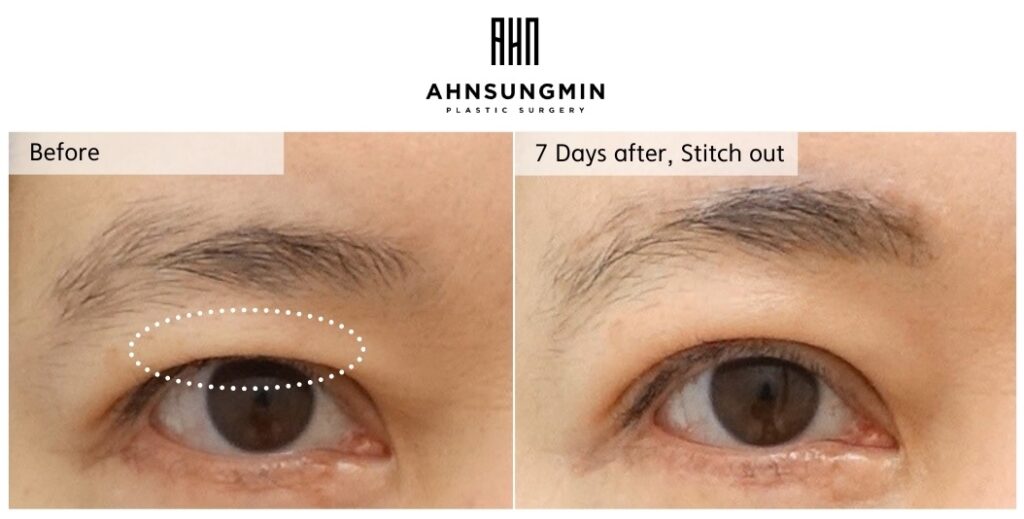
What Is a Brow Lift?
A brow lift is a procedure that elevates sagging eyebrows and forehead tissues to improve eyelid function and overall eye appearance.
By correcting eyebrow position, pressure on the upper eyelids is reduced. Patients often experience easier eye opening, and the results of previous upper eyelid surgery tend to remain more stable over time.
Surgical Approach
The surgical technique is selected based on eyebrow position and the degree of sagging.
One commonly used method involves an incision made directly along the upper border of the eyebrow. This approach provides strong, reliable fixation and is especially suitable for severe drooping or revision cases. The incision is carefully designed along the eyebrow hairline to minimize visible scarring.
When performed together with upper eyelid surgery, a brow lift can produce more natural and stable outcomes while reducing the risk of excessive skin removal and future revision surgery.
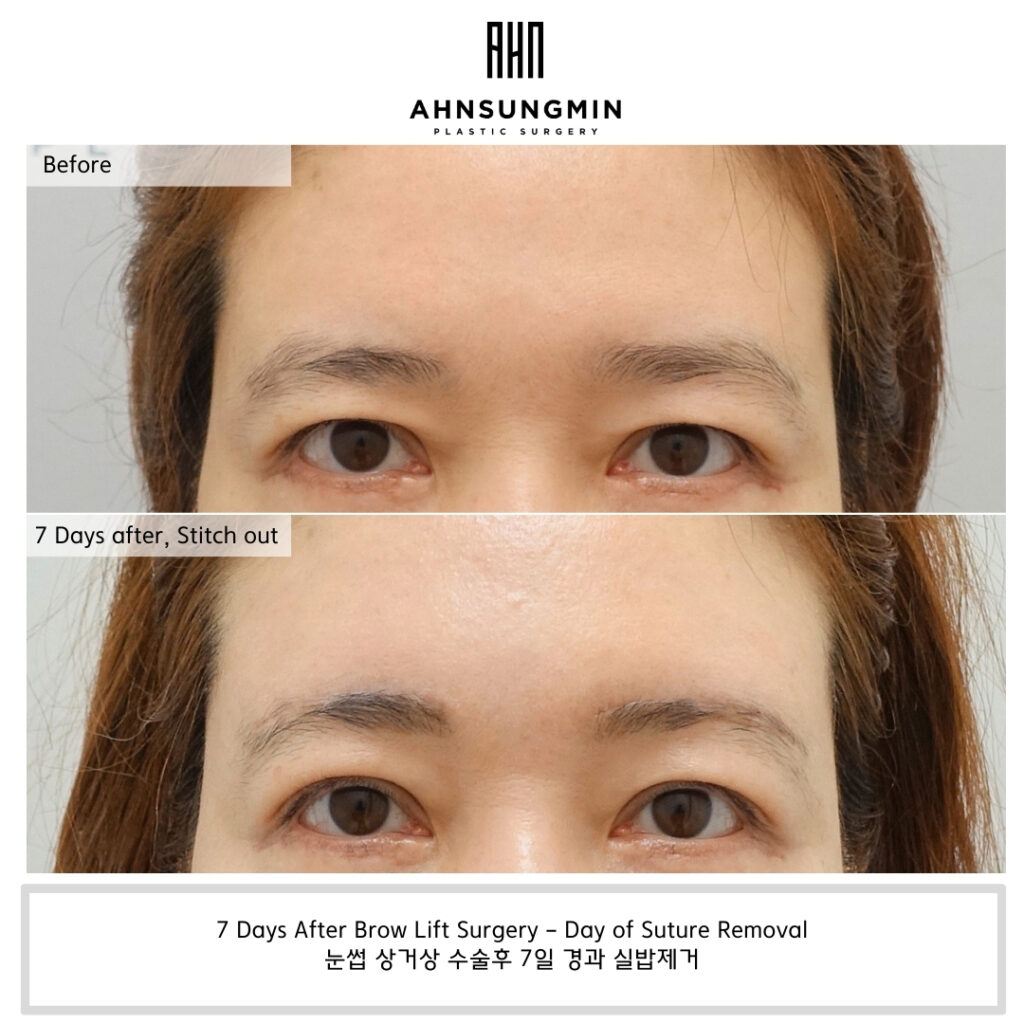
Before and After: What Changes Can Be Expected
Before surgery, downward eyebrow descent can compress the upper eyelids, creating a heavy appearance even in the presence of a double eyelid fold.
After surgery, eyebrow position is stabilized, the eyelids appear more open, and previously hidden eyelid folds become visible. Patients often report that opening their eyes feels noticeably easier.
The goal is not aggressive elevation, but measured correction that prioritizes balance, function, and natural appearance.
Recovery and Postoperative Care
- Swelling typically lasts 1–2 weeks, with residual swelling resolving over 1–2 months depending on the individual.
- Sutures are usually removed 5–7 days after surgery.
- Incision sites may appear red initially but gradually fade over time.
Overcorrection can result in a surprised appearance, asymmetry, or unnatural contour. Accurate diagnosis and a conservative surgical plan are therefore critical.
When Extra Caution Is Required
Particular care is necessary in patients who:
- Have a history of previous eyelid revision surgery
- Have thin skin or a tendency to form noticeable scars
- Have functional concerns such as ptosis or incomplete eyelid closure
In such cases, brow lift surgery should not be approached as a cosmetic adjustment alone. A detailed anatomical analysis and an experienced surgeon’s judgment are essential.
If heaviness persists after upper eyelid surgery, it is important to reassess eyebrow position and forehead structure before considering further eyelid revision.
A brow lift is not intended to make the eyes larger, but to restore the eyebrows to a physiologic position that allows the eyes to function comfortably and appear natural.
A balanced approach that considers both function and aesthetics is essential.
Seeing the Eye as a Whole, Not in Parts
Korea’s Specialized Eyelid Revision Clinic
Ahnsungmin Plastic Surgery
Ahnsungmin Plastic Surgery specializes exclusively in eyelid revision surgery.
With extensive experience and surgical expertise,
Dr. Ahn provides individualized treatment plans even for the most complex revision cases, aiming for stable, natural, and long-lasting results.
A H N S U N G M I N
E Y E P L A S T I C S U R G E R Y