[Revision Surgery] The reasons why you should not correct only one eyelid for uneven ptosis.
#RevisionalEyeSurgery #FemalePtosis #AHNSUNGMINPlasticSurgery #FemaleEyeSurgery #Post-surgeryResults # RevisionSurgerySpecialistClinic
At AHNSUNGMIN Plastic Surgery, we never retouch or edit photos.
All before-and-after photos are used exactly as they are, with the patient’s consent.
[Asymmetric Ptosis]
What is Asymmetric Ptosis?
There are several factors causing uneven ptosis; it is mainly attributed to genetic factors, habitual behaviors, or external injuries from previous eye surgery or accidents.
Since there exist internal issues contributing to uneven ptosis other than what is visible, it is crucial to identify and address underlying causes to achieve proper correction.
The case below involves the patient who had undergone two surgeries at another clinic, which aggravated the uneven ptosis.
Performing an additional surgery on only one eyelid could further aggravate the asymmetry caused by the previous surgeries.
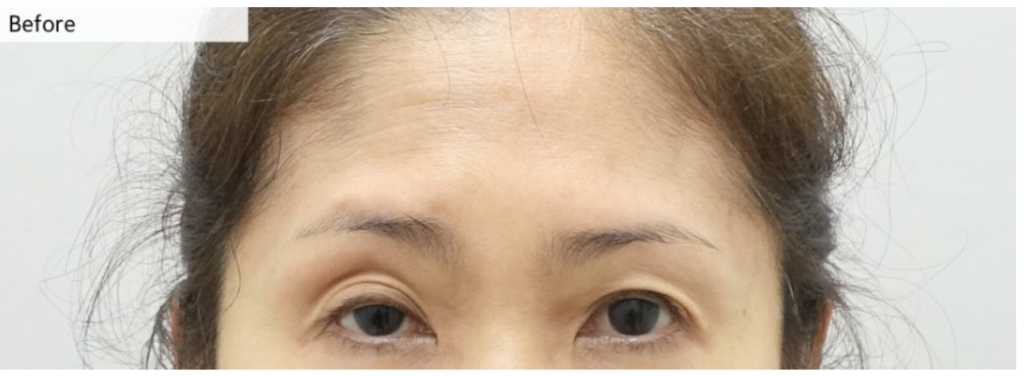
When looking at the preoperative photo, you can see that the patient lifts her forehead to open the eye with more severe ptosis (the right side). If the patient were to stop using the forehead muscles, she would have much more difficulty opening that eye – perhaps only half as much as she can now. Her forehead is raised to keep the right eye open. Because she needs to raise her right eyebrow to open the eye, wrinkles appear only on the right side of her forehead, as indicated by the yellow arrows.
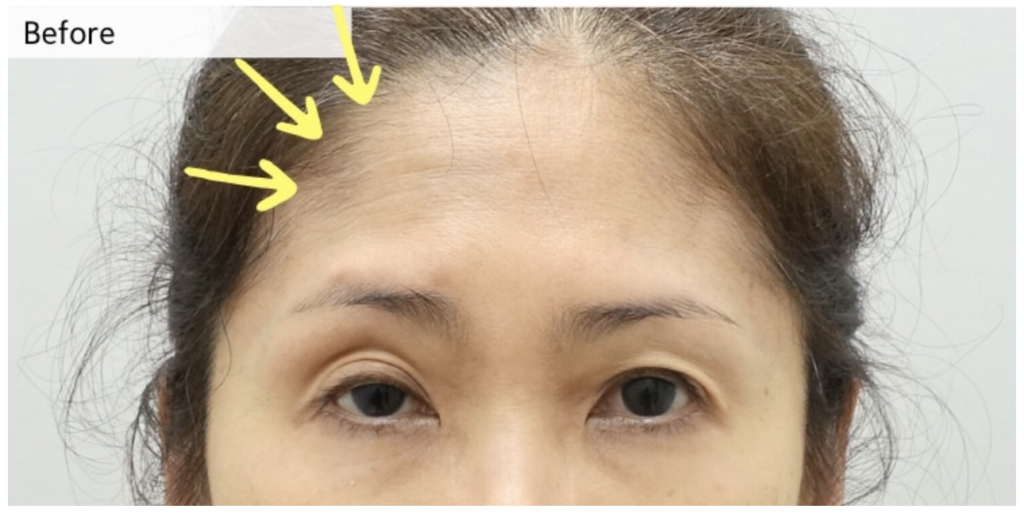
If this condition continues for a prolonged period, the wrinkles on the right side of the forehead will become deeper, further aggravating the asymmetry.
[Revisional Ptosis Correction Surgery for a Female Patient in Her 50s – Asymmetric Ptosis]
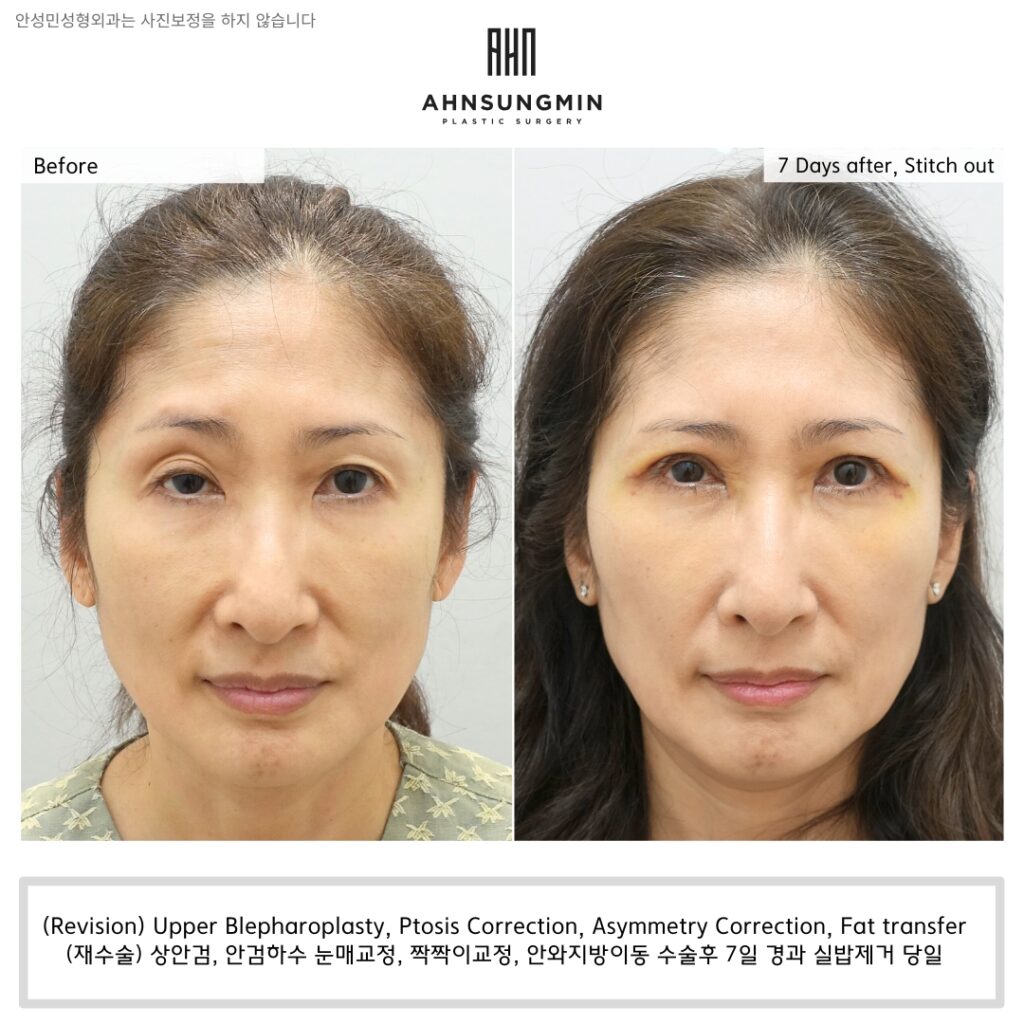
The uneven eyebrow height has been corrected, and the sunken upper eyelid with more significant ptosis also has improved after the revisional surgery. The patient no longer needs to lift her forehead to open the eyes, which has consequently improved the sunken eyelid.
The loose skin that had resulted from the constant forehead lifting was also tightened through upper blepharoplasty, restoring the symmetry.
The right-side photo has been taken 7 days after the surgery, following stitch removal. The asymmetry is expected to improve further as the swelling subsides.
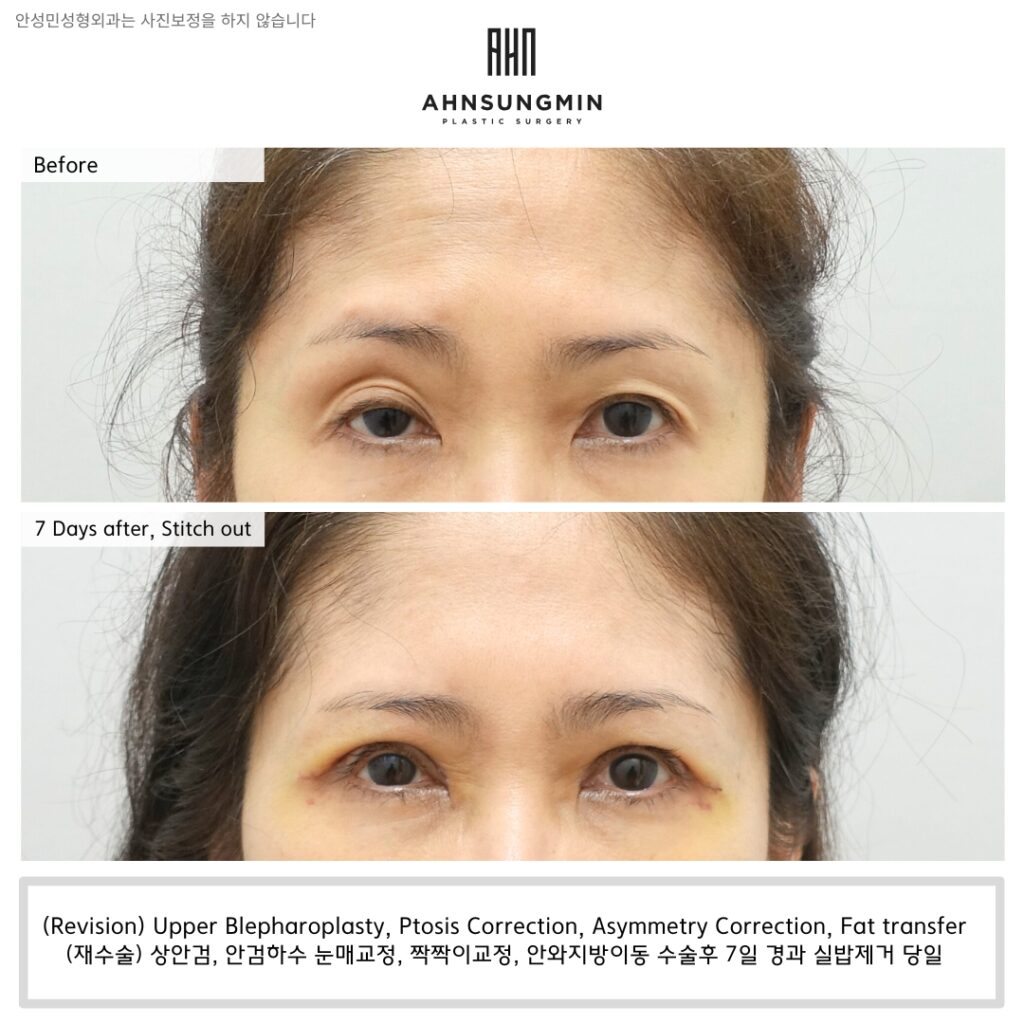
Postoperative Recovery Following Ptosis Correction
Since the surgical procedures were different for each eye, the side that underwent the more complex procedure develops more bruising and swelling. The healing time may vary between the two sides, but the full recovery will take about 2-6 months with gradual improvement.
[Hering’s Law] It is possible to operate on only one eye to correct asymmetry?
Asymmetric ptosis is not simply the difference between a double eyelid and a monolid.
A double eyelid is a fold formed on the upper eyelid. When asymmetry is due to this, depending on the case, surgery may be performed only on the side that needs a double eyelid.
Asymmetric ptosis occurs when the muscle strength responsible for lifting the eyelids differs between the two sides. If only the side with the weaker strength is corrected, the other side that has been performing normally may begin to work less actively because our brain sends a signal to reduce muscle activity. As a result, the unoperated eyelid may lose some of its lifting strength. This phenomenon is known as #Hering’s Law.
What is Hering’s Law?
The muscles in both eyelids are equally innervated and balanced, much like a seesaw. When only the side with significant ptosis is corrected, the muscle strength of the other side is reduced. This is how Hering’s Law works. This phenomenon is not simply the work of muscle, but the result of our brain activity.
Performing surgery only on one side will further aggravate the asymmetry as the unoperated side will gradually lose its muscle strength.
Therefore, the surgery must be performed on both eyes to correct asymmetric ptosis. It is a crucial process during the surgery for a patient to compare muscle strength for both sides while the patient is lifting the eyelids. This helps the surgeon restore proper balance and symmetry.
Such an assessment cannot be achieved under sleep sedation or by non-incisional method.
Among many types of ptosis surgeries, asymmetry correction is a highly complex procedure. The cost of surgery may vary depending on the number of revisional operations and the severity of the asymmetry. There may be the case that the asymmetry cannot be fully corrected through surgery due to the severely damaged eyelid muscles. Repeated revisional surgeries may lead to significant adhesions, which complicate surgical procedures and delays recovery.
It is essential to consult with a board-certified plastic surgeon.
Asymmetric Ptosis & Revision Surgery
Q1. Can non-incisional methods fix asymmetric ptosis?
→ In most cases, no. Functional imbalance requires muscle correction.
Q2. Will I need surgery on both eyes?
→ Yes. It is the safest approach to maintain long-term symmetry.
Q3. Is full correction always possible?
→ Severe muscle damage from prior surgeries may limit the result,
but we aim for maximum functional and aesthetic improvement.
No. 1 Clinic for Revision and Asymmetric Ptosis Correction Surgery
AHNSUNGMIN Plastic Surgery
We create natural-looking changes.
We look forward to seeing you at AHNSUNGMIN Plastic Surgery of Jamsil.
Thank you.