Lower eyelid fat repositioning is a surgical procedure designed to soften under-eye bulging and shadowing by redistributing protruding fat rather than simply removing it.
When performed appropriately, the procedure can restore a smoother under-eye contour and create a more natural, rested appearance.
However, a significant number of patients visit our clinic after having already undergone lower eyelid fat repositioning elsewhere. Over time, they may notice recurrent bulging, hollowing, asymmetry, or an uncomfortable pulling sensation under the eyes, leading them to consider revision surgery.
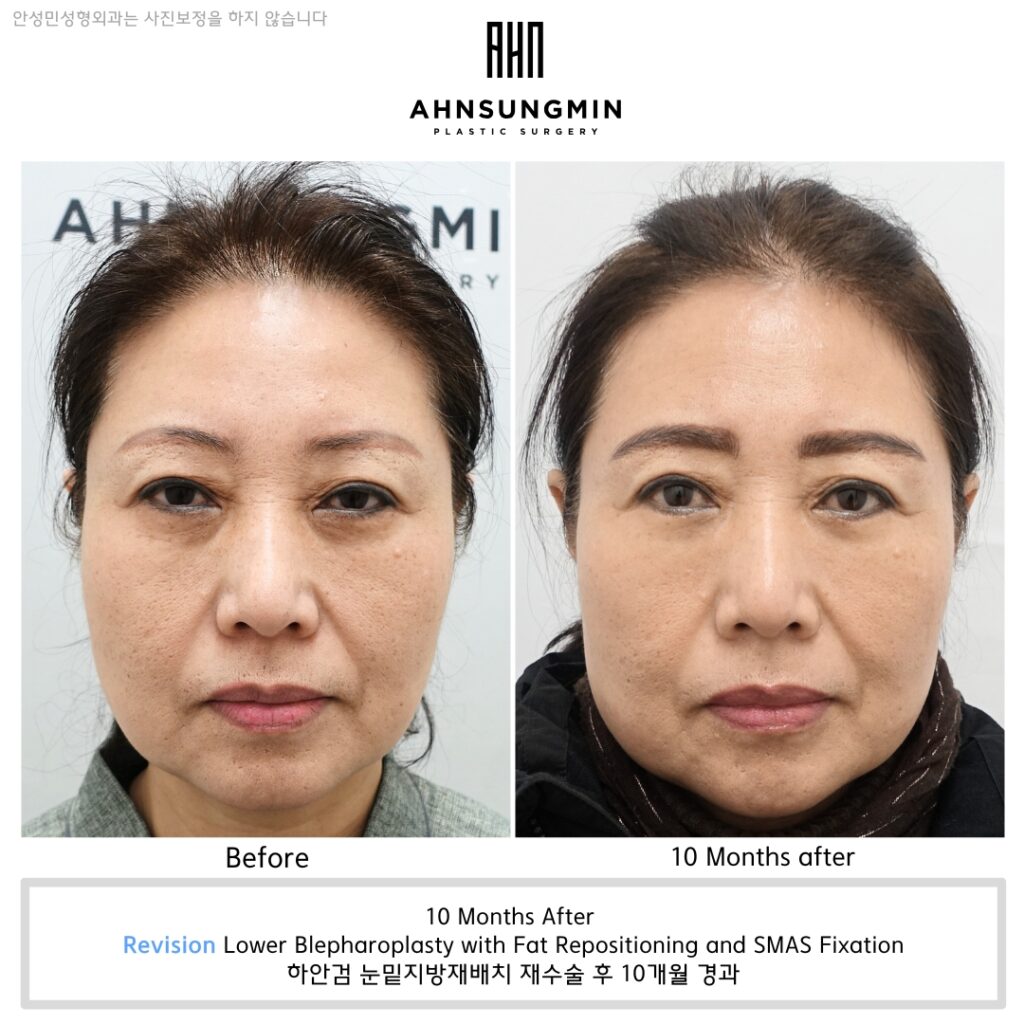
Persistent under-eye bulging, hollowing, or contour irregularities following prior lower eyelid fat repositioning.
In these situations, patients are often told that lower eyelid fat repositioning is “too difficult to revise” or that revision surgery is not possible. While revision procedures are indeed more complex, the challenge does not lie in the impossibility of surgery itself. Rather, it stems from the fact that the condition of the under-eye tissues changes substantially after the first operation.
Following an initial surgery, the tissues beneath the lower eyelid may become firmly adherent due to scarring. In some cases, excessive fat removal leads to hollowing, while in others the supporting structures of the lower eyelid are weakened. Under these circumstances, simply moving fat again is rarely sufficient to resolve the problem. If revision surgery is performed without addressing these underlying changes, secondary issues such as eyelid retraction, tightness, or contour deformities may occur.
For this reason, revision lower eyelid fat repositioning requires a fundamentally different approach from primary surgery. The focus shifts away from how much fat is removed and toward how the remaining tissues are preserved, released, and reorganized to restore balance. Careful dissection of scarred tissue, precise evaluation of residual fat, and thoughtful recontouring of the under-eye curve are essential steps. At the same time, the surgeon must account for eyelid support to prevent postoperative pulling or downward displacement.
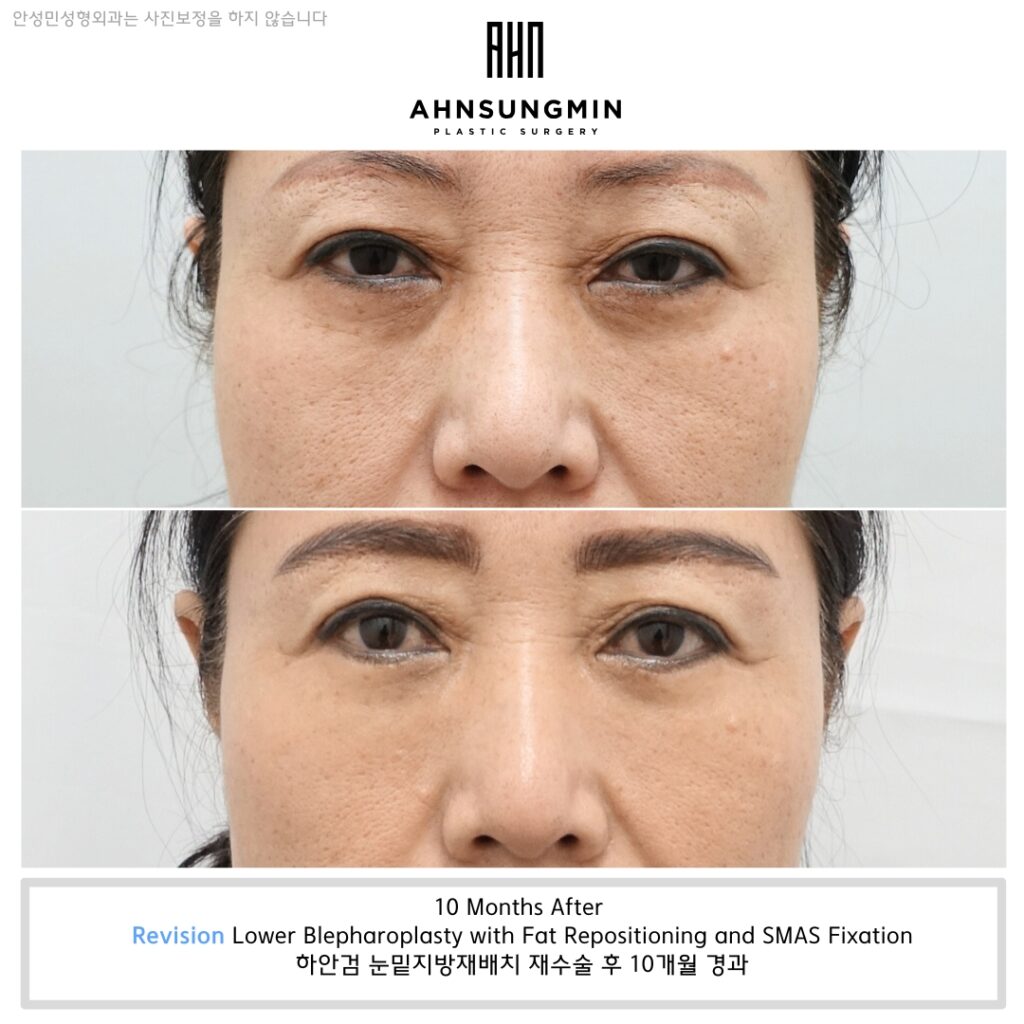
Improved under-eye contour with enhanced symmetry and reduced tension following revision surgery.
Evaluating the outcome of revision surgery also requires a broader perspective. A successful result is not defined solely by reduced bulging. It should be assessed by how naturally the under-eye contour flows in the frontal view, whether there is any discomfort during facial movement, how well the left and right sides harmonize, and whether the result remains stable over time. For this reason, before-and-after comparisons should be reviewed carefully from multiple angles rather than relying on a single photograph.
Because patients seeking revision surgery have already undergone one procedure, the decision to proceed should be made with particular care. Understanding why the original issue developed, confirming that the current tissue condition is suitable for revision, and ensuring that the surgical plan prioritizes long-term stability rather than short-term change are all critical steps in the decision-making process.
Revision lower eyelid fat repositioning is not simply a repeat operation. It is a process of re-evaluating and restoring the under-eye anatomy as a whole. As such, revision cases demand a higher level of surgical experience, anatomical understanding, and restraint. A meticulous and thoughtful approach is essential to achieve results that are not only aesthetically pleasing, but also comfortable and durable over time.
Seeing the Eye as a Whole, Not in Parts
A Clinic Dedicated to Eyelid Revision Surgery in Korea
Ahnsungmin Plastic Surgery