Symmetry Is Not Ignored
Ptosis correction is not about forcing symmetry.
But it is also not about ignoring it.
Patients naturally expect their eyes to look balanced.
In most cases, achieving symmetry to a reasonable degree is both possible and appropriate.
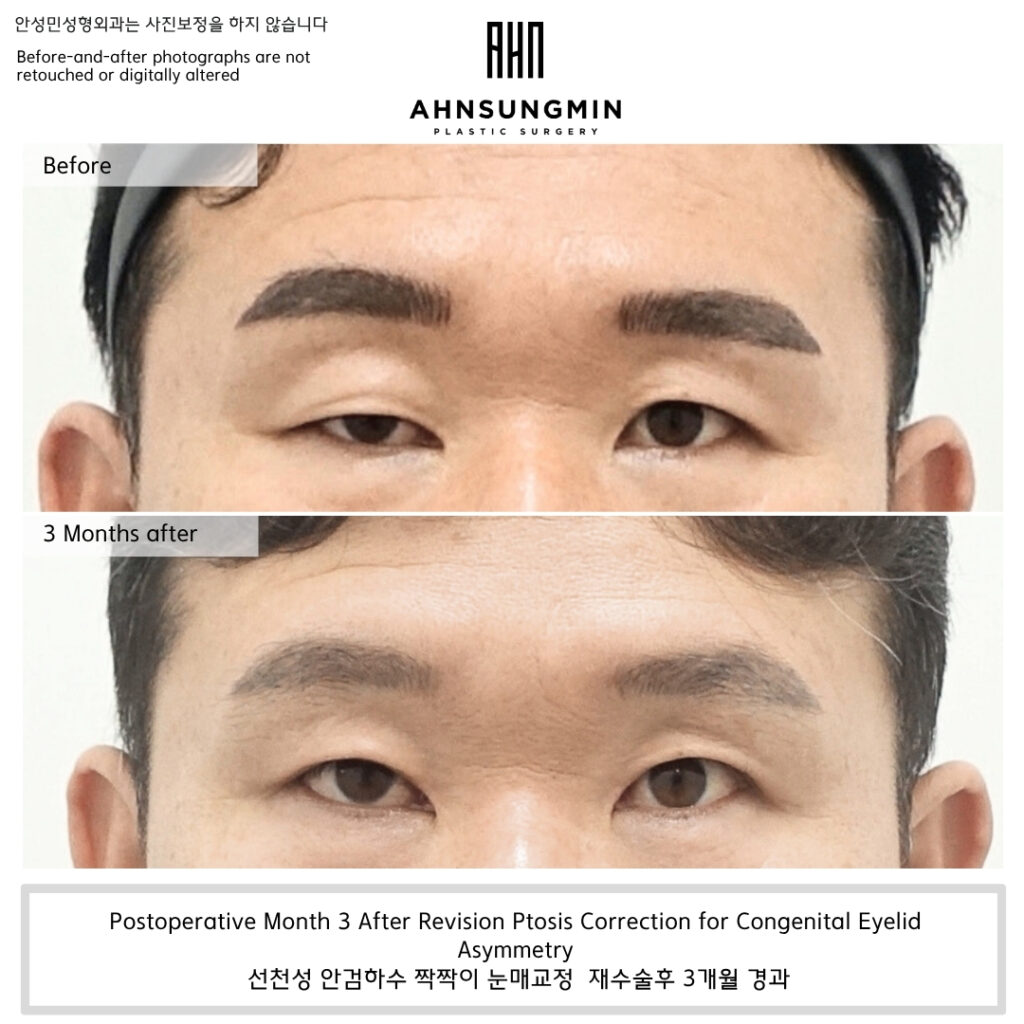
Not All Asymmetry Should Be Left Untouched
There is a misconception that asymmetry should simply be accepted.
This is not true.
When asymmetry is correctable without compromising function, it should be addressed.
Avoiding correction in the name of “naturalness” can lead to dissatisfaction.
Symmetry Is Pursued Within Functional Limits
The key is not whether symmetry is pursued, but how.
We aim to match eyelid height and movement as closely as possible,
but never at the cost of stability or function.
When symmetry requires overcorrection, it is no longer appropriate.
Achieving Symmetry Requires Precision, Not Speed
Creating symmetry between both eyes is not simple.
Even small differences in muscle response, swelling, or tissue tension can affect the final outcome.
For this reason, ptosis correction is performed under local anesthesia.
This allows real-time adjustment while the patient can open their eyes during surgery.
The procedure takes longer,
because achieving balance requires careful, incremental correction rather than rapid changes.
Symmetry is not created at once.
It is refined step by step.
Each Eye Is Adjusted With the Same Goal
Both eyes are evaluated independently,
but with a shared objective:
to create balanced, stable eyelid function.
This often results in a high degree of symmetry,
not because it was forced,
but because it was carefully planned.
Most Patients Can Achieve Noticeable Symmetry
Except in severe cases—
such as neurological conditions or structural limitations—
most patients can achieve a level of symmetry that feels natural.
The goal is not perfection,
but a result that does not draw attention to imbalance.
The Decision Is Based on Balance, Not Ideology
Ptosis correction is not guided by rigid principles like
“always match” or “never match.”
It is guided by balance.
When symmetry can be achieved safely,
it should be pursued.
Related Insights
-
When Ptosis Correction Is Not About Making Eyes Bigger
Ptosis correction is often misunderstood as a procedure to enlarge the eyes. -
When Ptosis Correction Is Not Necessary
Not every heavy eyelid requires functional correction. -
When We Try to Achieve Symmetry in Ptosis Correction
Symmetry is pursued within functional limits, not by force. -
Multiple Eyelid Creases in Ptosis Correction
Multiple creases are a result of instability, not a lack of definition. - High Crease in Ptosis Correction
A high crease must match structural capacity to remain stable.
Seeing the Eye as a Whole, Not in Parts
A Clinic Dedicated to Eyelid Revision Surgery in Korea
Ahnsungmin Plastic Surgery