What Patients Expect from Ptosis Correction in Korea
Ptosis correction in Korea is not about making the eyes bigger.
Ptosis correction in Korea is often misunderstood as a cosmetic procedure.
Many patients assume that ptosis correction will make their eyes look bigger.
This expectation often comes from the visible change after surgery, where the eyes appear more open.
However, this change is not the result of enlargement.
It is the result of restoring normal eyelid function.
Is Ptosis Correction in Korea Supposed to Make Your Eyes Bigger?
Ptosis correction in Korea is not intended to make the eyes bigger.
It restores normal eyelid opening by correcting functional imbalance.
When the eyelid opens properly, the eyes may appear clearer.
But this is not enlargement.
It is functional restoration.
The Misunderstanding Behind “Bigger Eyes”
When ptosis is present, eyelid opening is limited.
To compensate, patients raise their eyebrows and activate the forehead.
Even with this effort, the eyes may appear small or heavy.
After ptosis correction, the eyelid opens without compensation.
This often creates the impression that the eyes have become bigger.
In reality, ptosis correction surgery has not enlarged the eyes.
It has restored their natural function.
Many patients compensate by raising their eyebrows, which is explained in more detail here.
The Misunderstanding Behind “Bigger Eyes”
When ptosis is present, eyelid opening is limited.
To compensate, patients raise their eyebrows and activate the forehead.
Even with this effort, the eyes may appear small or heavy.
After ptosis correction, the eyelid opens without compensation.
This often creates the impression that the eyes have become bigger.
In reality, ptosis correction surgery has not enlarged the eyes.
It has restored their natural function.
Many patients compensate by raising their eyebrows, which is explained in more detail here.
Why Enlargement Is Not the Goal of Ptosis Correction
Ptosis correction is a functional procedure.
The goal is not to create a dramatic or exaggerated appearance.
It is to restore stable and natural eyelid opening.
Trying to make the eyes look bigger than their natural structure allows can lead to imbalance.
Overcorrection may result in unnatural movement, asymmetry, or long-term instability.
What a Proper Ptosis Correction Result Looks Like
Postoperative Month 4 After Upper Blepharoplasty, Ptosis Correction, and Epicanthoplasty
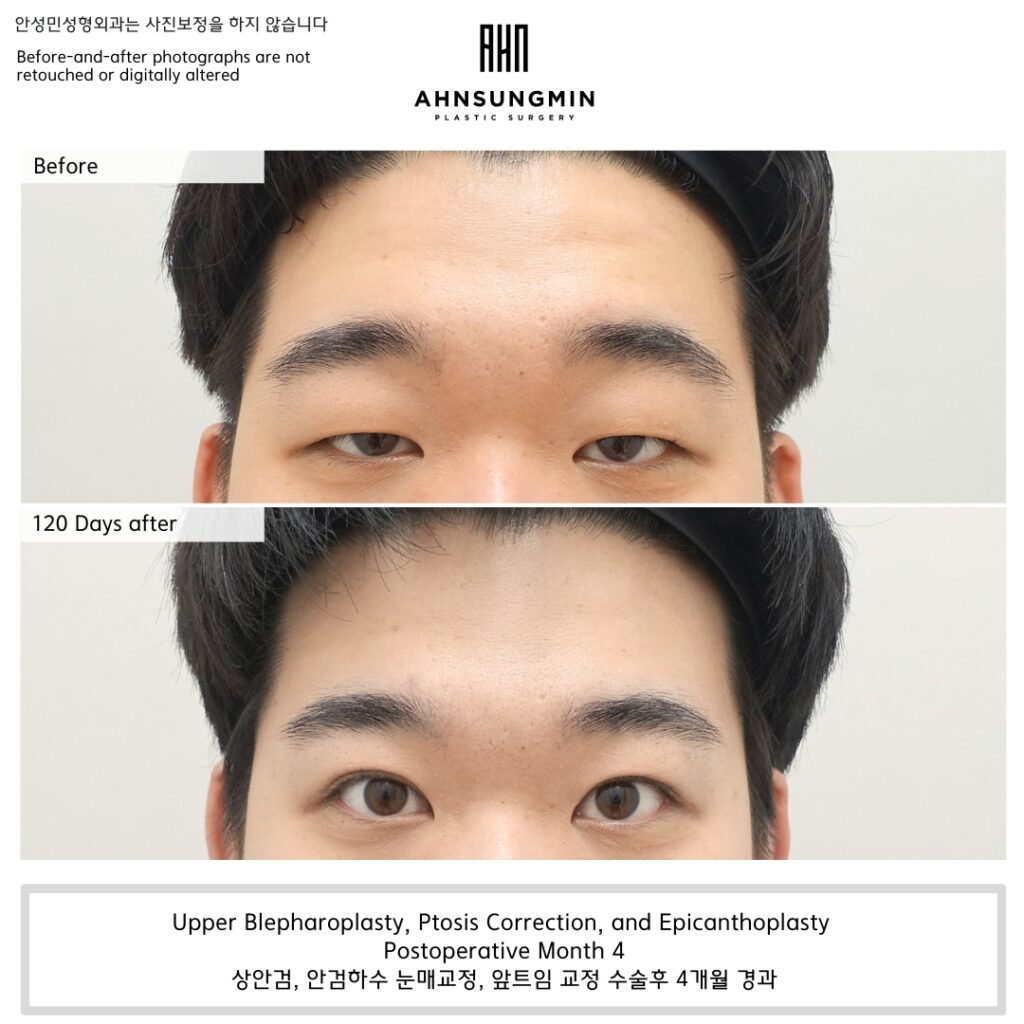
A proper result does not draw attention.
It feels natural.
The eyelid opens without effort, and the need for compensatory brow elevation disappears.
The eyes appear clearer, not because they are bigger,
but because they are functioning normally.
Ptosis correction in Korea focuses on restoring eyelid function rather than enlarging the appearance of the eyes.
Related Insights
-
When Ptosis Correction Is Not About Making Eyes Bigger
Ptosis correction is often misunderstood as a procedure to enlarge the eyes. -
When Ptosis Correction Is Not Necessary
Not every heavy eyelid requires functional correction. -
When We Try to Achieve Symmetry in Ptosis Correction
Symmetry is pursued within functional limits, not by force. -
Multiple Eyelid Creases in Ptosis Correction
Multiple creases are a result of instability, not a lack of definition.
Seeing the Eye as a Whole, Not in Parts
A Clinic Dedicated to Eyelid Revision Surgery in Korea
Ahnsungmin Plastic Surgery