Is Lower Eyelid Fat Repositioning Revision Surgery Possible?
Many patients tell us, “I heard that revision for lower eyelid fat repositioning is impossible.”
In reality, revision is possible—but the approach depends on the previous surgical method and the degree of tissue damage.
Why Some People Believe Revision Is Impossible
Lower eyelid fat repositioning is often performed through a transconjunctival approach, where fat is removed or repositioned from inside the eyelid.
This method is typically used for younger patients with minimal skin laxity.
Although it is not a wrong approach, it does not fundamentally address deeper structural issues, and therefore the risk of recurrence is high.
So when people say revision is “impossible,” it usually means:
A second transconjunctival approach is limited or not feasible,
because the fat layer often descends to deeper planes that cannot be accessed properly without an external incision.
If the previous surgery details are unknown—which is common—it becomes even more difficult to re-enter through the conjunctiva with enough visibility or control.
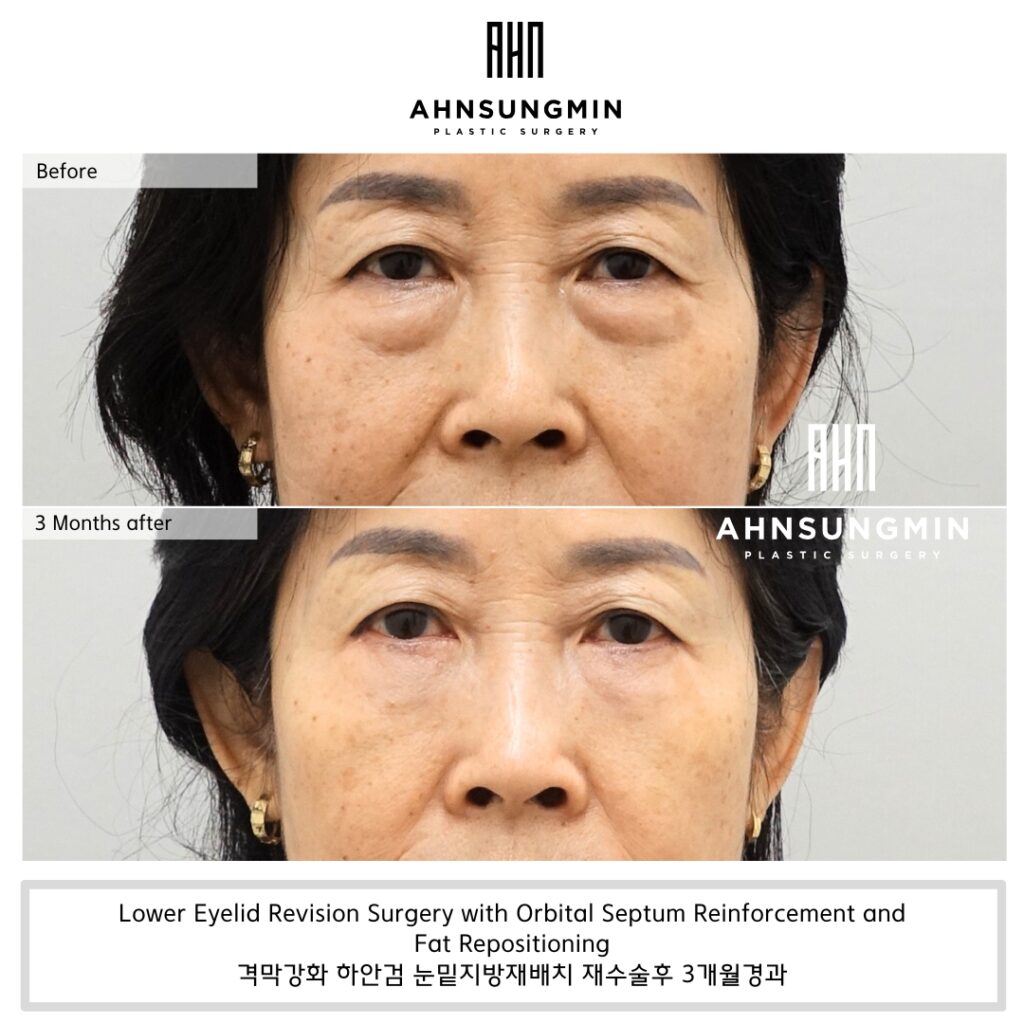
The Importance of a Subciliary (Lower Eyelid) Incision in Revision Surgery
For patients with significant fat descent or hollowing, a wider field of view is essential to reach the correct fat compartments.
In revision cases, fat may be:
- partially removed
- damaged
- replaced by filler
- clumped due to prior fat grafting
- mixed with scar tissue or foreign material
These situations make the revision more complex than a primary surgery.
A properly designed subciliary incision allows the surgeon to safely access deeper layers, manage scar tissue, and reposition or reconstruct the fat pads.
Surgical Steps for Lower Eyelid Revision with Subciliary Incision
- A fine incision is made right below the eyelashes.
- Adequate exposure is secured to access the descended fat compartments.
- Fat is repositioned, and orbital septum reinforcement is performed.
- Excess, stretched skin is removed.
- The midface (SMAS/ORBICULARIS) is lifted and fixed to the periosteum.
- The incision is meticulously closed.
Why Midface (Sub-SMAS) Lifting Is Essential
The midface muscles form the structural center of the midface and play a crucial role in preventing sagging.
During lower eyelid surgery, lifting and securing these tissues:
- prevents ectropion (lower lid turning outward)
- provides true, long-lasting support
- improves the tear trough and lid-cheek junction
- enhances the lifting effect
This step is especially important in revision cases where supporting structures have been weakened.
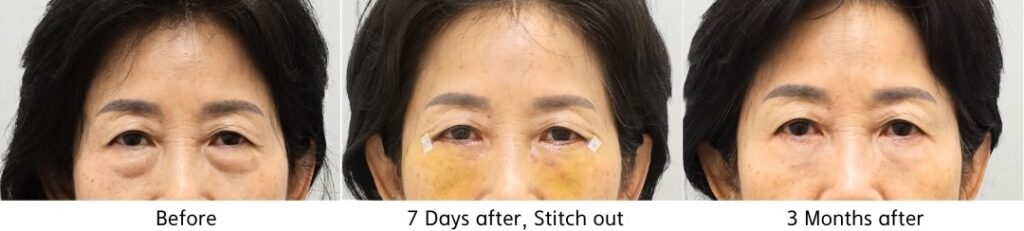
Ahn Sung Min Plastic Surgery — Lower Eyelid & Revision Specialist in Seoul
At Ahn Sung Min Plastic Surgery Clinic, all consultations are conducted one-on-one with
Dr. Ahn Sung Min, board-certified plastic surgeon and microsurgery-trained eyelid specialist
from Yonsei University.
Dr. Ahn has dedicated his entire career exclusively to eyelid surgery, including:
- primary lower and upper eyelid surgery
- complex revision procedures
- difficult cases resulting from previous operations, trauma, or congenital conditions
With extensive clinical experience and meticulous surgical technique, our clinic focuses on
identifying the root cause and providing only the most necessary and appropriate treatment.
Precision Matters — Especially in Revision Eyelid Surgery
Revision lower eyelid surgery is never simple.
There is no universal formula and no fixed set of rules.
Every case requires a customized plan based on anatomy, scar patterns, and prior surgical damage.
The ability to predict outcomes comes only from deep clinical experience.
At Ahn Sung Min Plastic Surgery Clinic, we are committed to providing the safest, most refined surgical results based on years of highly specialized eyelid practice.